
The short answer
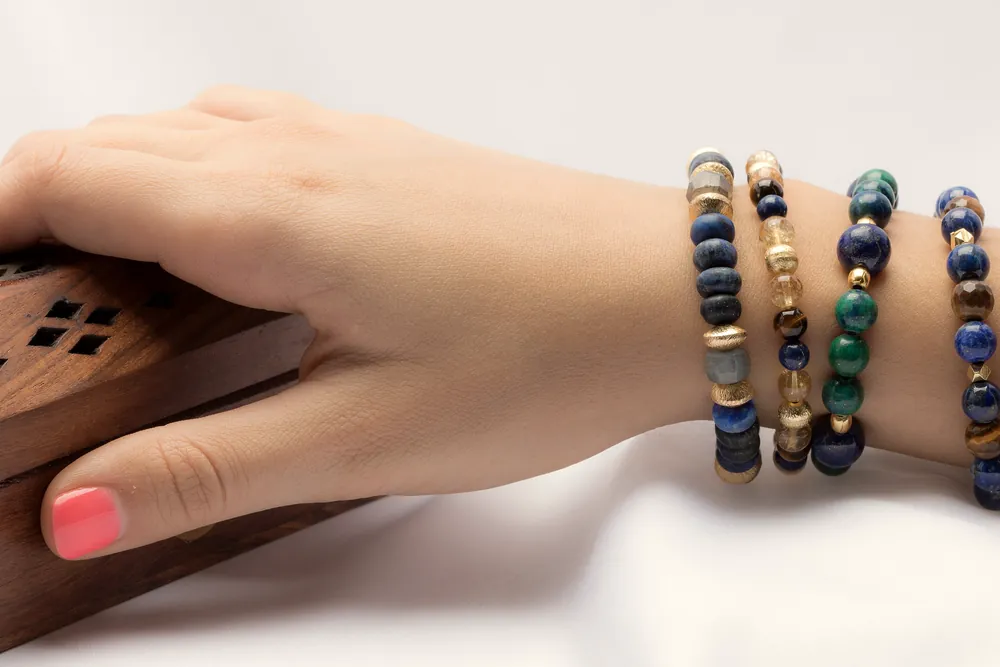
Most “crystal” bracelet beads belong to a handful of mineral families. Many are quartz in different forms: clear, rose, smoky, amethyst, citrine, tiger’s eye, aventurine, agate, carnelian, onyx and jasper. Others are feldspars (moonstone, sunstone, labradorite, amazonite), and a few are softer minerals and rocks such as lapis, turquoise, fluorite and malachite. Knowing the family tells you how hard a stone is, how to clean it, and which fakes to expect. Dyed agate, dyed “onyx”, man-made “hematite” and dyed imitations of turquoise and jade are common. The meanings attached to each stone are beliefs from tradition and modern crystal practice, not proven effects.
This is a reference. For choosing bead sizes, fit and construction, see our crystal bead bracelet guide. For cleaning and restringing, see how to care for a crystal bead bracelet.
A note on meanings. Each stone below lists associations that are common in modern crystal practice, and in some cases in older traditions. We report them so that you know what sellers mean. They are beliefs. No stone has been shown to heal, protect or attract money, and nothing here is health or financial advice.
The identification matrix
| # | Stone | Mineral family | Mohs hardness | Often treated or imitated? |
|---|---|---|---|---|
| 1 | Clear quartz | Quartz | 7 | Glass imitations |
| 2 | Rose quartz | Quartz | 7 | Dyed quartz; glass |
| 3 | Smoky quartz | Quartz | 7 | Irradiated colour is common |
| 4 | Amethyst | Quartz | 7 | Glass; synthetic quartz |
| 5 | Citrine | Quartz | 7 | Usually heated amethyst |
| 6 | Tiger’s eye | Quartz (fibrous) | about 7 | Heated (red) or dyed colours |
| 7 | Green aventurine | Quartz with mica | about 7 | Dyed quartz; sold as “jade” |
| 8 | Agate | Chalcedony (quartz) | 6.5–7 | Very often dyed bright colours |
| 9 | Carnelian | Chalcedony | 6.5–7 | Dyed or heated agate |
| 10 | Black onyx | Chalcedony | 6.5–7 | Usually dyed chalcedony |
| 11 | Red jasper | Quartz-rich rock | 6.5–7 | Dyed stones; reconstituted material |
| 12 | Moonstone | Feldspar | 6–6.5 | Glass (“opalite”) imitations |
| 13 | Sunstone | Feldspar | 6–6.5 | Glass with copper flecks (“goldstone”) |
| 14 | Labradorite | Feldspar | 6–6.5 | Coated or treated look-alikes |
| 15 | Amazonite | Feldspar | 6–6.5 | Dyed stones |
| 16 | Jade | Nephrite or jadeite | 6–7 | Dyed, bleached and impregnated; many substitutes |
| 17 | Obsidian | Volcanic glass | 5–5.5 | Coloured glass |
| 18 | Lapis lazuli | Rock (lazurite, calcite, pyrite) | about 5–5.5 | Dyed; dyed jasper or howlite |
| 19 | Sodalite | Feldspathoid | 5.5–6 | Sometimes sold as lapis |
| 20 | Turquoise | Copper aluminium phosphate | 5–6 | Stabilised, dyed; dyed howlite and magnesite |
| 21 | Pyrite | Iron sulphide | 6–6.5 | Can tarnish or decay in damp storage |
| 22 | Hematite | Iron oxide | 5.5–6.5 | “Magnetic hematite” beads are typically man-made |
| 23 | Fluorite | Calcium fluoride | 4 | Splits along cleavage; glass |
| 24 | Malachite | Copper carbonate | 3.5–4 | Reconstituted or dyed imitations |
| 25 | Rhodonite | Manganese silicate | 5.5–6.5 | Dyed stones |
Hardness values are standard Mohs figures. For example, GIA lists quartz varieties at 7, turquoise at 5–6, and nephrite at 6–6.5 and jadeite at 6.5–7 (GIA: citrine, turquoise, jade). Treatment notes summarise common trade issues; a specific bead needs its own report.
Hindi and trade names. Indian listings often use names such as sphatik (clear quartz), gulabi sphatik (rose quartz), katela (amethyst), sunela (citrine), lajward (lapis), hara yashab (green jade), bagha chakshu (tiger’s eye), chandrakant mani (moonstone), suryakant mani (sunstone), swarna makshik (pyrite), kaant loha (hematite) and lal hakik (carnelian). These are the names used on GemKrishna’s custom bracelet builder, checked 9 October 2026. Other sellers may use different spellings.
The quartz family
Quartz is hard (7) and durable, so quartz beads resist scratching and suit everyday bracelets.
1. Clear quartz (sphatik). Colourless quartz. It is often described in modern practice as an “amplifier”, a stone for clarity and focus. Sphatik malas are also used in Indian devotional practice. Check that it is not glass: look for bubbles or swirls under a loupe. Our comparison of clear quartz, milky quartz, selenite and glass explains how to tell them apart.
2. Rose quartz. Pink quartz, often cloudy. It is popularly associated with love and emotional calm. Very intense pink beads may be dyed. GIA describes rose quartz as generally stable to light and heat, although some transparent pink quartz and dyed beads can fade. See rose quartz vs pink glass vs dyed quartz.
3. Smoky quartz. Brown to grey quartz. Colourless quartz that contains traces of aluminium turns smoky when irradiated, so some commercial smoky quartz owes its colour to laboratory irradiation, a standard and stable treatment (ORAU Health Physics Museum). Natural smoky quartz is also common, and the two are hard to tell apart without testing. In modern practice it is associated with “grounding”.
4. Amethyst (katela, jamunia). Purple quartz. GIA notes that some amethyst can fade with prolonged exposure to intense light (GIA). It is associated with calm and sleep in modern practice, and with Saturn as a substitute stone in some astrology.
5. Citrine (sunela). Yellow to orange quartz, usually heated amethyst rather than natural citrine (GIA). It is associated with prosperity and optimism in modern practice. Our gemstone buying guide explains treatments and disclosure.
6. Tiger’s eye (bagha chakshu). Fibrous quartz with a silky, moving band of light (chatoyancy), golden brown when untreated. Red tiger’s eye is usually heated, and blue or other colours may be dyed or a different variety (see tiger’s eye: real, dyed, heated and imitation). It is associated with confidence and protection.
7. Green aventurine. Quartz with small flakes of green mica that sparkle. It is often confused with or sold as “jade”, which it is not (see green aventurine vs jade vs emerald). It is associated with luck in modern practice.
Chalcedony and jasper
8. Agate. Banded microcrystalline quartz (chalcedony). Natural agate is mostly in greys, browns, whites and reds. Bright blue, pink, purple and green agate is almost always dyed. It is associated with balance and stability.
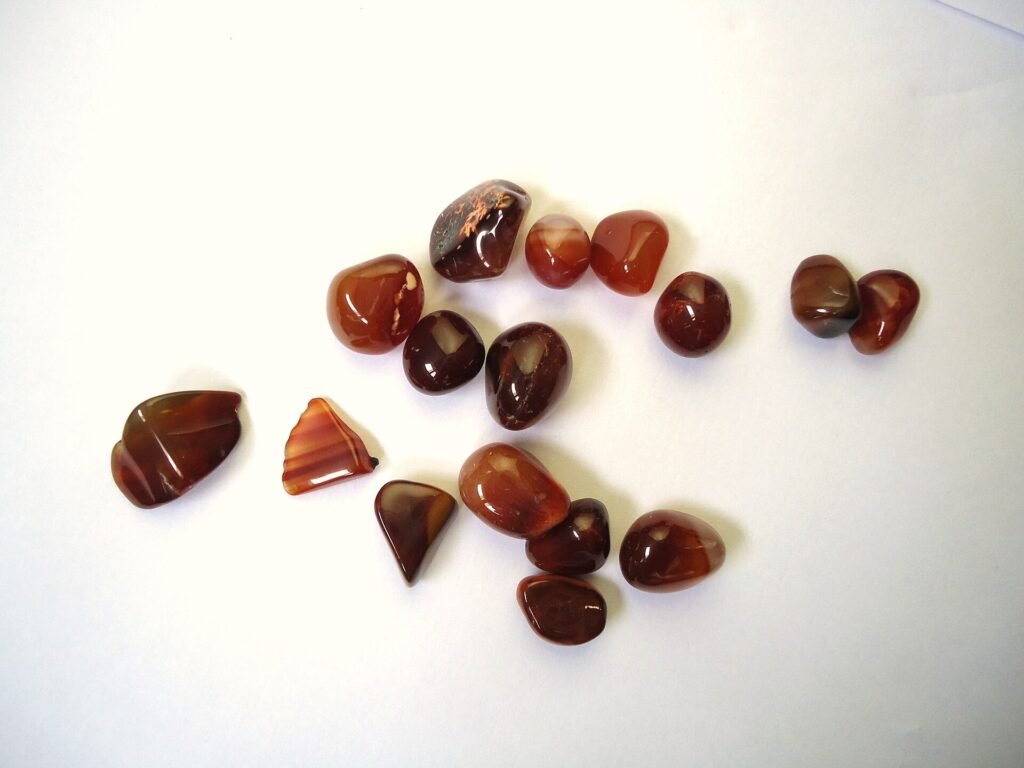
9. Carnelian (lal hakik). Orange to red chalcedony. Much is heated or dyed agate; natural colour varies (see natural carnelian vs heated or dyed agate). In some traditions it is associated with vitality and courage. Hakik stones are also widely worn in South Asian traditions.
10. Black onyx. Black chalcedony. Uniform jet-black onyx is generally dyed or carbon-treated chalcedony, a long-established practice (Onyx, Wikipedia; JCK notes that most black chalcedony is enhanced). It is associated with protection and strength. Ask whether it is dyed: the answer should be “yes” or “probably”. Our comparison of black tourmaline, obsidian and onyx explains how to tell these black stones apart.
11. Red jasper. An opaque, quartz-rich rock coloured by iron. It is associated with stamina and grounding. Some “jasper” beads are dyed or reconstituted from powder and resin.
Feldspars
Feldspars are slightly softer than quartz (6–6.5), and some split along cleavage planes, so they need a little more care.
12. Moonstone (chandrakant mani). Feldspar with a floating blue-white glow (adularescence). It is associated with intuition and the moon. “Opalite” is a man-made glass sold as a moonstone look-alike; see moonstone vs rainbow moonstone vs labradorite vs opalite.
13. Sunstone (suryakant mani). Feldspar with reflective flecks. It is associated with energy and warmth. “Goldstone” is a man-made glass with copper flecks, sometimes mis-sold as sunstone.
14. Labradorite. Grey feldspar that flashes blue, green and gold as it moves (labradorescence). It is associated with protection and intuition. The flash only shows at certain angles, so it is a good test of real labradorite compared with coated look-alikes.
15. Amazonite. Blue-green feldspar. It is associated with calm communication. Very even, saturated colour can indicate dye.
Jade, aventurine and other “green stones”
16. Jade (hara yashab). “Jade” is a generic term for two different minerals, nephrite and jadeite (GIA). Much inexpensive “jade” in bracelets is something else: dyed quartzite, aventurine, serpentine or glass. Jadeite is also often bleached and polymer-impregnated, or dyed. It is associated with harmony and luck, especially in East Asian traditions. For a price that suggests real jade, ask for a report that names nephrite or jadeite, and any treatment.
Volcanic glass
17. Obsidian. Natural volcanic glass, not a crystal mineral. Black, “snowflake” (with white spots) and “mahogany” varieties are common. It is associated with protection. It is brittle and chips with knocks, and coloured man-made glass is sometimes sold as “rainbow obsidian”.
Blue stones: lapis, sodalite, turquoise
18. Lapis lazuli (lajward). A rock made mainly of blue lazurite with white calcite and golden pyrite (GIA). It is associated with wisdom and truth. Lapis is often dyed or waxed to deepen and even its colour. Dyed jasper and dyed howlite are used as imitations. Gold flecks of pyrite are a good sign. A very uniform, inky blue with no calcite or pyrite is suspicious.
19. Sodalite. Royal blue with white veins, softer than quartz. It is associated with logic and calm. It is sometimes sold as “lapis”. Sodalite usually lacks lapis’s pyrite flecks.
20. Turquoise. A porous, opaque copper aluminium phosphate, hardness 5–6 (GIA). Most turquoise is stabilised (impregnated with resin) and some is dyed. Turquoise-coloured beads are very often dyed howlite or dyed magnesite. It is associated with protection and travel, and in Indian astrology as a substitute stone (firoza). Ask for a report that names the mineral, not just the colour.
Metallic minerals: pyrite and hematite
21. Pyrite (swarna makshik). Brassy yellow iron sulphide (“fool’s gold”). It is associated with prosperity in modern practice. It can tarnish, and in damp conditions some pyrite oxidises and crumbles (“pyrite decay”), which museum conservators control by keeping relative humidity low (Tacker 2020, Palaeontologia Electronica). Store it dry.
22. Hematite (kaant loha). Heavy, metallic grey iron oxide. It is associated with grounding. Shiny grey “hematite” beads that stick to magnets are typically a man-made magnetic material, sometimes sold as “hematine”. One analysed sample proved to be a barium-strontium ferrite, a ceramic magnet (Hematine, Wikipedia). Natural hematite is only weakly magnetic. Magnetic “therapy” claims are not supported by evidence.
Soft minerals: fluorite and malachite
23. Fluorite. Purple, green and banded calcium fluoride. It is soft (4) and splits easily along flat cleavage planes. It is associated with focus. Handle it gently and keep it away from harder beads.
24. Malachite. Banded green copper carbonate. It is soft (3.5–4) and sensitive to acids, heat and household chemicals. It is associated with transformation and protection. Imitations include reconstituted malachite and printed or dyed stone. Do not soak it, and do not use cleaners on it.
25. Rhodonite. Pink manganese silicate with black veins. It is associated with emotional healing in modern practice. Dyed look-alikes exist.
Wear, cleaning and hardness
| Group | Everyday wear | Cleaning | Avoid |
|---|---|---|---|
| Quartz and chalcedony (1–11) | Good | Wipe or rinse briefly; dry at once | Long soaks for dyed stones (dye can leach) |
| Feldspars (12–15) | Good, with care | Wipe; brief rinse | Hard knocks; harsh chemicals |
| Jade (16) | Good | Wipe; brief rinse | Heat, solvents (for impregnated jadeite) |
| Obsidian, lapis, sodalite (17–19) | Moderate | Wipe with a damp cloth | Soaking, chemicals, knocks |
| Turquoise (20) | Moderate | Warm, soapy water on a cloth; never steam or ultrasonic (GIA) | Oils, cosmetics, solvents, heat |
| Pyrite, hematite (21–22) | Moderate | Dry cloth | Water and damp storage |
| Fluorite, malachite (23–24) | Delicate | Dry or barely damp cloth | Water, acids, heat, harder beads rubbing against them |
Which stones should not be soaked? Turquoise, lapis, malachite, pyrite, hematite, fluorite, obsidian, and any dyed or impregnated stone. Soaking also weakens elastic and thread, so do not soak any bead bracelet. Wipe it with a barely damp cloth and dry it straight away.
Mixing hard and soft stones. Quartz (7) will slowly scratch fluorite (4) or malachite (3.5–4) where the beads rub. Use spacers, or keep soft stones in their own bracelet.
Dyes and marketplace names
- “Natural” is not the same as “undyed”. Ask both questions: what is the mineral, and is it dyed, heated, stabilised or impregnated?
- Watch for trade names that suggest a more valuable stone: “Swiss lapis” (dyed jasper), “Indian jade” (often aventurine), “turquenite” (dyed howlite), “opalite” (glass), “goldstone” (glass), “magnetic hematite” (man-made).
- Colour that is too bright, too even, or concentrated in cracks and drill holes suggests dye. Dye often collects in fractures and around the drill holes of beads.
- A good seller names the dye. GemKrishna’s builder, for example, describes its howlite option as “high-quality dyed magnesite” and lists dyed and natural red coral separately. Its premium beads include cultured pearls, labelled as cultured (builder, checked 9 October 2026). Many other cards on the same builder carry no treatment note, so for dyed-prone stones such as agate, onyx, lapis and turquoise, ask, and check what the report states.
Using this matrix to choose
- For an everyday bracelet, favour quartz, chalcedony and feldspar beads (hardness 6–7).
- For softer stones (turquoise, lapis, fluorite, malachite), wear the bracelet occasionally, or use spacers and keep it away from harder bracelets.
- For value, pay for identity and disclosure. A report that names each stone and its treatment is worth more than a romantic name. See what a bracelet report covers.
FAQ
Can different stones be worn together in one bracelet?
Yes. Mixed-stone bracelets are common. Practically, avoid putting very soft stones (fluorite, malachite) right next to quartz beads, which will scratch them, and keep stones that need dry care (pyrite, hematite) away from water. Beliefs about which stones “combine” vary between practitioners.
Which stones cannot be soaked in water?
Turquoise, lapis lazuli, malachite, pyrite, hematite, fluorite and obsidian, plus any dyed, stabilised or impregnated stone. And no bead bracelet should be soaked, because water weakens elastic and thread.
Is all jade nephrite?
No. “Jade” covers two different minerals, nephrite and jadeite, and much inexpensive “jade” is neither: it is aventurine, dyed quartzite, serpentine or glass. Ask for a report that names the mineral.
What are dyed beads?
Beads coloured artificially, usually porous stones such as agate, howlite, magnesite, jasper and some jade, to imitate a more valuable stone or to create bright colours. Dyeing is acceptable if it is disclosed and priced accordingly. It is not acceptable when it is hidden.
How do I size a crystal bracelet?
Measure your wrist snugly, add about 1–1.5 cm for comfort, then divide the total length in millimetres by the bead diameter to estimate the bead count. Our crystal bracelet guide has a sizing table.
Are crystal meanings scientifically proven?
No. The associations listed here come from tradition and modern crystal practice. They can be personally meaningful, but they are not evidence-based effects, and no stone replaces medical or financial advice.
Why does my “hematite” bracelet stick to a magnet?
Because it is probably a man-made magnetic material sold as “magnetic hematite” or “hematine”. Natural hematite is only weakly magnetic.
Sources
- GIA gem encyclopedia: Citrine, Citrine description, Amethyst care, Jade, Lapis lazuli, Turquoise, Turquoise care and cleaning, checked 9 October 2026.
- Howlite, Wikipedia (citing the Handbook of Mineralogy and Mindat), for howlite and the trade name “turquenite”.
- Irradiated quartz (smoky quartz), ORAU Health Physics Museum, checked 10 October 2026.
- Onyx, Wikipedia, and Black chalcedony, JCK, checked 10 October 2026.
- Tacker, R. C. (2020), A review of “pyrite disease” for paleontologists, Palaeontologia Electronica.
- Hematine, Wikipedia, checked 10 October 2026.
- GemKrishna (seller): custom bracelet builder, checked 9 October 2026, for Indian trade names and disclosure examples.
Correction, 11 October 2026: an earlier version said rose quartz colour can fade with long exposure to strong light. GIA describes rose quartz as generally stable to light and heat; fading applies to some transparent pink quartz and to dyed beads. The rose quartz entry was corrected.
Next steps
Read our crystal bead bracelet guide, learn how to care for a bead bracelet, or compare custom builders.