The short answer
All three are real minerals, and they are often confused.
- Howlite is a genuine white calcium borosilicate mineral with grey veins.
- Magnesite is a white magnesium carbonate.
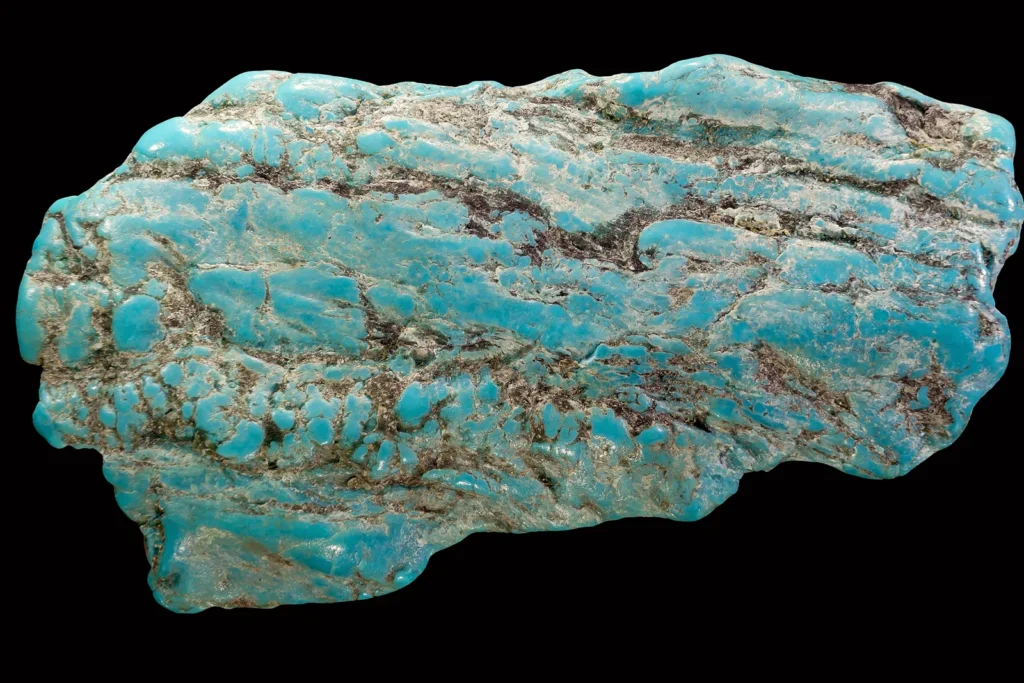
- Turquoise is a blue-green copper aluminium phosphate.
Howlite and magnesite are both porous and take dye easily, so both are dyed blue to imitate turquoise. A European gem laboratory goes further: it says nearly all “howlite” beads on the market are actually magnesite. The texture and veining of all three can look alike, so a photograph cannot settle it. A laboratory report can, and the honest label is whatever the laboratory finds, such as “dyed magnesite”, even if the trade calls it howlite.
This guide expands on the dyed-stone notes in our crystal bead bracelet guide.
Three minerals, three chemistries
| Howlite | Magnesite | Turquoise | |
|---|---|---|---|
| Chemistry | Calcium borosilicate hydroxide, Ca₂B₅SiO₉(OH)₅ | Magnesium carbonate, MgCO₃ | Hydrated copper aluminium phosphate, CuAl₆(PO₄)₄(OH)₈·5H₂O |
| Mineral class | Borate (inoborate) | Carbonate | Phosphate |
| Natural colour | White to colourless, with fine grey or black web-like veins | White to pale yellow, brown or pink; often chalky | Blue to green, sometimes with brown or black matrix |
| Mohs hardness | 3.5 | 3.5–4.5 | 5–6 |
| Specific gravity (approx.) | about 2.5–2.6 | 3.0–3.2 | about 2.6–2.9 |
| Porosity | Porous; takes dye | Porous, chalky; takes dye | Porous; usually stabilised |
| Reacts with dilute acid? | No | Yes (a carbonate fizzes) | No |
Sources: Howlite and Magnesite (Wikipedia, citing the Handbook of Mineralogy and Mindat); GIA, Turquoise; EPI gem laboratory for the acid reactions. Specific gravity values for howlite and turquoise are approximate trade figures.
Natural howlite is real
It is sometimes said that “natural howlite doesn’t exist”. That is false. Howlite was first identified in Nova Scotia in 1868, named after Henry How, and is also known from California (Wikipedia). It forms white nodules with characteristic grey or black veining. It is sold undyed as white “buffalo” stone, and dyed blue under names such as “turquenite”.
What is true is that genuine howlite beads are less common than the label suggests. The German gem laboratory EPI says that magnesite “misleadingly is declared as ‘howlite’”, and that nearly all howlite beads and cabochons on the market are in fact magnesite, because genuine howlite has become scarce (EPI).
Magnesite: the common substitute
Magnesite is a widespread carbonate mineral. In its massive, chalky form it can be cut, drilled, polished and dyed in many colours, including a light turquoise blue (Wikipedia). Blue-dyed magnesite has been reported as a turquoise imitation for decades. Gems & Gemology ran a short item headed “Magnesite: dyed blue to imitate turquoise” in 1986 (GIA).
Being magnesite is not a defect. White and dyed magnesite beads are legitimate, inexpensive materials. The problem is naming: selling magnesite as “howlite”, or dyed magnesite as “turquoise”.
Turquoise: real, porous and usually treated
Turquoise is a porous, semi-translucent to opaque phosphate (GIA). Because it is porous, most turquoise on the market is stabilised, meaning impregnated with resin or polymer to harden it and fix the colour. Some is also dyed. GIA’s Gems & Gemology has described dyeing, impregnation with polymer, wax or plastic, and a proprietary “Zachery” process as the main treatments (GIA, 2015). You will also see reconstituted turquoise, made from powdered turquoise bound in resin.
Honest turquoise descriptions therefore include “stabilised turquoise”, “dyed and stabilised turquoise” and “reconstituted turquoise”. Natural, untreated turquoise of good colour is the rarest and most expensive of these.
In Indian listings, turquoise is often called firoza, and “Irani firoza” refers to the Iranian (Persian) material traditionally prized. Treat the name as a description, not proof of origin or of an untreated stone.
How dye makes imitation turquoise
Dye soaks into the porous stone and settles more heavily in cracks and veins. That produces the blue body and darker matrix lines that mimic turquoise. Signs of dye include:
- Colour concentrated in cracks, veins and drill holes.
- Colour that is too even and too bright across a whole strand.
- White or paler cores visible at a chipped or drilled edge.
- Colour transfer onto a cotton bud with a little solvent (acetone). This is destructive: it strips dye and ruins the finish, so do not do it on beads you want to keep, and never on stabilised turquoise.
Why surface texture confuses
All three can show fine dark veining in a pale or blue body. Under ordinary light, in a photograph or on a screen, dyed howlite, dyed magnesite and veined turquoise can be indistinguishable. Weight in the hand differs (magnesite is denser), but not reliably enough for beads. A photograph cannot identify turquoise.
How a laboratory tells them apart
Laboratories use some or all of the following:
- Spectroscopy (infrared or Raman) identifies the mineral’s chemical bonds: phosphate (turquoise), carbonate (magnesite) or borate (howlite). It also detects polymer impregnation.
- X-ray powder diffraction confirms the crystal structure. In GIA’s work on turquoise identification, this needed only about 3 mg of powder (Gems & Gemology, 1983).
- Specific gravity and refractive index support the identification.
- Acid reaction (on a tiny scraping): magnesite reacts, but turquoise and howlite do not (EPI). This is a laboratory step, and it is damaging, so not for home use.
- Microscopy shows dye concentrations and surface treatments.
Reading a specimen-level report
| Report says | What you have | Fair name on a listing |
|---|---|---|
| “Turquoise; no indication of treatment” | Natural, untreated turquoise | Natural turquoise |
| “Turquoise; impregnated” or “stabilised” | Real turquoise, stabilised | Stabilised turquoise |
| “Turquoise; dyed and impregnated” | Real turquoise, dyed and stabilised | Dyed, stabilised turquoise |
| “Reconstituted turquoise” or “turquoise in polymer matrix” | Powder bound in resin | Reconstituted turquoise |
| “Magnesite, dyed” | Dyed magnesite | Dyed magnesite (not “howlite”, not “turquoise”) |
| “Howlite, dyed” | Dyed howlite | Dyed howlite |
| “Howlite” | Natural howlite | Howlite |
A report on a whole bracelet may identify stone types without testing every bead. Check whether it covers each bead or a sample.
Marketplace naming ethics
Once a laboratory identifies a material, the honest label is the laboratory’s identification, even if the trade has long called it something else. “Howlite” beads that test as magnesite should be sold as magnesite (and “dyed magnesite” if dyed).
GemKrishna’s custom bracelet builder is an example of this. Its “howlite option” is described in the builder as “high-quality dyed magnesite” (builder, checked 9 October 2026). That tells a buyer exactly what they are getting. It also lists “Irani firoza” among its premium beads, priced per bead. Its turquoise bracelet listings that we checked do not state whether the turquoise is stabilised, so ask before buying, as you should with any seller. Its builder states that a free GJSPC report identifies each gemstone and discloses any treatment, and that other laboratories can be chosen.
Price and transparency
| Material | Relative price | What you are paying for |
|---|---|---|
| White or dyed magnesite | Lowest | Colour and design |
| White or dyed howlite | Low | Colour and design |
| Reconstituted turquoise | Low to moderate | Some turquoise content |
| Stabilised turquoise | Moderate to high | Real turquoise, made durable |
| Natural, untreated, fine-colour turquoise | Highest | Rarity and quality |
If a “turquoise” bracelet costs the same as a dyed-magnesite one, it is very probably dyed magnesite. Price follows identity. Ask for the identity in writing.
Caring for porous beads
All three are porous and relatively soft, so:
- Do not soak them. Wipe with a soft, barely damp cloth and dry at once.
- Keep away from perfume, lotion, sanitiser, sweat-soaked wear, and solvents such as acetone and alcohol, which can lift dye or attack stabilisers.
- Avoid heat, steam and ultrasonic cleaners. GIA advises that turquoise should never be cleaned with steam or ultrasonic cleaners, and that heat or solvents can damage treated surfaces (GIA turquoise care).
- Store them separately from harder stones, which scratch them.
- See how to care for a crystal bead bracelet for the cord and restringing.
Buying checklist
- The listing names the mineral (howlite, magnesite or turquoise), not just “blue stone”.
- Treatment is stated: dyed, stabilised, reconstituted, or none.
- “Howlite” beads are confirmed as howlite or magnesite, ideally by a report.
- Turquoise origin names (Irani, Tibetan) are treated as descriptions unless evidenced.
- The report covers each bead or says how many were tested, and its number looks up online.
- The price makes sense for the stated identity.
FAQ
Is howlite a real mineral?
Yes. Howlite is a genuine calcium borosilicate mineral, first described in 1868 from Nova Scotia, white with grey or black veins. Much of what is sold as “howlite” is actually magnesite, however.
Is magnesite a fake stone?
No. Magnesite is a real, common magnesium carbonate mineral. It becomes a problem only when it is sold under another name, such as howlite or turquoise.
Is dyed magnesite natural?
The magnesite is a natural mineral, but the colour is not. Dyed magnesite should be described as dyed magnesite. It is not turquoise and not natural blue stone.
Can a photo identify turquoise?
No. Dyed howlite, dyed magnesite and real turquoise can look the same in photographs. Identification needs laboratory methods such as spectroscopy, X-ray diffraction and gemmological testing.
What should a certificate say?
The mineral (turquoise, magnesite or howlite), any treatment (dyed, stabilised or impregnated, reconstituted), whether the report covers every bead, and a report number you can verify on the laboratory’s own website.
How do I clean turquoise, howlite or magnesite beads?
Wipe them with a soft, barely damp cloth and dry them straight away. Do not soak them, and keep them away from perfumes, lotions and solvents. Never use steam or ultrasonic cleaners on turquoise.
Why is real turquoise so expensive?
Natural, untreated turquoise of good, even colour is rare. Most turquoise needs stabilising to be usable, and imitations are cheap to make, so the price gap between real untreated turquoise and dyed look-alikes is large.
Sources
- GIA: Turquoise, Turquoise care and cleaning, Impregnated and dyed turquoise (Gems & Gemology, Fall 2015), Turquoise spectroscopy and X-ray diffraction (Gems & Gemology, Fall 1983), Gem News, Summer 1986, checked 9 October 2026.
- EPI Institute of Gemstone Testing: Magnesite and howlite look-alikes.
- Wikipedia: Howlite and Magnesite.
- GemKrishna (seller): custom bracelet builder and turquoise bracelets, checked 9 October 2026.
Next steps
Read our crystal bead bracelet guide, learn how to care for a bead bracelet, or compare testing laboratories.
Related reading
- How to tell if a crystal bracelet is real: 9 checks, dyes and trade names
- Which crystals can get wet? A mineral-by-mineral water, sweat and sunlight reference for bracelet stones
- Rose quartz vs pink glass vs dyed quartz: how to check rose quartz bracelet beads
- How to verify a gemstone or rudraksha report online (GJSPC, IGI, GIA, GRS, IIGJ)