The short answer
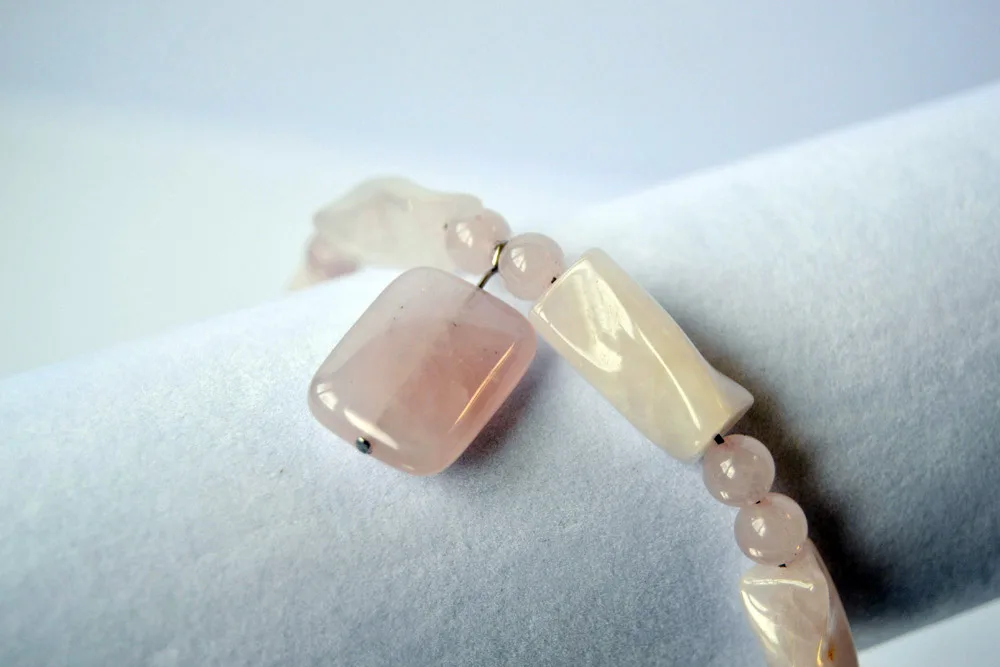
- Real rose quartz is usually cloudy, soft pink and slightly uneven. GIA explains that its colour comes from microscopic, aligned mineral fibres similar to dumortierite, which also give it a “characteristic cloudy translucence”. That is why it is cut mostly into beads and cabochons.
- Pink glass tends to be too clear, too evenly coloured or too bright, and may show round bubbles or swirl lines under a 10× loupe. Bright “cherry quartz” beads are usually glass.
- Dyed quartz shows colour concentrated in cracks, pits and the drill hole, often with a crackled look, and a hotter pink than natural rose quartz.
- Other pink stones (rhodonite, rhodochrosite, kunzite, morganite) are different minerals, not fakes, but they are not rose quartz.
- A laboratory can confirm it quickly. Rose quartz is quartz: refractive index 1.544 to 1.553, specific gravity about 2.66, hardness 7 (GIA). Glass gives different readings.
- Price: rose quartz is common, so natural bracelets need not be expensive. A very cheap, very bright, very clear “rose quartz” bracelet is the one to question.
What makes rose quartz pink
Rose quartz is a pink variety of quartz, chemically silicon dioxide. Its colour is not a dye and not, in most cases, a trace element in the crystal itself. GIA’s summary of the research is that “rose quartz owes its delicate pink color to microscopic inclusions of aligned silicate mineral fibers”, which are “generally similar, but not identical, to the mineral dumortierite” (GIA, rose quartz description).
Those fibres explain what a real bead looks like:
- Cloudy, not glassy. The fibres scatter light, so most rose quartz is translucent to milky rather than transparent.
- Soft, slightly greyish or milky pink, ranging from “very light pink to medium-dark pink” (GIA, rose quartz).
- Variation between beads. Shade and clarity differ a little from bead to bead in a natural bracelet.
- Occasionally a star. A correctly oriented cabochon can show a six-rayed star (asterism) from the aligned fibres.
The best rough typically comes from Brazil; other sources include India, Madagascar and Sri Lanka (GIA).
Rose quartz vs “pink quartz”
Sellers use the two names loosely, but gemmologists distinguish them.
| Rose quartz | Pink (crystalline) quartz | |
|---|---|---|
| Appearance | Cloudy, massive material | Transparent, well-formed crystals |
| Cause of colour | Microscopic dumortierite-like fibres | A different mechanism (aluminium and phosphorus-related colour centres) |
| Rarity | Common | “Exceptionally rare” compared with rose quartz (GIA) |
| Light stability | “Generally stable when exposed to light and heat” (GIA care guide) | Material from some deposits fades in natural light (GIA) |
| Typical use | Beads, cabochons, carvings | Mostly mineral specimens |
So a bracelet of perfectly transparent, evenly pink beads sold cheaply as rose quartz should make you ask more questions, not fewer. Truly transparent pink quartz is rare, and synthetic pink quartz can be grown with aluminium and phosphorus impurities (GIA).
Rose quartz, pink glass and dyed quartz compared
| Natural rose quartz | Pink glass (“cherry quartz”, “rose crystal”) | Dyed quartz or quartzite | |
|---|---|---|---|
| Transparency | Translucent to cloudy; rarely clear | Often very clear, or evenly milky throughout | Often crackled; can be clear between cracks |
| Colour | Soft, slightly milky pink; varies bead to bead | Very even; can be bright or unnaturally saturated | Hotter pink; concentrated in cracks, pits and the drill hole |
| Under a 10× loupe | Fine fibrous haze, irregular natural inclusions | Round gas bubbles, swirl or flow lines | Dye lines along fractures |
| Beads in one strand | Slight natural variation | Often identical | Variable crackle, similar dye tone |
| Temperature | Stays cool for a few seconds | Warms quickly in the hand | Cool, like quartz |
| Refractive index (lab) | 1.544 to 1.553, doubly refractive | Single reading; varies with the glass | 1.544 to 1.553 (it is quartz) |
| Specific gravity (lab) | About 2.66 | Varies with the glass | About 2.66 |
| Is it “real”? | Yes | No, it is an imitation | Real quartz, but treated, and not natural rose quartz |
Sources for the data: GIA, rose quartz and description; GIA notes that dyeing has long been used on quartz and chalcedony (GIA, gem treatments). The general checks for glass bubbles, dye and weight are explained in our guide to whether a crystal bracelet is real; this article focuses on what is specific to rose quartz.
Why “too perfect” is the main warning sign
For most stones, buyers look for clarity. For rose quartz, the logic is reversed. Because its colour comes from fibres that also scatter light, a deep, even pink with glass-like clarity is the least likely appearance for natural rose quartz beads. That does not prove a bead is glass, but it is the appearance to check first.
Pink stones that are not rose quartz
These are genuine minerals with their own names and properties. The problem only arises if one is sold as another.
| Stone | How it differs from rose quartz | Key data |
|---|---|---|
| Rhodonite | Opaque pink to red, usually with black veins (International Gem Society) | Relatively soft; often beaded and carved |
| Rhodochrosite | Pink with white or pale banding when massive; softer, with perfect cleavage and heat sensitivity (International Gem Society) | Needs protective settings; not ideal for daily bracelets |
| Kunzite (spodumene) | Transparent pink to violet; faceted rather than beaded | RI 1.660 to 1.676; SG 3.18; hardness 6.5 to 7 (GIA) |
| Morganite (beryl) | Transparent pink to orange-pink; faceted, priced much higher | RI 1.583 to 1.590; SG 2.80 to 2.91; hardness 7.5 to 8 (GIA) |
| Pink-dyed agate or chalcedony | Waxy lustre, often banded, colour sometimes in stripes | Quartz family, but not rose quartz |
A laboratory separates all of these easily by refractive index and specific gravity, which is why a report naming each stone is worth having for any bracelet sold at more than a token price.
Checks you can do at home
- Look in daylight. Natural rose quartz is soft pink with a milky depth. Note any bead that is noticeably clearer, brighter or more saturated than the rest.
- Use a 10× loupe on three or four beads. Look for round bubbles and swirl lines (glass) or colour lines along cracks (dye). A fine haze is normal for rose quartz.
- Check the drill holes. Darker pink collecting around the hole is a strong sign of dye.
- Compare the beads. In a natural strand, beads differ slightly. Identical colour and clarity in every bead suggests glass.
- Feel the temperature. Hold a bead against your lip or the inside of your wrist. Quartz stays cool for a few seconds; glass warms faster. This is only a hint.
- Read the label. “Rose crystal”, “cherry quartz” or just “pink crystal” is not a stone name. Ask what the material is.
Tests to avoid: scratching a bead with a knife or another stone (it damages the bead and proves little, because some glass is nearly as hard as quartz) and soaking in solvents. If you want to test for surface dye, a cotton bud with a little acetone on one inconspicuous bead may lift colour, but only do it if you accept the risk of marking it.
What a laboratory checks
A gem laboratory can confirm rose quartz without damaging the bead:
- Refractive index: quartz reads 1.544 to 1.553, with two readings because it is doubly refractive. Glass is singly refractive and gives one reading.
- Specific gravity: about 2.66 for quartz (GIA).
- Magnification: fibrous inclusions in rose quartz; bubbles and flow lines in glass; dye in fractures.
- Spectroscopy, if needed, to confirm dye or glass composition.
For a bracelet, check whether the report names every bead type and states any treatment, and whether it covers each bead or a sample. Then verify the report number on the laboratory’s own website (how to verify a report online).
Treatment and fading
- Irradiation: GIA notes that rose quartz “is occasionally treated with radiation to intensify its color” (GIA, rose quartz care). It is not detectable at home; a report should disclose it if found.
- Dye: used on quartz and quartzite to imitate rose quartz, as above.
- Fading: a widely repeated claim is that rose quartz fades in sunlight. GIA describes rose quartz as “generally stable when exposed to light and heat”, while noting that transparent pink quartz from some deposits does fade in natural light. Dyed beads can also lose colour. Storing any bracelet out of strong sun is a sensible precaution, not a sign of a problem.
Care
Rose quartz is durable for daily wear: hardness 7, the same as other quartz.
- Clean with warm, soapy water and a soft cloth, as GIA advises, and dry the cord straight away. Avoid soaking a strung bracelet, because the elastic or thread suffers before the stone does.
- Avoid ultrasonic and steam cleaners (GIA).
- Store separately from softer stones, such as pearls and malachite, which rose quartz can scratch.
Our crystal bracelet care guide covers restringing and storage in more detail.
What drives the price
Rose quartz is one of the more common gem materials, so a natural rose quartz bracelet does not need to be expensive. What you pay for is mostly:
| Factor | Effect on price |
|---|---|
| Bead colour and clarity | Deeper, more even pink with good translucence costs more; very pale or very cloudy material less |
| Bead size and count | 10 mm beads use more material than 8 mm; see our bead size guide |
| Cut | Faceted or star (asteriated) beads cost more than plain round polished beads |
| Findings | A 925 silver lock or spacers add metal cost; elastic adds nothing |
| Documentation | A laboratory report that names the stone adds cost, or is included by some sellers |
| Customisation | Built-to-wrist bracelets are usually excluded from ordinary returns |
One verified example. On 11 October 2026, GemKrishna’s custom bracelet builder listed rose quartz (“Gulabi Sphatik”) among its included stones, at a base price of ₹999 for 8 mm beads or ₹1,249 for 10 mm, with a free GJSPC laboratory report that it says “identifies every gemstone in your bracelet and discloses any treatment”. It also states that custom bracelets are “not eligible for a standard full refund”, so check the return terms before ordering (GemKrishna). Prices from other custom-bracelet sellers are compared in our guide to custom crystal bracelet brands.
Use any price as a reference, not a rule. The key questions are the same at every price: is the material named, is any treatment disclosed, and can you check the report?
Buying checklist
- The listing names the material as rose quartz, not “pink crystal” or a trade name
- Any treatment (dye, irradiation) is stated, or the seller confirms in writing that there is none known
- Photos or a video in daylight show natural variation between beads
- Bead size in mm, bead count and the lock or cord type are stated
- For a bracelet sold as natural, a laboratory report names the stone and can be verified online
- Return terms are clear, especially for a custom-sized bracelet
FAQ
How can I tell if my rose quartz bracelet is real?
Look for soft, slightly cloudy pink with small differences between beads. Under a 10× loupe, glass shows round bubbles or swirls, and dyed quartz shows colour in cracks and drill holes. A laboratory confirms quartz by refractive index (1.544 to 1.553) and specific gravity (about 2.66).
Is clear, bright pink “rose quartz” fake?
Not always, but it is the appearance to question. Most natural rose quartz is cloudy because the fibres that colour it also scatter light. Transparent pink quartz exists but is rare, and bright, clear beads are often glass.
Is dyed rose quartz real?
Dyed quartz is real quartz, but it is not natural rose quartz, and the dye should be disclosed. Its colour tends to collect in cracks and around drill holes and can fade or rub off.
What is the difference between rose quartz and pink quartz?
Rose quartz is the common, cloudy material coloured by microscopic fibres. Pink (crystalline) quartz is a rare, transparent variety coloured by a different mechanism, and some of it fades in light.
Does rose quartz fade in the sun?
GIA describes rose quartz as generally stable to light and heat. Some transparent pink quartz, and dyed beads, can fade. Keeping bracelets out of strong sun is a reasonable precaution.
Is rose quartz the same as rhodonite or kunzite?
No. Rhodonite is opaque pink with black veins, and kunzite is a transparent pink spodumene. Both are different minerals with different properties.
Sources
- GIA: Rose quartz (refractive index, specific gravity, hardness, colour range), Rose quartz description (dumortierite-like fibres, cloudy translucence, pink quartz, fading of some pink quartz, sources) and Rose quartz care and cleaning (stability, cleaning, irradiation), checked 11 October 2026.
- GIA: An introduction to gem treatments (dyeing of quartz and chalcedony), checked 11 October 2026.
- GIA: Kunzite and Morganite (data), checked 11 October 2026.
- International Gem Society: Rhodonite and Rhodochrosite, checked 11 October 2026.
- GemKrishna (seller): Custom bracelet builder (included stones, base prices, report and refund statements), checked 11 October 2026.
Related reading
- How to tell if a crystal bracelet is real: 9 checks, dyes and trade names
- 25 crystal bracelet stones: mineral identity and traditional meanings
- How to care for a crystal bead bracelet: cleaning, water, storage and restringing
- How to verify a gemstone or rudraksha report online (GJSPC, IGI, GIA, GRS, IIGJ)