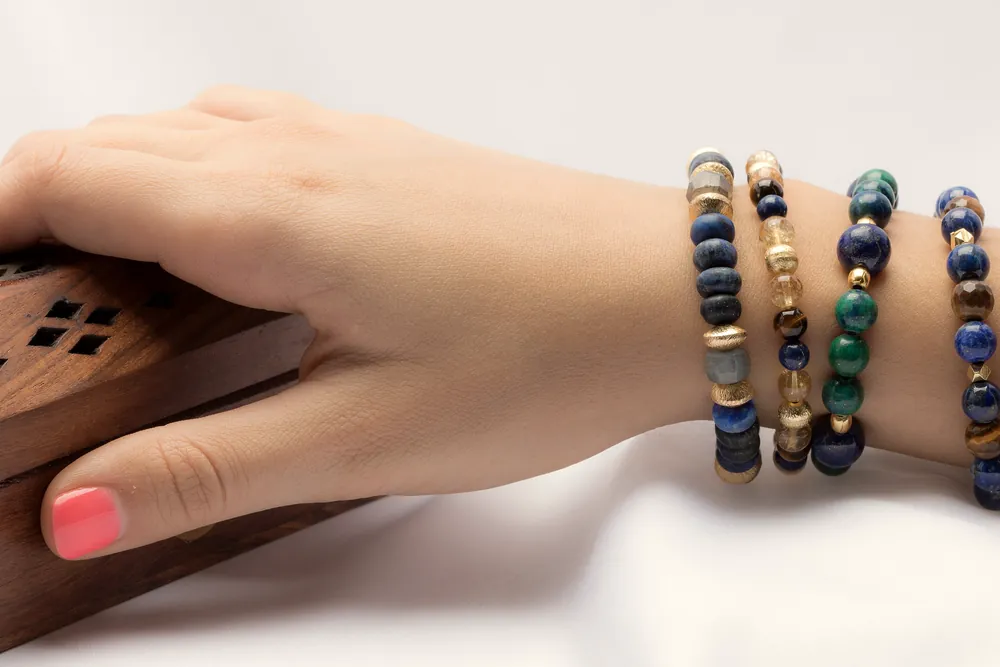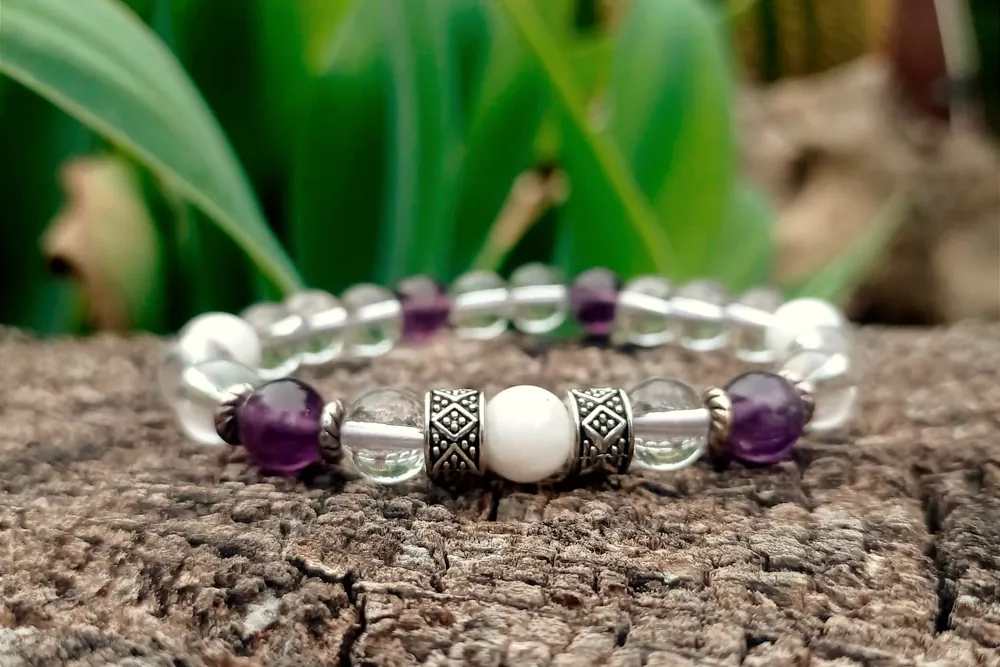
The short answer
- 6 mm: delicate and light; good for stacking and smaller wrists.
- 8 mm: the everyday standard; suits most wrists.
- 10 mm: bold; shows each stone’s pattern clearly, but is noticeably heavier.
- 12 mm and up: a statement piece; heavy and bulky.
Volume, and so weight, rises with the cube of the diameter. A 10 mm bead has about 1.95 times the volume of an 8 mm bead, and an 8 mm bead about 2.4 times that of a 6 mm bead. A 17 cm quartz bracelet weighs roughly 8 g in 6 mm beads, 15 g in 8 mm and 24 g in 10 mm. Heavy stones such as pyrite and hematite weigh about twice as much again.
Side by side
| 6 mm | 8 mm | 10 mm | 12 mm | |
|---|---|---|---|---|
| Look | Fine, delicate | Balanced, classic | Bold | Chunky |
| Beads in a 17 cm bracelet | about 28 | about 21 | about 17 | about 14 |
| Volume per bead | 113 mm³ | 268 mm³ | 524 mm³ | 905 mm³ |
| Weight per bead (quartz) | about 0.30 g | about 0.71 g | about 1.39 g | about 2.40 g |
| 17 cm bracelet (quartz) | about 8 g | about 15 g | about 24 g | about 34 g |
| 17 cm bracelet (pyrite) | about 16 g | about 28 g | about 45 g | about 63 g |
| Pattern visibility | Low | Medium | High | Very high |
| Stacking with others | Easy | Good | Limited | Rarely |
| Typical wearer | Smaller wrists, minimal style | Most people | Larger wrists, bold style | Statement pieces |
How we calculated: volume = 4/3 × π × radius³; weight = volume × specific gravity (quartz 2.65, pyrite about 5.0), ignoring the small drill hole. Bead counts = 170 mm ÷ bead size, rounded. Real beads vary by about ±0.5 mm and in shape.
Why the jump from 8 mm to 10 mm feels so big
Diameter goes up by 25%, but each bead fills space in three dimensions:
- volume goes up by 1.25³ ≈ 1.95×;
- fewer beads fit a given wrist (17 instead of 21), but each is nearly twice as heavy.
So a 10 mm bracelet is about 60% heavier than an 8 mm one of the same length. For dense stones this matters: a 10 mm pyrite or hematite bracelet can weigh 45–50 g, which is heavy for all-day wear and hard on elastic.
Which size suits you
| Wrist | Often comfortable | Bold choice |
|---|---|---|
| Under 15 cm (child or petite) | 6 mm | 8 mm |
| 15–17 cm | 8 mm | 10 mm |
| 17–19 cm | 8 or 10 mm | 12 mm |
| Over 19 cm | 10 mm | 12 mm |
Other factors:
- Stone pattern. Stones with patterns, such as tiger’s eye, jaspers, agates and labradorite, show more at 10 mm. Plain stones such as amethyst and rose quartz look fine at 8 mm.
- Mixed stones. A multi-stone design at 6 mm can look busy; at 8–10 mm each stone reads clearly.
- Daily activity. Typing, sports and household work favour smaller, lighter beads.
- Sleeves. Large beads catch on cuffs.
Bead size and fit
Larger beads sit further from the skin, so the inner circle of the bracelet is smaller than its bead-line length. With 10 mm or larger beads, add a little more room than you would with 8 mm. Our crystal bead bracelet guide explains measuring and fit.
A published builder formula, wrist inches × 25 ÷ bead mm, plus one comfort bead, illustrates the effect. One builder offers 8 mm and 10 mm beads:
- a 7-inch wrist needs about 23 beads at 8 mm;
- the same wrist needs about 19 beads at 10 mm.
Bead size and price
- More beads, more cost for stones priced per bead: 6 mm needs about 28 beads for a 17 cm bracelet; 10 mm needs about 17.
- Larger beads of fine material are rarer. In valuable stones (fine lapis, natural turquoise, precious stones), 10–12 mm beads of good, even quality cost disproportionately more.
- Bracelets priced as a unit often charge more for 10 mm. One builder lists ₹999 for 8 mm and ₹1,249 for 10 mm.
Bead size and durability
- Elastic: heavy beads stretch elastic faster. Use thicker elastic, or a clasp, for 10 mm and above, and for dense stones.
- Drill holes: larger beads usually have larger holes, which allow stronger cord.
- Chipping: large beads knock into things more; harder stones (quartz family, Mohs 7) chip less than softer ones.
FAQ
Is 8 mm or 10 mm better for men?
There is no rule. Many men choose 10 mm for a bolder look, but 8 mm suits many wrists better. Match the size to your wrist and how you will wear it.
How big is a 10 mm bead in real life?
About the size of a small green pea, or the width of a typical adult fingernail. Put a ruler next to your wrist to visualise it.
Why does my 10 mm bracelet feel so much heavier?
Each 10 mm bead has nearly twice the volume of an 8 mm bead, so even with fewer beads the bracelet is about 60% heavier.
Can I mix bead sizes?
Yes. A larger centre bead, or larger feature beads among smaller ones, is common. Graduated sizes need careful stringing to sit evenly.
What about 4 mm beads?
Very delicate. They are used for layering and children’s bracelets, or as spacers. Very small natural beads can be harder to judge for authenticity.
Sources
- Our own calculations (geometry and standard specific gravities: quartz 2.65; pyrite 4.95–5.10). See Quartz and Pyrite, Wikipedia.
- GemKrishna, Custom Bracelet Builder (published formula and 8/10 mm prices), checked 10 October 2026.
Related reading
- Crystal bead bracelets: choosing stones, bead sizes, fit, construction and reports
- How to care for a crystal bead bracelet: cleaning, water, storage and restringing
- How to assess a jewellery seller: a consistent evidence checklist
- Bracelet size chart for India: how to measure your wrist for bead bracelets and bangles
- Custom GemKrishna Builders