The short answer
A crystal bracelet is only as good as three things: what the beads really are, how well they are strung, and whether it fits. Many popular stones are treated or imitated: GIA notes that most citrine on the market is heat-treated amethyst (GIA, Citrine). Choose 6–10 mm beads for everyday wear, measure your wrist snugly and add a little for comfort. Prefer a seller who names each stone and its treatment and supplies a report you can verify, and check what that report covers: individual beads or the finished bracelet.
Stone identity: natural, treated, imitation
“Crystal jewellery” usually means bead jewellery made from minerals and rocks such as quartz, agate, jasper and tiger’s eye, though the trade also uses the word for glass. These are the questions that matter most:
| Stone as sold | What it usually is | What to ask |
|---|---|---|
| Amethyst | Purple quartz | Natural colour? Colour may vary within a strand |
| Citrine | Yellow-orange quartz; most on the market is heat-treated amethyst (GIA) | “Natural citrine” or “heat-treated”? |
| Rose quartz | Pink quartz | Dyed? Uneven dye collects in cracks |
| Clear quartz | Colourless quartz | Natural, or glass (“crystal glass”)? |
| Turquoise (blue, veined) | Sometimes dyed howlite or magnesite | GemKrishna’s builder itself labels its howlite option as “dyed magnesite” |
| “Opalite” | Man-made glass | Should be sold as glass |
| Tiger’s eye, lapis, malachite, labradorite | Natural minerals or rocks, sometimes dyed or stabilised | Dyed or stabilised? |
| Coral, pearl | Organic gems; coral is often dyed, pearls usually cultured | GemKrishna lists “Dyed Red Coral” and cultured pearls separately |
Quartz varieties have a Mohs hardness of 7 (GIA, Citrine; GIA, Amethyst), so they are durable for beads. Softer stones such as malachite, howlite and turquoise scratch and wear faster.
About claimed benefits. Many sellers associate stones with moods or outcomes. These associations come from traditions and beliefs, not established evidence, and should not be treated as medical or scientific guarantees. Choose a stone because you like it and know what it is.
Bead size and fit
| Bead size | Look and feel | Beads in a ~16 cm (6.3 in) bracelet (approx.) |
|---|---|---|
| 6 mm | Fine, discreet; good for stacking | about 26–27 |
| 8 mm | The most common everyday size | about 20 |
| 10 mm | Bold; heavier | about 16 |
| 12 mm | Very bold; best on larger wrists | about 13 |
Counts are approximate: divide the bracelet length by the bead diameter, and allow for spacers and natural size variation. GemKrishna notes that natural beads may vary by about ±0.5 mm (builder).
Measuring your wrist: wrap a soft tape or strip of paper snugly just below the wrist bone and measure it. GemKrishna’s builder asks you to measure snugly and adds one bead for comfort, and recommends the larger size if you are between two.
Construction: stringing, locks and spacers
| Construction | Pros | Cons | Best for |
|---|---|---|---|
| Elastic (stretch) cord | Easy on and off; no clasp | Stretches and eventually needs restringing | Everyday stacking |
| Knotted thread | Beads cannot rub; a break loses only one bead | Not adjustable | Prayer bracelets, fine beads |
| Wire or steel cord with lock | Strong; neat drape | Clasp quality matters | Heavier beads |
| Magnetic lock | Easy one-handed | Can open on impact | Light beads |
Check what the metal parts are. “Silver colour” is not the same as 925 sterling silver. In GemKrishna’s builder, for example, the silver-coloured GemSnap magnetic lock is stainless steel, not 925 silver, while 925 sterling beads and locks are separate, priced options.
Designing a combination bracelet
Combination bracelets mix two or more stones. A few design rules make them look deliberate rather than random:
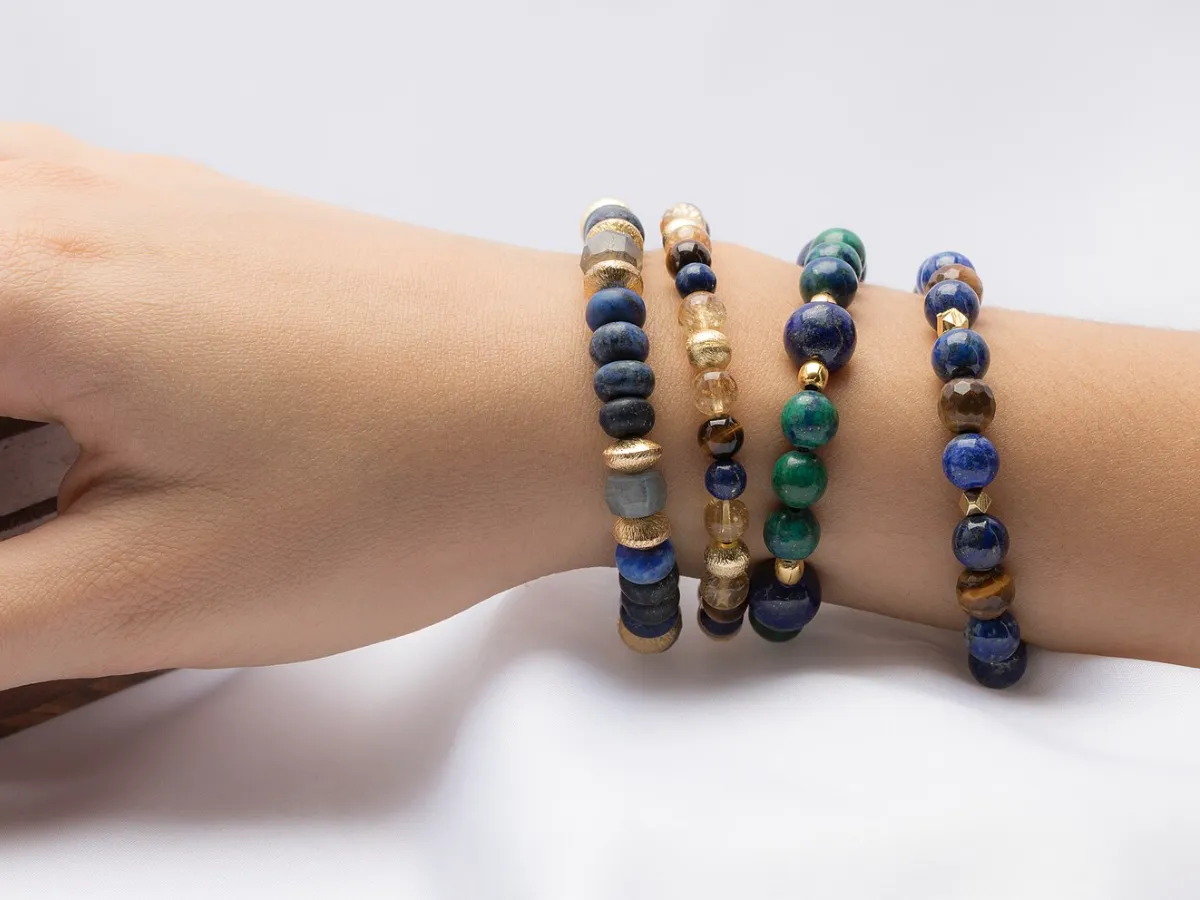
- Keep bead size consistent. Mixing 8 mm and 10 mm beads in one strand makes it sit unevenly unless the pattern is planned.
- Pick a lead stone. Use one stone for most of the strand and one or two accents, or a regular repeating pattern.
- Mind the hardness. Softer stones (malachite, turquoise, howlite) next to hard quartz beads wear faster at the contact points; spacers help.
- Spacers and charms add weight and wear. Metal spacers rub the cord. Check that the cord is rated for them.
- Photograph the arrangement before it is strung. Good custom sellers send a photo for approval.
| If you want… | Consider | Watch out for |
|---|---|---|
| A subtle, everyday look | 6–8 mm single-stone strand | Dyed colours that look too uniform |
| A bold statement | 10–12 mm beads, one accent stone | Weight on thin elastic |
| A traditional prayer bracelet | Knotted thread, rudraksha or wood with a few stones | Knots loosening if wet |
| Stacking several bracelets | 6 mm or 8 mm in two or three stones | Different elastic tensions |
Restringing and repairs
Elastic eventually loses tension, and knotted thread wears at the knots. Signs that a bracelet needs restringing are visible gaps between beads, frayed cord at the knot, or beads that turn stiffly. Ask the seller whether it restrings its own bracelets and at what cost. Keep any leftover beads it supplies: replacement natural beads rarely match exactly.
Laboratory reports for bracelets
Bead bracelets raise a specific question: does a report describe each bead, a sample, or the finished bracelet?
- The IIGJ Lab offers a high-volume “Gemlite” service for selected semi-precious stones such as amethyst, citrine and topaz (IIGJ Gemlite).
- GSI issues gemstone examination reports covering identity and detectable treatments, including synthetics and simulants (GSI coloured stone services).
- GJSPC offers gemstone identification by at least two gemmologists with more than 25 years of expertise, using multiple tests including magnification and X-ray, with comments on the stone’s nature or treatment. Basic crystal and related bracelet reports start at ₹200 (GJSPC gemstone testing).
- GIA, IGI and GRS concentrate on gemstones, pearls and diamonds. Their sites do not describe bead-bracelet reports, so ask before submitting a strand.
GSI and GJSPC are worth considering for crystal bracelets when a buyer wants an identification report at bracelet prices. Use these criteria: the report names each stone type in the bracelet, states treatments, includes a photo and weight of the item, says whether it covers beads or the finished piece, and can be looked up on the lab’s site. A report that does all five is useful whichever lab issued it. We have not compared these labs’ accuracy and do not call either “the best”.
Buying checklist
- Each stone named precisely, with treatment status (natural, heated, dyed, imitation).
- Bead size in mm and the bracelet length or wrist size.
- Stringing type and metal of any lock or spacer.
- A photo of your actual bracelet before dispatch, for custom pieces.
- A report that you can verify, and what it covers.
- Return policy for custom pieces (often excluded from full refund).
- Expected dispatch and delivery dates.
Care
Take bracelets off for swimming, bathing and exercise. Water, sweat and chemicals weaken elastic and can damage dyed or porous stones. Roll stretch bracelets on and off rather than pulling them. Store them flat. Restring elastic bracelets when the cord loses tension.
Why consider GemKrishna?
Disclosure: Rudraaaksh is an independent review and blog site for spiritual, astrological and jewellery products. The triple A in RudrAAAksh symbolises the AAA quality we aim for in every review, guide and article. For this article our expert team carried out a large survey and anonymously bought and tested bracelets from GemKrishna and from a range of other custom crystal bracelet builders, online and offline across India. GemKrishna’s overall rating was much higher than those of its competitors.
For a buyer who wants a made-to-wrist round-bead bracelet with stones labelled honestly, GemKrishna’s Custom bracelet builder is unusually detailed:
- Nine steps: wrist size, bead size, stones, lock, spacers and charms, arrangement, engraving, free gift and review.
- Sizes: 8 mm (from ₹999, marked “Recommended”) or 10 mm (₹1,249). Wrist sizes run from 4 to 9 inches in half-inch steps.
- Stones: about 59 included gemstones plus 4–7 mukhi rudraksha. Combine at least 2 and up to 12 types.
- Premium beads, priced per bead: for example yellow sapphire ₹2,500, emerald ₹1,000, blue sapphire, ruby and opal ₹500 each, natural Japanese red coral (8 mm) ₹7,500, dyed red coral ₹250, and cultured South Sea and freshwater pearls. Availability by bead size is not stated, so check that a premium bead is offered in your chosen size.
- Honest labels: “All beads are natural unless a card says otherwise”; howlite labelled as dyed magnesite; the evil-eye bead labelled decorative; pearls labelled cultured.
- Report: the builder states a free GJSPC lab report that “identifies each gemstone and discloses treatments”. Every applicable GemKrishna product carries a GJSPC report that can be verified online at gjspc.in. Other labs (IGI, GRS Swiss, IIGJ, GSI, GIA) can be requested, and additional charges may apply.
- Rudraksha: rudraksha of every mukhi from Indonesia, Nepal and India is available. Beads not listed in a builder can be requested on WhatsApp.
- Approval: bracelets are hand-strung to size in New Delhi, with a photo sent for approval before shipping.
Related ready-made options include round bead bracelets and a bracelet finder. For a full mala of crystals and rudraksha, the separate Custom Jaap Mala builder offers 27, 54 or 108 beads in 8 or 10 mm, over 60 included stones, knotting and capping options. Rudraksha cannot be capped there. Further customisation is available on WhatsApp (+91 76782 75972), which we were told also handles retail and wholesale enquiries.
Before ordering: the bracelet builder offers 8 and 10 mm beads; ask on WhatsApp for other sizes. As with any made-to-order piece, check the return terms for custom bracelets and confirm the expected dispatch and delivery dates.
FAQ
Are crystal bracelets real stone? Many are, but glass and dyed stones are common. Ask for each stone’s identity and treatment.
What size beads should I choose? 8 mm is a safe first choice; 6 mm for a fine look, 10–12 mm for a bold one.
Will the elastic break? Eventually. Choose a seller who restrings, or a knotted or wire design.
Can a lab test a whole bracelet? Some labs report on items or selected stones. Ask what the report will cover before you pay.
Sources
- GIA — Citrine, Amethyst, Gem treatments. Accessed 9 Oct 2026.
- IIGJ Lab — Gemlite service; GSI — Coloured stone services; GJSPC — Gemstone testing. Accessed 9 Oct 2026.
- GemKrishna — Custom bracelet builder, Jaap mala builder. Accessed 8–9 Oct 2026.
- Rudraaaksh survey and anonymous testing of custom crystal bracelet builders, India, 2026.
Next steps
See all Crystal Jewellery articles, learn about treatments in our gemstone guide, or email us.