The short answer
- Generally water-safe (rinse, wash, wear in the rain): the quartz family (amethyst, clear and rose quartz, citrine, smoky quartz, tiger’s eye, aventurine) and the chalcedonies (agate, onyx, carnelian), plus jade and black tourmaline. All are hardness 6.5–7 or tough, and non-porous when undyed.
- Briefly, then dry at once: moonstone, labradorite, lapis lazuli, turquoise, opal, hematite and fluorite. They are softer, porous, often treated, or prone to cleavage.
- Keep dry: selenite (gypsum, which is water-soluble), malachite (soft; dissolves in acids), pyrite (decays in damp conditions), howlite (soft, porous and usually dyed), pearls, and wooden beads such as karungali.
Two cautions apply to every stone:
- Dyed and filled stones can lose colour or filler.
- The cord and metal parts are often the weakest point. Soap, sweat, chlorine and salt water all shorten their life.
What “getting wet” actually does
Water damages a stone in a few specific ways, so the answer depends on the stone:
- Dissolving. A few minerals are measurably soluble. Gypsum (selenite) dissolves at about 2.0–2.5 g per litre at 25 °C (Wikipedia, Gypsum).
- Chemical decay. Pyrite “adsorbs water and oxygen and grows efflorescent minerals that eventually make their own acidic puddle” (Tacker, 2020).
- Porosity. Porous stones such as turquoise and howlite absorb water, oils and dyes, and can change colour.
- Treatments. Dyes can bleed, and waxes, oils and resins can be attacked, especially by warm water, soaps and solvents.
- Heat and temperature shock. Hot water, steam and sudden temperature changes crack stones with cleavage or internal water, such as opal and moonstone.
- Softness. Water is not the problem for soft stones; the grit carried in it and abrasion during washing are.
Plain water at room temperature, briefly, then dried, is harmless to most hard, untreated stones.
The reference table
Each row gives hardness (Mohs), brief water contact (a rinse, washing hands, rain), soaking (minutes or longer, swimming, bathing) and sunlight where it matters.
| Stone | What it is | Hardness | Brief water | Soaking / swimming | Sunlight | Notes and source |
|---|---|---|---|---|---|---|
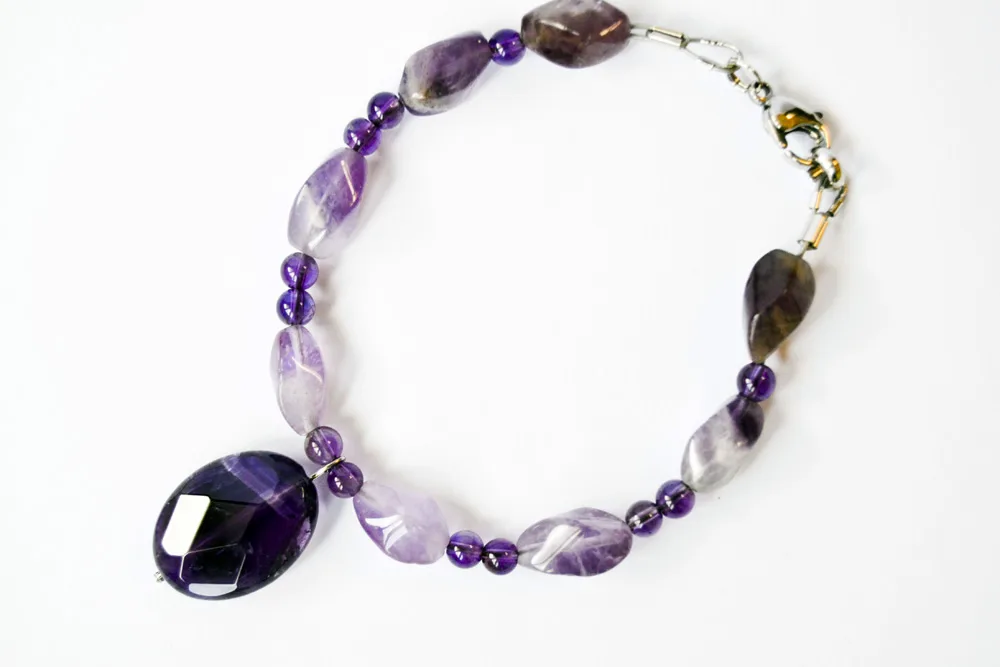
| Amethyst | Quartz | 7 | Yes | Avoid long soaks for bracelets (cord) | Some colour “can fade with prolonged exposure to intense light” | GIA: warm soapy water safe; no steam or heat |
| Clear quartz (sphatik) | Quartz | 7 | Yes | Stone fine; cord is the limit | Stable | |
| Rose quartz | Quartz | 7 | Yes | Stone fine | Massive rose quartz stable; “pink quartz is photosensitive” | Wikipedia, Rose quartz |
| Citrine, smoky quartz | Quartz (often heated or irradiated) | 7 | Yes | Stone fine | Keep out of strong light (precaution) | |
| Tiger’s eye, aventurine | Quartz | about 7 | Yes | Stone fine | Stable | Dyed colours may bleed |
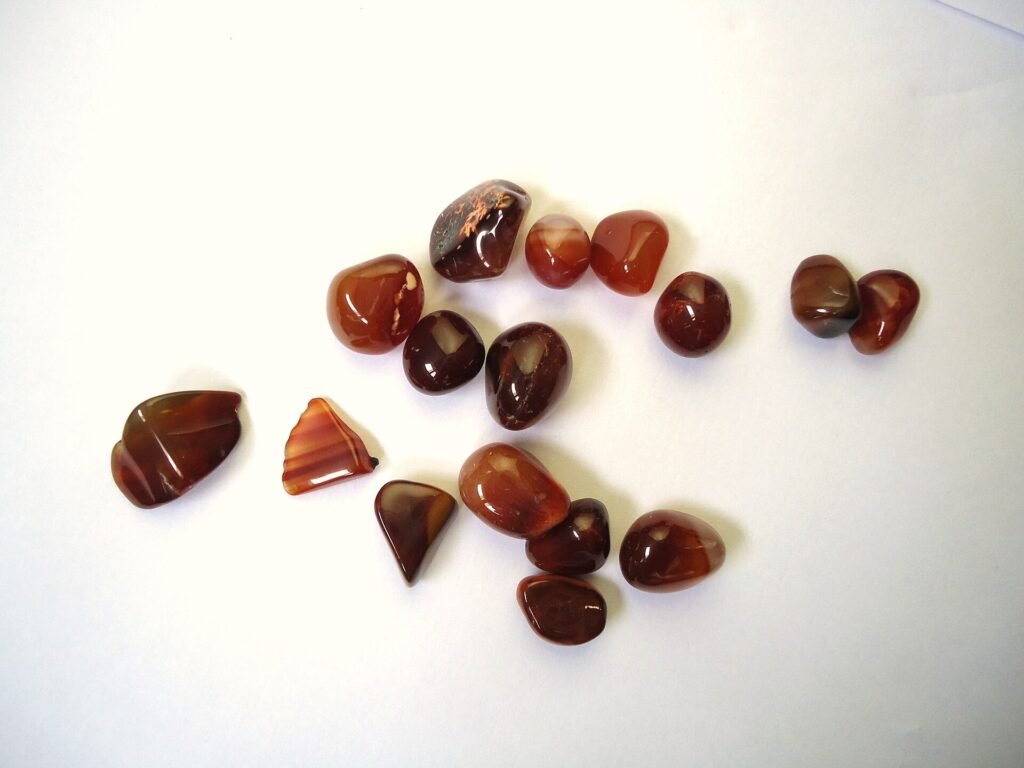
| Agate, onyx, carnelian, sulemani hakik | Chalcedony | 6–7 | Yes | Stone fine | Stable | Black onyx is usually dyed; avoid solvents |
| Black tourmaline | Schorl | 7–7.5 | Yes | Fine; dry well | Stable | |
| Jade (jadeite, nephrite) | Silicate aggregates | about 6–7 | Yes | Untreated fine | Stable | GIA: warm soapy water “always a safe choice”; treated jade needs gentler care |
| Obsidian | Volcanic glass | 5–6 | Yes | Fine | Stable | Chips easily |
| Moonstone | Feldspar | 6–6.5 | Brief only | Avoid; poor toughness | Stable | GIA: warm soapy water only; no ultrasonic or steam; no sudden temperature change |
| Labradorite | Feldspar | 6–6.5 | Brief only | Avoid | Stable | Same family and cleavage as moonstone |
| Lapis lazuli | Rock (lazurite, calcite, pyrite) | 5–6 | Brief only | Avoid | Stable | GIA: dye may come off with acetone or alcohol; waxed lapis harmed by heat or solvents |
| Turquoise | Copper phosphate, porous | 5–6 | Brief only | Avoid | “Generally stable to light” | GIA: can be discoloured by chemicals, cosmetics, skin oils or perspiration; never steam or ultrasonic |
| Opal | Hydrated silica | 5–6.5 | Brief only | Avoid; no doublets or triplets in water | Heat from intense light can cause crazing | GIA: “very poor to fair” toughness |
| Hematite | Iron oxide | 5.5–6.5 | Brief; dry fully | Avoid | Stable | Brittle |
| Fluorite | Calcium fluoride | 4 | Brief only | Avoid; “slightly water soluble” | Can fade (precaution) | Four perfect cleavage planes (Wikipedia) |
| Howlite | Calcium borosilicate | about 3.5 | Avoid | No | Usually dyed (sold as turquoise imitation) | |
| Malachite | Copper carbonate | 3.5–4 | Avoid | No | “Readily soluble in dilute acids” (Wikipedia); soft | |
| Pyrite | Iron sulphide | 6–6.5 | Avoid | No | Decays with water and oxygen (Tacker, 2020) | |
| Selenite | Gypsum | 2 | No | No | Water-soluble; scratches with a fingernail | |
| Pearl | Organic gem | 2.5–3 | Wipe only | No | GIA: damaged by “all acids”, perspiration, cosmetics; no ultrasonic or steam | |
| Karungali, sandalwood, tulsi | Wood | Wood | Wipe only | No | Absorbs water and oils |
Precaution means a general care rule rather than a documented problem for every stone of that type. Most quartz is very stable, but heated or irradiated colours (citrine, smoky quartz) and some fluorite can fade in strong light. Keep valued pieces out of long, direct sun.
The parts people forget: cord, metal and treatments
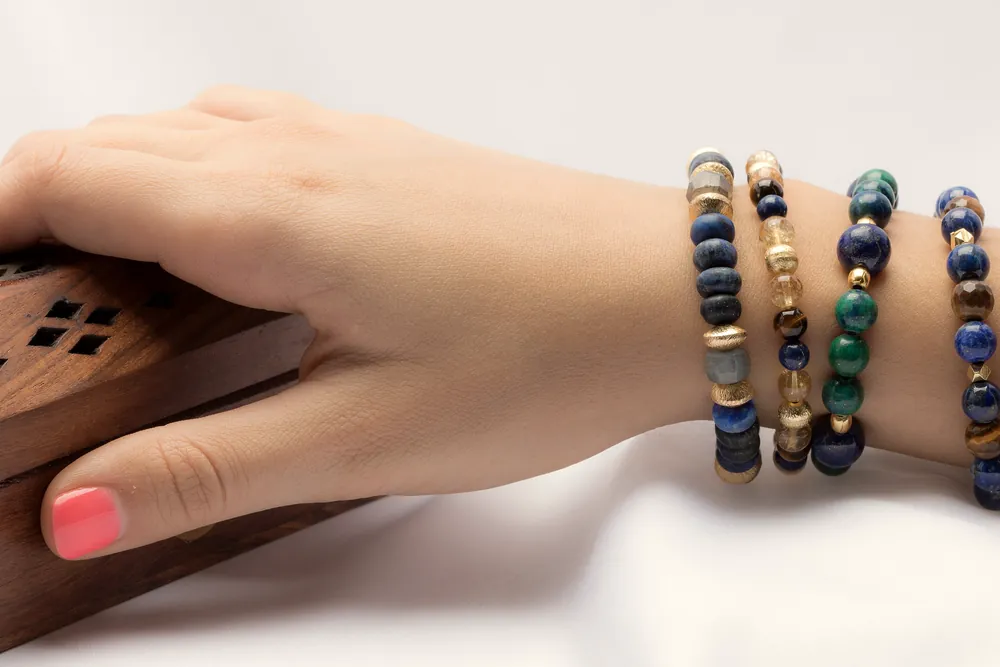
Elastic cord. Most crystal bracelets are strung on elastic. Water does not dissolve the stones in these, but repeated soaking, soap, sweat, sun and chlorine age the cord. A wet bead bracelet that you roll on and off also stretches more. Take bead bracelets off for bathing and swimming. See crystal bracelet care and restringing.
Metal spacers, charms and locks:
- Sterling silver tarnishes faster with sulphur compounds and some chlorides.
- Plated base metals can corrode or lose their plating.
- Salt water and pool water are harder on metal parts than fresh water.
Dry metal parts after any contact.
Dyed and treated stones are the main reason a “water-safe” stone can still be damaged. Ask the seller which beads are dyed: howlite, many agates and onyx, some jade, quartz “cherry quartz” and lapis. Assume warm water, soap and any solvent can affect the dye. See gemstone treatments explained.
Selenite: a worked example
How much selenite could a glass of water actually dissolve?
- Gypsum solubility: about 2.0–2.5 g per litre at 25 °C (Wikipedia). Use 2.2 g/L.
- A 250 ml glass of water can hold about 0.55 g of dissolved gypsum before it is saturated.
- A 10 mm selenite bead has a volume of 0.524 cm³. At gypsum’s density of about 2.3 g/cm³, it weighs about 1.2 g.
So, given enough time, a single glass of standing water could in principle dissolve almost half of a bead’s weight. In practice dissolution is slow, and the first signs are a frosted, pitted surface and softened edges, not a vanished bead. Even short, repeated wetting (wearing a selenite bracelet while washing hands) visibly dulls the surface.
Hardness 2 also means a fingernail can scratch it. Selenite is better kept as a display piece than worn as a daily bracelet.
Pyrite: why damp storage matters more than a splash
Pyrite decay (“pyrite disease”) is a reaction of water and oxygen together. Tacker reviews research showing that “the effect of O2 or H2O alone is far less than both together”, with damage linked to high humidity (Tacker, 2020).
For a pyrite bracelet:
- Wipe off sweat and water promptly.
- Store it dry, not in a humid bathroom.
- Do not soak it.
- A yellowish or white powdery bloom or a sulphur smell means decay has started.
See how to check if pyrite is real.
Salt water, chlorine and “cleansing” rituals
- Salt water (sea, or salt-water “cleansing”): it does not harm quartz or chalcedony, but salt crystallising in pores and cracks can stress porous or fractured stones, and salt corrodes metal parts. Avoid salt soaks for turquoise, lapis, malachite, pyrite, howlite, selenite, opal and pearls.
- Pool chlorine is harsh on metal findings, elastic and dyes. Remove bracelets before swimming.
- Moonlight or sunlight “charging”: long sun exposure can fade some stones (see the table). Moonlight does no harm.
- Running-water rituals: fine for quartz and chalcedony. Hold a strung bracelet so the cord is not soaked, and dry it immediately.
Cleansing rituals are traditional practices; we describe only their physical effects on the material.
How to clean a bracelet safely
- Wipe with a soft, damp cloth. This is safe for every stone in this table except those marked “wipe only”, for which you should use a barely damp cloth.
- For water-safe stones, a quick rinse in lukewarm water with a drop of mild soap on the beads, avoiding the cord where possible.
- Dry at once with a soft cloth, then air-dry flat, not hanging, so the cord does not stretch.
- Never use ultrasonic or steam cleaners on bead bracelets, or on porous, treated, soft or cleavable stones (GIA advises against them for turquoise, moonstone and pearls).
- Never use acetone, alcohol or household cleaners on dyed or waxed stones.
Our care guide covers storage and restringing.
Mistakes and misconceptions
- “Crystals are rocks, so water can’t hurt them.” Some are soft, porous, soluble or chemically reactive.
- “If the stone is fine, the bracelet is fine.” The cord and metal often fail first.
- “Selenite and pyrite can be cleansed in water like quartz.” Both are damaged by water.
- “Rose quartz always fades in sunlight.” Massive rose quartz is described as stable; it is the rarer crystalline pink quartz that is photosensitive.
- “Saltwater cleansing is harmless.” It can harm porous stones and metal parts.
FAQ
Can I shower with a crystal bracelet?
For quartz and chalcedony beads, an occasional splash does no harm to the stones, but regular showering ages elastic cord and metal parts. For soft, porous, soluble or treated stones, no. Take the bracelet off.
Which crystals cannot go in water?
Selenite, malachite, pyrite, howlite, pearls and wooden beads should be kept dry. Turquoise, lapis lazuli, opal, moonstone, labradorite, fluorite and hematite tolerate only brief contact and should be dried immediately.
Can amethyst get wet?
Yes. GIA states that amethyst “can be safely cleaned with warm soapy water”. Avoid heat and steam, and keep it out of prolonged intense light, which can fade some amethyst.
Can I put crystals in salt water?
Quartz and chalcedony tolerate it, but rinse and dry them afterwards. Avoid salt water for porous, soft or reactive stones, and for bracelets with metal parts.
Can fluorite get wet?
Briefly. Fluorite is listed as slightly water-soluble and is soft (hardness 4) with perfect cleavage. Wipe it rather than soak it.
How do I clean crystals that can’t get wet?
Use a soft, dry or barely damp cloth, then dry the piece fully. For dust, use a soft brush. Do not use solvents.
Sources
- GIA care guides: Amethyst, Moonstone, Jade, Lapis lazuli, Turquoise, Opal and Pearl, checked 11 October 2026.
- Wikipedia: Gypsum (solubility, hardness), Malachite, Fluorite, Hematite, Rose quartz, Howlite and Chalcedony, checked 11 October 2026.
- Tacker, R. C. (2020): A review of “pyrite disease” for paleontologists, Palaeontologia Electronica, checked 11 October 2026.