The short answer
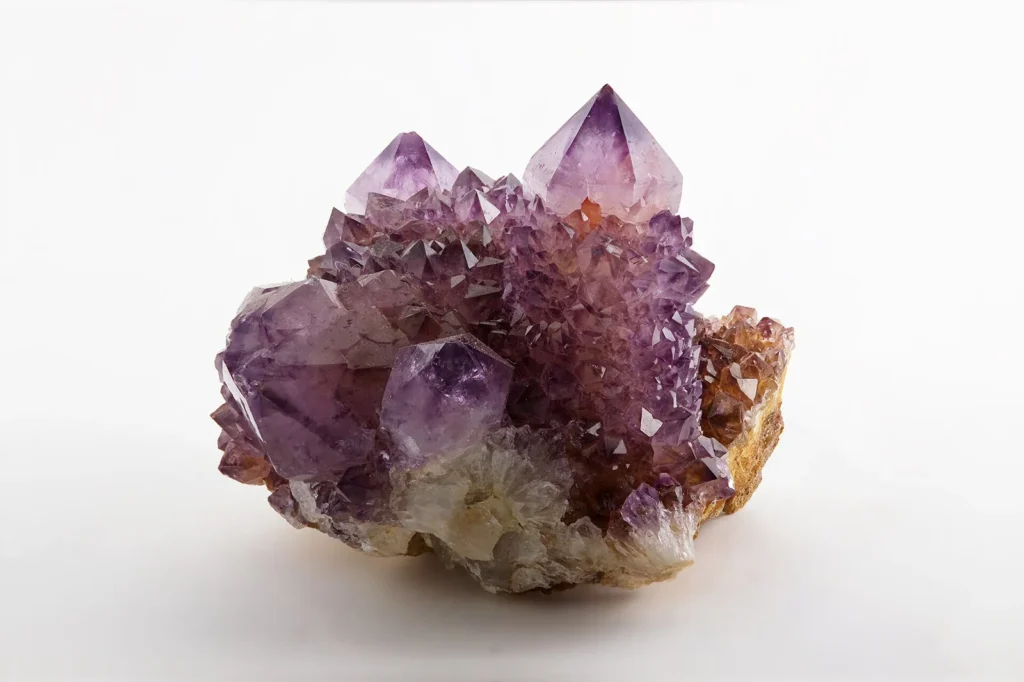
Natural amethyst is purple quartz (Mohs 7, specific gravity about 2.65). Clues that point to natural material:
- uneven colour, often in bands or patches;
- small natural inclusions;
- a cool feel.
Clues to glass:
- round gas bubbles or swirl lines under a loupe;
- perfectly even colour;
- chips with smooth, shell-like breaks;
- seams from moulding.
Synthetic amethyst (lab-grown quartz) has the same properties as natural, so only a laboratory can reliably separate them. For an expensive stone or a bracelet sold as natural, ask for a report that names it natural.
What amethyst is
Amethyst is a variety of quartz. Its purple colour comes from iron impurities activated by natural irradiation in the ground (Amethyst). Key facts:
- Hardness: 7 on the Mohs scale, the same as all quartz (GIA).
- Colour: GIA describes the finest colour as “strong reddish purple to purple with no visible color zoning” (GIA). Most natural material does show zoning.
- Heating: heating turns amethyst yellow or brown. Much commercial “citrine” is heated amethyst (see our guide to gemstone treatments).
- Fading: long exposure to strong light can lighten some amethyst.
- Synthetic amethyst is grown hydrothermally and has the same chemistry and physical properties, so separating it from natural usually needs advanced testing (Amethyst).
Natural amethyst vs glass vs synthetic
| Check | Natural amethyst | Glass imitation | Synthetic amethyst |
|---|---|---|---|
| Colour | Often uneven: bands, patches, darker at crystal tips | Very even, can look “inky” or too bright | Often even; can show zoning |
| Under a 10× loupe | Natural inclusions: tiny crystals, “fingerprints”, feathers | Round gas bubbles, swirl or flow lines | Few inclusions; sometimes growth features only a lab can read |
| Feel | Cool to the touch at first | Warms quickly in the hand | Cool (it is quartz) |
| Hardness | 7: resists steel; scratches glass | About 5–6: a steel file can mark it | 7 |
| Chips and breaks | Small conchoidal chips; crystalline facets on raw pieces | Smooth shell-like breaks; mould seams on cheap beads | As natural |
| Price | Varies by colour and clarity | Cheap | Usually cheaper than fine natural |
| Reliable test | Laboratory (spectroscopy, twinning) | Loupe often enough; refractometer or lab | Laboratory only |
GIA’s laboratory notes show why bubbles matter but are not the whole story. In one case GIA identified glass from gas bubbles and flow marks, then confirmed it by infrared spectroscopy (GIA, Gems & Gemology lab notes).
Checks you can do at home
- Daylight look. Turn a bead or stone in daylight. Natural amethyst usually shows zones of deeper and paler purple. Perfect uniformity in every bead of a bracelet is a warning sign, not proof.
- Loupe. A 10× loupe (inexpensive online) reveals bubbles in glass. Look near the drill hole and under the surface, not at surface scratches.
- Touch. Hold a bead against your lip or cheek. Quartz feels cool longer than glass. This is a weak test but quick.
- Drill holes. Glass beads often have smooth, glossy holes; natural stone holes may show slight chipping. Coloured coatings sometimes wear away at the hole.
- Avoid scratch tests on beads you will wear. Scratching a hidden spot with a steel point can separate glass from quartz, but it damages the bead.
What not to rely on
- “It is cold, so it is real.” Many materials feel cool at first.
- Colour in water or alcohol. Natural amethyst does not bleed colour, but most dyed fakes are not dyed amethyst: they are dyed quartz or glass. Bleeding colour proves dye; no bleeding proves little.
- Certificates you cannot verify. A report number must check out on the laboratory’s own site. Our laboratory guide explains how.
Amethyst bead bracelets
- “Natural amethyst” vs “amethyst colour”. Ask the seller to confirm in writing that the beads are natural amethyst, not glass or dyed quartz.
- Grades. “AAA”, “A grade” and similar labels are seller grading, with no common standard. Compare colour and clarity in photographs of the actual bracelet.
- Synthetic disclosure. Lab-grown amethyst is legitimate if disclosed, but should be priced as synthetic.
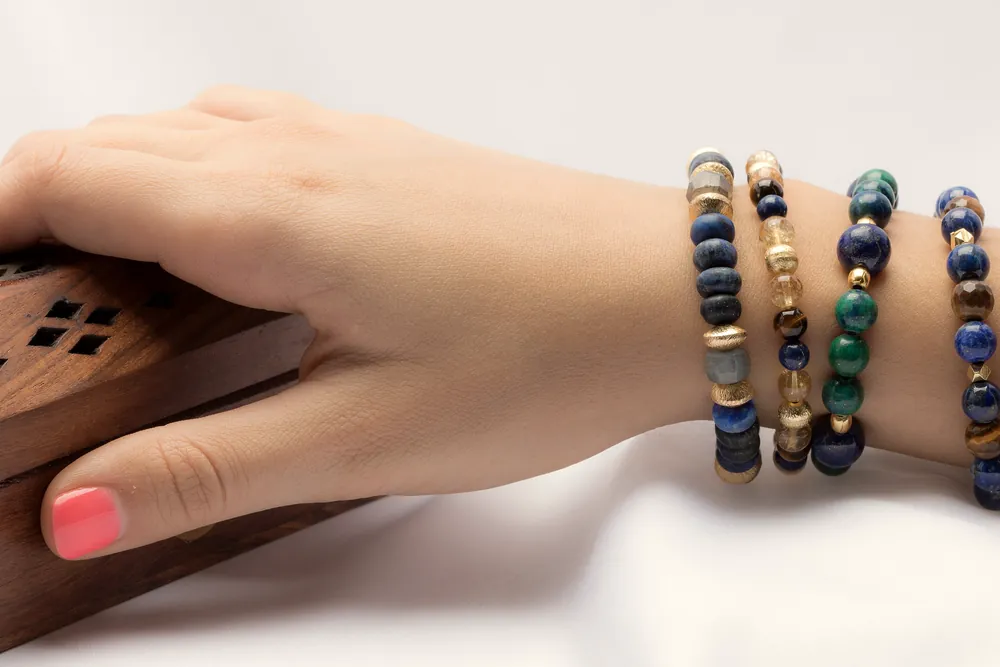
- Bracelet reports. Some sellers include a report for the bracelet. Check whether it identifies each stone, and look up the number. See our crystal bracelet guide.
Amethyst rings and cut stones
- Look at the stone through the side with a loupe. Glass often shows bubbles and rounded facet edges (moulded), while quartz has sharper facet junctions.
- Fine amethyst has strong, even colour, which makes it harder to tell from synthetic by eye. For valuable cut stones, ask for a laboratory report stating “natural”.
- Our guide to judging coloured gemstone quality covers colour, clarity and cut.
Care
- Quartz is hard (7) but can chip on edges and drill holes. Store it apart from softer stones.
- Avoid long periods in strong sunlight if you want to keep the colour.
- Clean with lukewarm water and mild soap, then dry. This is fine for loose stones and metal-set rings. For bead bracelets, protect the thread or elastic and do not soak.
Traditional associations
In Indian trade amethyst is called katela or jamunia. In Jyotish it is used as an uparatna (substitute stone) associated with Saturn, in place of blue sapphire. Modern crystal practice links it with calm. These are traditions, not tested effects.
FAQ
Can real amethyst be very cheap?
Yes. Amethyst is abundant, so natural beads can be inexpensive. A low price alone does not mean fake, but very bright, uniform, very cheap “amethyst” deserves a loupe check.
Is synthetic amethyst fake?
It is real quartz grown in a laboratory, so it is not an imitation. It must be disclosed as synthetic or lab-grown, and priced accordingly.
Does real amethyst fade?
Some amethyst can lighten after long exposure to strong light. Keep it out of direct sun when stored.
Is “heated amethyst” the same as citrine?
Heated amethyst turns yellow to brown and is widely sold as citrine. It is a treatment that should be disclosed.
How do I know a laboratory report covers my bracelet’s beads?
Look up the report number on the laboratory’s site and check that it describes your bracelet (bead count, size, weight, photo), not just “one sample bead”.
Sources
- GIA, Amethyst, checked 10 October 2026.
- Amethyst, Wikipedia (colour cause, heating, synthetic production), checked 10 October 2026.
- GIA, Gems & Gemology lab notes, Summer 2022: an interesting set of blue “rough” gemstones, checked 10 October 2026.