The short answer
They are completely different materials that happen to be black:
- Black tourmaline (schorl): an iron-rich crystalline mineral, hardness 7–7.5. In beads it is usually opaque, with a faintly fibrous or striated look.
- Black obsidian: natural volcanic glass, hardness 5–6. It is glassy, lighter in weight, and breaks with shell-like (conchoidal) chips.
- Black onyx: chalcedony (microcrystalline quartz), hardness 6.5–7. Most black onyx is artificially coloured, a traditional treatment that is stable but should be disclosed.
- Sulemani hakik: a trade name for black or black-and-white banded agate, also chalcedony.
- Hematite: an iron oxide, very heavy and metallic. Strongly magnetic beads are usually a synthetic sold as “magnetic hematite”.
- Karungali: not a stone. It is ebony wood (Diospyros ebenum).
Weight is the most useful home clue. Ten-millimetre beads of these materials differ by about four and a half times in weight (see the table below).
Why these get confused
Black hides the features buyers normally rely on: colour, transparency and inclusions. All six are sold as black round beads, often in the same shop, often with overlapping traditional claims of “protection” or “grounding”. Those claims are beliefs; they do not tell you what the bead is. This guide sticks to what can be checked. Our 25-stone identity matrix covers the wider family of bracelet stones.
The materials compared
| Black tourmaline | Black obsidian | Black onyx | Sulemani hakik | Hematite | Karungali | |
|---|---|---|---|---|---|---|
| What it is | Schorl, an iron-rich borosilicate mineral | Natural volcanic glass (mineraloid) | Chalcedony (quartz family), usually dyed black | Banded agate (chalcedony) | Iron oxide mineral | Ebony wood |
| Hardness (Mohs) | 7–7.5 | 5–6 | 6.5–7 | about 6–7 (chalcedony) | 5.5–6.5 | Wood: dents and wears |
| Specific gravity | about 3.0–3.3 | about 2.4 | 2.59–2.61 (chalcedony) | 2.59–2.61 | 5.26 | up to about 1.2 |
| Typical look in beads | Opaque; fibrous or striated texture; vitreous to slightly resinous lustre | Very glassy; sometimes a golden or rainbow sheen, or white “snowflakes” | Uniform jet black, high polish | Black with white or grey bands, or plain black | Metallic, mirror-like grey-black | Matte to satin brown-black wood grain |
| Breaks or chips | Uneven to small conchoidal | Conchoidal, sharp-edged | Smooth chips | Smooth chips | Brittle | Splinters, dents |
| Common treatment or imitation | Glass or dyed stone sold as “tourmaline” | Black glass | Dyeing is the norm | Dyed agate | “Hematine” (synthetic, magnetic) | Stained or dyed lighter woods |
Sources:
- Tourmaline: GIA (“Schorl is typically black, and rich in iron”) and the Wikipedia article on schorl.
- Obsidian: Wikipedia.
- Onyx and chalcedony: Wikipedia.
- Hematite and hematine: Wikipedia.
- Ebony: Wikipedia.
All are listed under Sources at the end.
Black tourmaline (schorl)
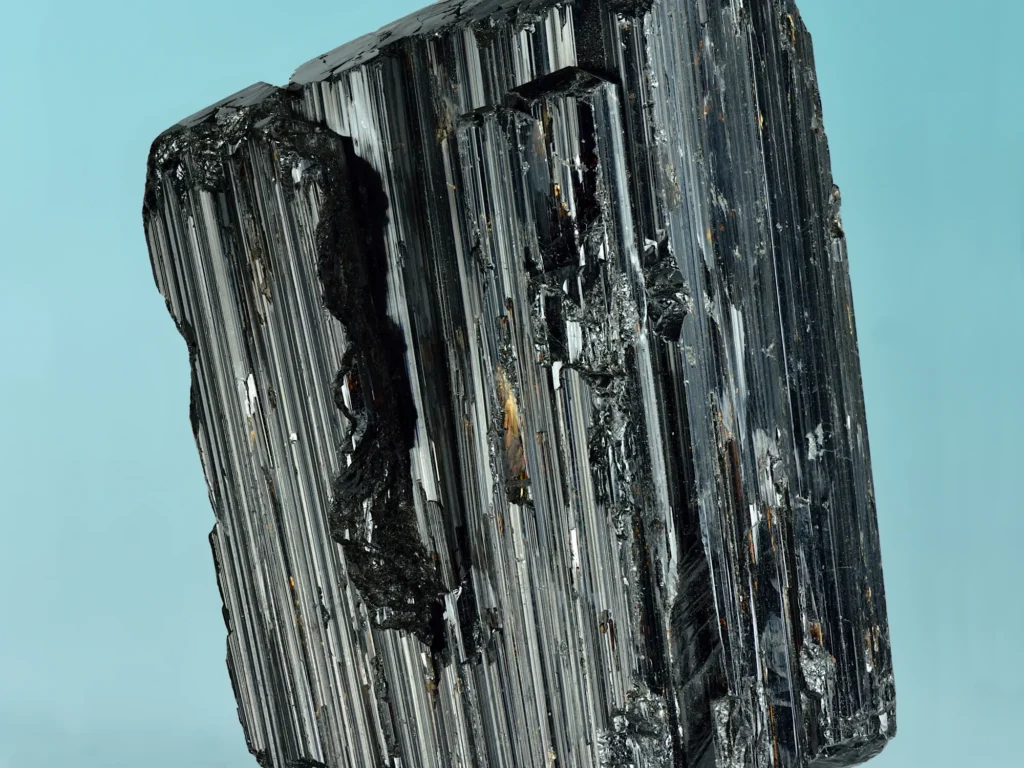
Tourmaline is a family of related minerals; GIA describes schorl as “typically black, and rich in iron” (GIA, tourmaline). Natural crystals grow as long prisms, usually triangular in cross-section, with “heavy vertical striations” along their length (Wikipedia, Schorl). You can see this in the photograph above.
In bead form, those striations become a faint fibrous or streaky texture in reflected light. The polish is often slightly uneven, because the stone is not uniform. Good-quality beads look like stone, not like glass.
Hardness 7–7.5 makes it scratch-resistant, but crystals are often fractured, so beads can chip at the drill hole.
Magnet note: schorl has a high magnetic susceptibility (Wikipedia). A strong neodymium magnet may tug very slightly at a bead hanging on a thread. An ordinary fridge magnet will not lift it. Beads that snap firmly to an ordinary magnet are not tourmaline; see hematite below.
Common substitutes: black glass, dyed stone and resin. A uniformly glossy, perfectly identical, glass-smooth “tourmaline” bead with conchoidal chips is a warning sign.
Black obsidian
Obsidian is a “naturally occurring volcanic glass” that forms when lava cools too quickly for crystals to grow. It is mostly silica, “usually 70% by weight or more”, and is classed as a mineraloid, not a mineral (Wikipedia, Obsidian).
Identifying features:
- Glass-like lustre and smoothness.
- Conchoidal (shell-shaped) fracture, with very sharp edges where it chips.
- Hardness 5–6, so it scratches more easily than onyx or tourmaline.
- Varieties have a name for their pattern: snowflake (white cristobalite clusters), sheen (golden or silver sheen from aligned gas bubbles) and rainbow (iridescent bands).
The obsidian problem: because obsidian is glass, telling natural obsidian from manufactured black glass is genuinely difficult without gemmological testing. A sheen or snowflake pattern is good evidence of natural obsidian. Plain jet-black “obsidian” beads at a very low price could be either.
Black onyx
Onyx is a banded variety of chalcedony, a microcrystalline form of quartz. Its classic form is black and white. Most black onyx sold is artificially coloured (Wikipedia, Onyx). The method is ancient: chalcedony is soaked in a sugar solution, then treated with acid so that the sugar carbonises inside the stone and turns it black. Pliny the Elder described the technique in the first century.
What this means for you:
- Dyed black onyx is a traditional, stable treatment. It is still chalcedony, and it is acceptable when disclosed.
- “Natural black onyx” with no treatment is uncommon. Ask the seller what “natural” means on their listing: natural chalcedony, or untreated colour?
- Hardness 6.5–7 and good toughness make onyx one of the most durable black beads.
- “Onyx” is also misused for banded calcite and marble, which are much softer (Wikipedia). For beads, ask the seller to confirm the stone is chalcedony.
Sulemani hakik (banded agate)
In India, hakik (also aqiq or aqeeq) is the trade name for agate. Sulemani hakik is used for grey-black or black stones with white banding, and for plain black agate beads. Sellers describe it this way, and the folk name refers to King Solomon (Sulaiman) (Zanvari guide; IndiaMART listings).
Mineralogically it is chalcedony, the same family as onyx. Agate is “a fibrous, banded variety of chalcedony”, and onyx “a variant of agate with black and white banding” (Wikipedia, Chalcedony). Like onyx, black agate is commonly dyed to deepen or even out its colour; commercial chalcedony’s colour is “often enhanced by dyeing or heating” (Wikipedia).
So, “black obsidian vs sulemani hakik”? They are different materials: a volcanic glass (obsidian) and a microcrystalline quartz (agate). Agate is slightly heavier and harder. Banding is the clearest visible difference.
Hematite and “magnetic hematite”
Hematite is iron oxide. It is heavy (specific gravity 5.26), metallic and brittle. Hematite leaves a “rust-red streak” when rubbed on unglazed porcelain. Natural hematite “is not noticeably attracted to an ordinary magnet” (Wikipedia, Hematite).
Bracelets sold as “magnetic hematite” are usually hematine, which Wikipedia describes as “a synthetic material sold as magnetic hematite”. That is not wrong in itself, but it should be described as synthetic, not as natural stone.
Do not streak-test a bracelet bead on a tile unless you accept a scratch on the bead. Weight and the magnet test are enough for a first check.
Karungali (ebony)
Karungali is the Tamil name for ebony, Diospyros ebenum (“Ceylon ebony”). It is a dense hardwood: wood density “up to 1,200 kg/m3”, so pieces can sink in water (Wikipedia, Diospyros ebenum). Karungali malas are wood, not stone. Comparing them with obsidian or tourmaline is comparing wood with stone.
What to check with karungali:
- Grain: real wood shows grain under a loupe. Uniform, grainless “wood” may be stained or composite material.
- Colour: genuine ebony is deep brown-black. Ask whether beads are dyed; lighter woods are sometimes stained.
- Care: wood absorbs oils and water. Keep it dry and do not soak it.
The weight check: a worked comparison
Weight separates these materials better than appearance. Here is the calculation for round 10 mm beads, ignoring the small volume of the drill hole, which reduces each figure by a few per cent.
Volume of a 10 mm bead: (4/3) × π × (0.5 cm)³ = 0.524 cm³. Weight = volume × specific gravity.
| Material | Specific gravity used | One 10 mm bead | 20-bead bracelet (beads only) |
|---|---|---|---|
| Karungali (ebony) | about 1.1–1.2 | 0.58–0.63 g | about 12 g |
| Black obsidian | 2.4 | 1.26 g | 25 g |
| Black onyx / sulemani hakik | 2.60 | 1.36 g | 27 g |
| Black tourmaline | 3.1 (mid-range) | 1.62 g | 32 g |
| Hematite | 5.26 | 2.75 g | 55 g |
How to use it:
- Weigh the bracelet on a 0.01 g kitchen or jewellery scale, count the beads and measure one with a ruler or calliper.
- Subtract the weight of any metal spacers or charms. Elastic cord weighs very little.
- Compare the weight per bead with the table. You can tell obsidian from tourmaline (about 30% heavier) and hematite from everything else (about twice the weight of onyx).
- Onyx, agate and black glass have similar specific gravities, so weight cannot separate them. Use banding, chips and the seller’s disclosure instead.
Checks you can do, and their limits
- Weight per bead, as above. The most informative home test.
- 10× loupe: striated or fibrous texture (tourmaline), gas bubbles (glass), banding (agate or onyx), wood grain (karungali), conchoidal chips around drill holes (obsidian or glass).
- Magnet: a firm snap means synthetic hematine or another magnetic material. A faint tug from a strong magnet is consistent with schorl.
- Temperature: stone and glass both feel cool at first, so this does not separate obsidian from other stones. Wood feels warmer.
- Consistency: natural tourmaline beads vary slightly from bead to bead. Perfectly identical beads suggest glass, dyed or reconstituted material.
Do not scratch-test, burn, or apply acetone or acid to beads. These tests damage dyes and finishes and do not prove identity. Our nine-check guide explains which tests are safe.
What only a laboratory can confirm: whether obsidian is natural or glass, whether onyx is dyed, and the identity of resin-bonded or reconstituted material. If you are paying a premium for a specific material, ask for a report that names each type of bead.
Durability and care
| Material | Water | Knocks | Notes |
|---|---|---|---|
| Black tourmaline | Brief contact fine; dry after | Can chip at drill holes | Avoid ultrasonic if fractured |
| Obsidian | Fine | Chips easily (hardness 5–6) | Keep apart from harder beads |
| Onyx / agate | Fine | Durable | Dye is stable to water; avoid solvents |
| Hematite | Brief contact; dry fully | Brittle; can crack if dropped | Ask whether it is natural or synthetic |
| Karungali | Keep dry | Wears and dents | Wood absorbs water and oils |
Bead bracelets often fail at the cord rather than the stone; see bracelet care and restringing.
Traditional associations
Black stones are widely associated in crystal and astrological traditions with protection, grounding or warding off negativity. Karungali malas are used in devotional practice in South India. These are traditional beliefs, not measurable effects. They do not help identify the material, and no bead’s colour or claimed energy can tell you whether it is tourmaline, obsidian, onyx or glass.
Which should you choose?
- Most durable black bead for daily wear: onyx or agate (sulemani hakik). Accept that black onyx is usually dyed.
- A specific mineral for collecting: black tourmaline. Check weight and texture, and ask for a report if the price is high.
- A glassy look with natural patterns: obsidian, ideally snowflake or sheen varieties, which are easier to recognise as natural.
- A heavy metallic look: hematite. Ask whether it is natural or “magnetic hematite” (hematine).
- A wooden devotional mala: karungali. Check grain and ask about dyeing.
FAQ
Is black onyx real if it is dyed?
Yes. It is real chalcedony with an artificial colour. Most black onyx is dyed this way. It should be disclosed, but it is not an imitation.
Black obsidian vs black tourmaline: which is better?
Neither is “better”; they are different materials. Tourmaline is harder (7–7.5 vs 5–6) and heavier. Obsidian is a natural glass that chips more easily. Choose on durability, look and verified identity, not on claimed energies.
Is black tourmaline magnetic?
Weakly. Schorl has a high magnetic susceptibility, so a strong neodymium magnet may tug slightly. Beads that snap firmly to an ordinary magnet are usually synthetic “magnetic hematite”.
What is sulemani hakik?
An Indian trade name for black or black-and-white banded agate, a variety of chalcedony. It is related to onyx and is often dyed to deepen the black.
Is karungali a stone?
No. Karungali is ebony wood (Diospyros ebenum). A karungali mala is a wooden mala.
How can I tell black tourmaline from black glass?
Look for striated or fibrous texture and slight bead-to-bead variation. Weigh it: tourmaline is roughly 20–30% heavier than glass of the same size. Glass shows smooth conchoidal chips and sometimes gas bubbles under a loupe.
Sources
- GIA: Tourmaline description, checked 11 October 2026.
- Wikipedia: Schorl, Obsidian, Onyx, Chalcedony, Hematite and Diospyros ebenum (mineral data cite the Handbook of Mineralogy and Mindat), checked 11 October 2026.
- Trade usage of “sulemani hakik”: Zanvari, aqeeq stone guide and IndiaMART product listings, checked 11 October 2026 (commercial sources, cited for naming only).