The short answer
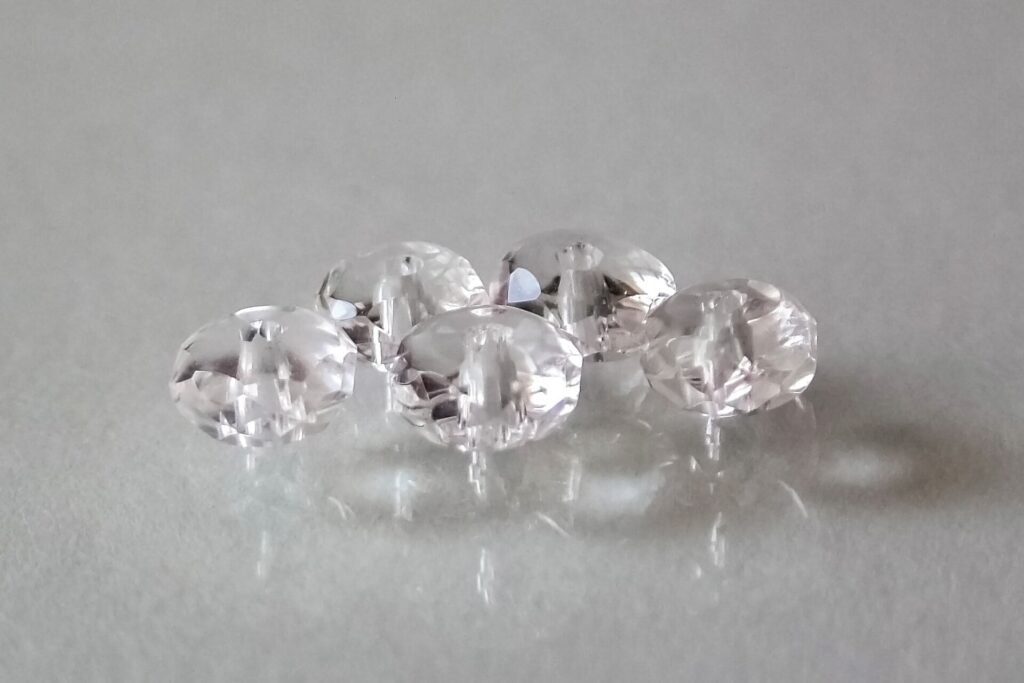
- Sphatik is the traditional Indian name for clear quartz (rock crystal). In Sanskrit texts sphaṭika refers to “a quartz of a superior quality” (Wisdom Library).
- Clear quartz vs glass: quartz is hardness 7, doubly refractive (refractive index 1.544 to 1.553) and has natural inclusions. Glass is singly refractive, usually warms faster in the hand and may show round bubbles or swirls. A laboratory separates them in minutes.
- Lab-grown (synthetic) quartz has the same chemistry as natural quartz. It is often identified by a lack of natural inclusions or by growth features (International Gem Society). Most home tests cannot detect it.
- Milky quartz is quartz made white by “myriad tiny cavities and bubbles filled with CO₂ or water”. It is real quartz, but not clear.
- Selenite is not quartz. It is gypsum: hardness 2, water-soluble and easily scratched. Most silky “selenite” sticks and beads are actually satin spar, the fibrous form of gypsum.
- “Herkimer diamond” is not diamond. It is a trade name for double-terminated clear quartz crystals from Herkimer, New York.
The four materials at a glance
| Clear quartz (sphatik) | Milky quartz | Selenite / satin spar (gypsum) | Glass | |
|---|---|---|---|---|
| What it is | Colourless crystalline quartz | Quartz clouded by fluid and gas inclusions | Calcium sulphate mineral | Man-made, no crystal structure |
| Transparency | Transparent to slightly included | Translucent to opaque white | Selenite transparent; satin spar silky, fibrous | Usually very clear, or evenly frosted |
| Hardness (Mohs) | 7 | 7 | 2 (scratches with a fingernail) | About 5 to 6 for common glass |
| Refractive index | 1.544–1.553, doubly refractive | Same as quartz | 1.520–1.530 | Single reading; varies with the glass |
| Specific gravity | About 2.65 | About 2.65 | About 2.32 | Varies with the glass |
| Feel | Cool for a few seconds | Cool | Warm, soft, waxy | Warms faster |
| Water | Safe | Safe | Water-soluble: avoid wetting | Safe |
| Under a 10× loupe | Natural inclusions, sometimes none | Dense cloud of tiny inclusions | Parallel fibres (satin spar) | Round bubbles, swirl lines, moulded seams |
Sources: International Gem Society, quartz (refractive index, specific gravity, milky quartz, synthetic quartz, Herkimer) and gypsum (selenite, satin spar, hardness, solubility, refractive index and specific gravity); GIA, amethyst (quartz hardness 7). Glass hardness is approximate and varies by composition.
Clear quartz vs glass: the main question for sphatik buyers
A clear bead is the easiest thing to imitate, because glass can look identical to quartz at a glance. The checks that help:
- Look for bubbles. Under a 10× loupe, round gas bubbles or swirl lines suggest glass. Natural quartz may show irregular crystals, fluid inclusions or fine fractures, or may be clean.
- Compare the beads. In a natural mala, beads differ slightly in clarity and inclusions. Perfectly identical, flawless beads in a cheap mala suggest glass or lab-grown quartz.
- Check the temperature. Hold a bead to your lip: quartz stays cool for a few seconds; glass warms more quickly. This is a hint, not proof.
- Look at the drill holes and surface. Moulded glass beads can show seams or rounded, soft facet edges.
- Ask for a laboratory report for any mala sold at a quartz price. A refractive-index reading separates quartz from glass immediately.
Doubling. Quartz is doubly refractive, but its birefringence is small (0.009), so looking through a bead for doubled lines rarely works at home. Leave that to a laboratory.
What a laboratory checks
- Refractive index: quartz reads 1.544 to 1.553 with two readings; glass gives one.
- Polariscope and specific gravity: further confirmation.
- Magnification: natural inclusions, or the “breadcrumb” inclusions, seed plates and lack of natural inclusions that the International Gem Society lists for synthetic quartz.
Separating natural from lab-grown quartz is harder than separating quartz from glass. If “natural” matters to you, ask whether the laboratory tested for that, not only for “quartz”.
Milky quartz
Milky quartz is ordinary quartz, made white by countless tiny cavities filled with carbon dioxide or water. It is common and inexpensive. It is not a fake, but it should not be sold as clear sphatik, and it is not the same as moonstone (a feldspar), although “moonstone” is sometimes misused for milky quartz in the trade.
Selenite and satin spar: soft, and damaged by water
Selenite is gypsum, a soft calcium sulphate mineral. The International Gem Society describes gypsum as “both water soluble and very heat sensitive”, with a hardness of 2 that “means it’s very easy to scratch” (IGS, gypsum).
Two names cause confusion:
- Selenite, strictly, means colourless, transparent gypsum crystals.
- Satin spar is the “massive, fibrous variety of gypsum”, with a silky lustre and sometimes a cat’s-eye effect. The white, silky sticks, towers and beads sold as “selenite” are usually satin spar.
Both are gypsum, and both need the same care: keep them dry, away from heat, and away from harder stones that will scratch them. Gypsum is not a practical material for a bracelet or mala worn every day. For which stones tolerate water, see our crystal bracelet care guide.
“Herkimer diamond”
The International Gem Society lists “Herkimer diamond” among quartz misnomers: “double terminated, colorless quartz crystals from Herkimer, New York”. They are attractive natural quartz crystals, pointed at both ends, but they are not diamond. Many “Herkimer” crystals sold online come from other places; the name describes a type of crystal more than a guaranteed origin.
Sphatik malas: what to check
Sphatik malas are traditionally used for japa (prayer counting), often 108 beads plus a guru bead. If you are buying one:
| Check | Why |
|---|---|
| Material named as quartz | “Crystal” alone can mean glass, as in “crystal glass” |
| Natural vs lab-grown stated | Lab-grown quartz is real quartz but should be disclosed |
| Bead size and count | 108 + 1 is common; size affects weight and comfort |
| Faceted or round | Glass is easily faceted, so facets do not prove quartz |
| Stringing | Knotted silk or cotton, or wire; check the knotting if the beads are heavy |
| Report | For a mala sold as natural, a report naming the material, and ideally covering the strand |
Our guide to custom japa mala configurations covers bead counts, sizes and stringing in more detail.
Rudraksha or sphatik? Both are traditional mala materials with different associations in Hindu practice. They are physically very different: rudraksha is a seed with natural grooves; sphatik is a mineral. Neither choice changes how you should check authenticity. For rudraksha, see our rudraksha buying guide.
Price: what is reasonable
Clear quartz is one of the most common minerals, so plain round quartz beads are not expensive. Prices rise with clarity (water-clear beads with few inclusions), size, faceting and craftsmanship, and with a laboratory report. A very low price for a large, flawless, faceted “sphatik” mala is the clearest warning sign of glass.
Care
- Quartz is durable (hardness 7). Clean with warm soapy water and dry the string at once. Avoid soaking knotted malas, because the thread weakens.
- Selenite and satin spar must stay dry. Dust with a soft, dry brush.
- Store separately: quartz will scratch selenite, pearls and other soft materials.
FAQ
How can I tell if my sphatik mala is real quartz or glass?
Look for round bubbles or swirl lines under a 10× loupe (glass), compare beads for natural variation, and note whether beads stay cool in the hand. For certainty, a laboratory reads the refractive index (1.544–1.553 for quartz).
What is the difference between clear quartz and milky quartz?
Both are quartz. Milky quartz is white because of countless tiny fluid and gas inclusions; clear quartz is transparent.
Is selenite the same as clear quartz?
No. Selenite is gypsum: much softer (hardness 2), water-soluble and easily scratched. Quartz is hardness 7 and water-safe.
Can selenite get wet?
It should not. Gypsum is water-soluble, so water dulls and damages it over time. Keep selenite and satin spar dry.
Is a Herkimer diamond a real diamond?
No. It is a trade name for double-terminated clear quartz crystals, originally from Herkimer, New York.
Is lab-grown quartz fake?
It is real quartz made in a laboratory, with the same chemistry. It is not fake if it is disclosed, but it should not be sold as natural.
Sources
- International Gem Society: Quartz value, price and jewellery information (rock crystal, milky quartz inclusions, synthetic quartz identification, “Herkimer diamond”, refractive index and specific gravity) and Gypsum (selenite, satin spar, alabaster, hardness 2, water-soluble, optics), checked 11 October 2026.
- GIA: Amethyst (quartz hardness and specific gravity), checked 11 October 2026.
- Wisdom Library: Sphatika (Sanskrit usage, including “a quartz of a superior quality”), checked 11 October 2026.
Related reading
- How to tell if a crystal bracelet is real: 9 checks, dyes and trade names
- 25 crystal bracelet stones: mineral identity and traditional meanings
- How to care for a crystal bead bracelet: cleaning, water, storage and restringing
- Custom japa mala configurations: 27, 54 or 108 beads, bead size, length, knotting and capping