The short answer
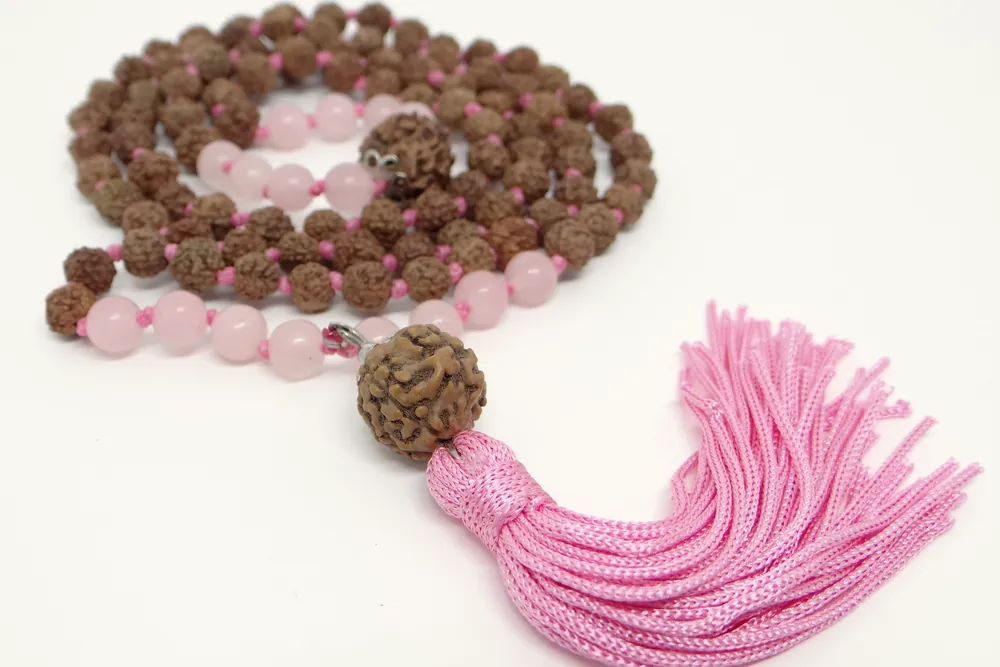
- Count: 108 beads (plus a guru bead) is the full traditional japa mala. 54 is a half mala, counted round twice. 27 is a hand or wrist mala, counted four times.
- Size: 8 mm is light and easy to move one bead at a time. 10 mm is easier to feel but makes a long, heavy strand: a 108-bead mala of 10 mm stone beads is over a metre of beads and weighs about 150 g.
- Construction: knotting protects beads and keeps them if the thread breaks. Capping looks finished but is stiffer and heavier, and wire-linked malas cannot be knotted.
Decide how you will use it first: counting in the hand, wearing, or both.
Bead count: 27, 54 or 108
| Count | Rounds to reach 108 | Typical use | Notes |
|---|---|---|---|
| 108 + guru | 1 | Full japa practice | The standard. The guru bead is not counted |
| 54 + guru | 2 | Lighter practice mala; wearable as a long necklace | Half the weight of a 108 |
| 27 + guru | 4 | Wrist or pocket mala | Often worn as a bracelet |
The Devi Bhagavata Purana mentions 108 beads and also other counts for wearing on different parts of the body (trans. Vijnanananda). 108 is the japa standard, but not the only traditional number. Our mala vs kantha vs bracelet guide covers these forms.
Bead size, length and weight: worked figures
Length is roughly count × bead diameter. Knotting adds about 10–15%; one builder we reviewed states this range. A mala hangs as a loop, so its hanging length is about half its circumference.
| Configuration | Beads end to end | With knots (+10–15%) | Hangs about | Weight (quartz-family beads) |
|---|---|---|---|---|
| 27 × 8 mm | 22 cm | 24–25 cm | wrist | about 19 g |
| 54 × 8 mm | 43 cm | 48–50 cm | 24 cm | about 38 g |
| 108 × 6 mm | 65 cm | 71–75 cm | 36 cm | about 32 g |
| 108 × 8 mm | 86 cm | 95–99 cm | 48 cm | about 77 g |
| 27 × 10 mm | 27 cm | 30–31 cm | wrist (large) | about 38 g |
| 108 × 10 mm | 108 cm | 119–124 cm | 60 cm | about 150 g |
Our calculations: bead length = count × diameter. Weight = count × sphere volume × 2.65 (the specific gravity of quartz), excluding the guru bead, tassel and fittings. Real beads vary by about ±0.5 mm. Denser stones such as hematite or pyrite weigh about twice as much; rudraksha weighs much less.
What this means in practice:
- A 108 × 8 mm mala wraps about twice round the wrist, or hangs to mid-chest. It is a common all-round choice.
- A 108 × 10 mm mala in stone is heavy for long sessions and very long to wear.
- 27 × 8 mm fits most wrists as a bracelet. Check it against your wrist size with our bracelet size chart.
Construction options
| Option | How it is made | Pros | Cons |
|---|---|---|---|
| Knotted thread | A knot between every bead | Traditional; beads don’t rub; a break loses one bead | Longer strand; thread wears and needs restringing |
| Unknotted thread | Beads flush on cord | Shorter, sleeker | A break scatters the beads |
| German silver capping | Each bead capped and linked on alloy wire | Finished look; cheap | No silver content (copper-nickel-zinc); nickel can irritate skin |
| 925 silver capping | Each bead capped and linked in sterling silver | Durable, valuable | Much higher cost; heavier; cannot be knotted |
Our silver capping guide covers costs, metals and care.
Stones, mixing and the guru bead
- Single stone or mixed: many makers let you share the counting beads between several stones. Patterns run from equal groups to alternating, or a highlight next to the guru bead.
- Premium beads: precious beads such as ruby, emerald and yellow sapphire usually replace counting beads one for one and are priced per bead. Check the bead count stays the same.
- Rudraksha in a gemstone mala: rudraksha are natural seeds sold in size ranges. Choose sizes close to your gemstone bead size, or the strand looks uneven.
- The guru bead (sumeru) marks the start and end of a round and is not counted.
A worked example from a builder
GemKrishna’s Jaap Mala builder shows how these choices are priced. On 10 October 2026 it listed:
- 8 mm, thread: ₹1,099 (27), ₹2,099 (54), ₹4,099 (108);
- 8 mm, 925 silver capping: ₹8,999, ₹17,999, ₹35,999;
- 10 mm, thread: ₹1,399, ₹2,599, ₹5,099.
It includes up to 12 stones, and states that a GJSPC laboratory report is included. Premium beads and rudraksha are charged per bead, and rudraksha with capping is quoted on request.
Our Custom GemKrishna Builders guide walks through every step. Other makers price differently; compare the same configuration.
Questions to ask any maker
- What is the finished length, including knots and the guru bead?
- What is the weight?
- Are the beads natural, dyed or synthetic, and is there a report? Can I check its number? See buying a rudraksha or japa mala online for the documents to insist on.
- Is it knotted, and what thread or wire is used?
- For capping: is it 925 or German silver, and how much silver?
- What happens if a bead breaks or the strand needs restringing?
FAQ
Why does a japa mala have 108 beads?
108 is the traditional number of repetitions in one round of japa. Shorter malas of 54 and 27 are counted round two or four times.
Is 8 mm or 10 mm better for japa?
8 mm is the common choice, being lighter and easier to move one bead at a time. 10 mm beads are easier to feel, but a 108-bead strand becomes long and heavy.
Is the guru bead counted?
No. It marks the start and end of a round.
Can a capped mala be knotted?
Not usually. Wire-linked capped malas join bead to bead with wire, so there is no thread to knot.
How do I care for a mala?
Keep it dry, wipe it after use, and restring a knotted mala when the thread frays. See our rudraksha cleaning guide.
Sources
- Devi Bhagavata Purana, Book 11, chapter 7, trans. Swami Vijnanananda, sacred-texts.com, checked 10 October 2026.
- GemKrishna, Custom Jaap Mala Builder (options, store prices and knotting note, seller statements), checked 10 October 2026.
- Quartz, Wikipedia (specific gravity used in the weight calculations), checked 10 October 2026.