The short answer
These are three different objects.
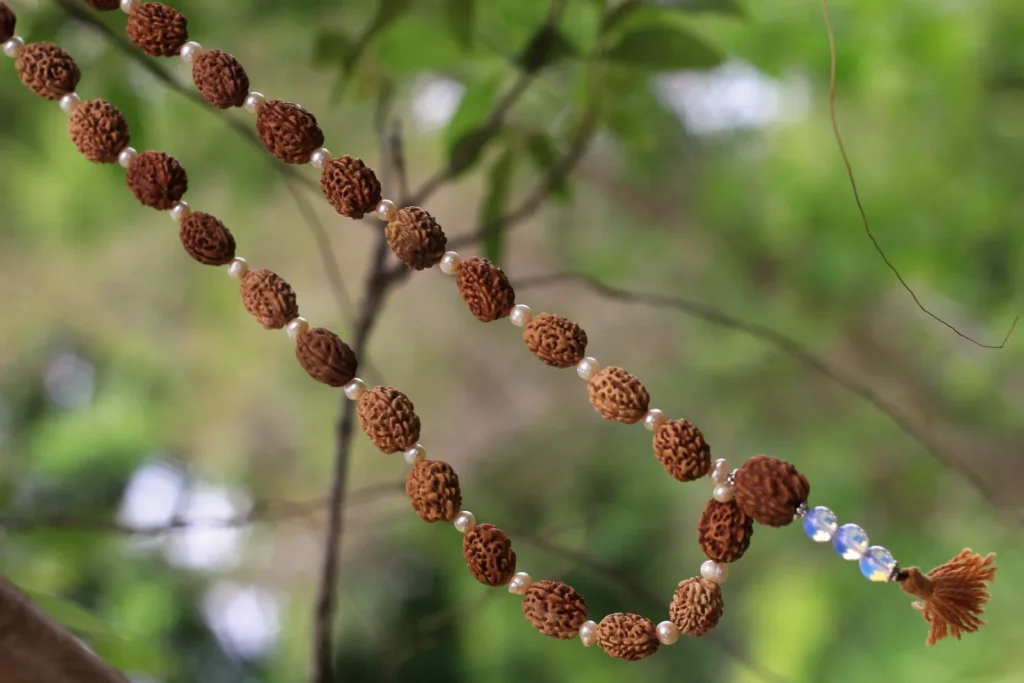
- A japa mala is a counting strand, traditionally 108 beads plus one guru bead, of small, even beads, held in the hand during repetition.
- A kantha is a necklace worn at the throat or chest, usually with fewer, larger beads, often selected for particular face counts and sometimes capped in silver.
- A bracelet is a wrist strand of about 15–25 beads, sized to the wrist.
Choose by how you will use it. If you will count, buy a mala. If you will wear it, buy a kantha or bracelet. Then judge it on bead size, weight, stringing and documentation, not on promised results.
All three forms use natural rudraksha beads. If you are new to the beads themselves, read our rudraksha buying guide first. This article is about the design of the strand.
Three forms, three jobs
| Japa mala | Kantha | Bracelet | |
|---|---|---|---|
| Main purpose | Counting repetitions (japa) | Wearing at the neck | Wearing at the wrist |
| Usual bead count | 108 + 1 guru bead; 54 + 1 or 27 + 1 for shorter forms | Varies: a few large beads to a full strand; combination kanthas of 16–23 main beads | About 15–25, set by wrist size and bead diameter |
| Usual bead size | Small and even, about 5–8 mm | Larger, often 10 mm and up for main beads | About 8–14 mm |
| Construction | Knotted between beads on thread | Thread or wire, often with silver caps; a back chain of smaller beads | Elastic, braided thread, steel-core cord or knotted thread; sometimes a clasp |
| Handling | Moved bead by bead through the fingers | Rarely handled | Constant wrist contact and knocks |
| Main wear point | Thread at the knots | Caps and the back chain | Elastic or cord, and caps |
Bead counts and the guru bead
The 108-bead mala is the most familiar form, with one larger guru bead (also called sumeru or meru) where the two ends meet. In common practice:
- The guru bead is not counted. A round of japa is 108 beads.
- 54 + 1 and 27 + 1 strands are halves and quarters of 108. They are lighter and easier to carry, and are counted round two or four times.
- Many teachers say not to cross the guru bead at the end of a round, and to turn the mala back instead. This is a convention of practice, and teachers differ.
Older texts list several counts for different uses. The Devi Bhagavata Purana (Book 11, ch. 7) mentions 108 beads worn in place of the sacred thread, a rosary of 50 beads worn suspended to the belly, and smaller numbers for the neck, arms and wrists (trans. Vijnanananda). The Rudrakshajabala Upanishad likewise gives counts by part of the body (summary). So 108 is the standard for japa, but it is not the only traditional number, and it is not compulsory for wearing. For worked lengths and weights of 27-, 54- and 108-bead malas, see our guide to custom japa mala configurations.
What a kantha is
“Kantha” means throat, and a rudraksha kantha is a necklace. Three styles are common:
- A single large bead or a few beads, usually on thread or a chain, sometimes capped in silver.
- A combination kantha, with one bead of each face count in a set: for example a Siddha kantha of 1–14 mukhi with Ganesh and Gauri Shankar beads (16 main beads), or an Indra kantha of 1–21 mukhi with the same two (23 main beads).
- A full strand of larger beads, for example 32 or 36, worn as a necklace rather than for counting.
The main beads usually sit at the front. The back is completed with smaller, cheaper beads (the back chain) or a cord, so that the expensive beads are not wasted where they are not seen. Our guide to how a custom rudraksha kantha is built covers Siddh and Indra layouts, back chains and construction in detail.
Bead size, weight and comfort
Bead size drives both comfort and price. Weight rises roughly with the cube of the diameter: a 10 mm bead has about 4.6 times the volume of a 6 mm bead, and a 12 mm bead about 8 times. This is simple geometry, and it explains why a 108-bead mala of large beads is heavy in the hand.
| Use | Comfortable bead size (typical) | Why |
|---|---|---|
| Daily japa, 108 + 1 | About 5–8 mm | Light; beads pass easily between thumb and finger |
| Japa mala worn as a necklace | About 6–8 mm | Moderate weight on the neck all day |
| Bracelet for daily wear | About 8–12 mm | Visible without being bulky; lighter on the wrist |
| Statement bracelet | About 12–14 mm | Bold, but heavier and more likely to knock |
| Kantha main beads | About 10–25 mm | Single beads chosen for face count; size varies by mukhi |
Ranges are typical, not rules. Higher-mukhi beads are usually larger, so a combination kantha is naturally graduated.
How to size a bracelet
Measure your wrist snugly with a soft tape, or with a strip of paper marked and then measured against a ruler, just above the wrist bone. Then add comfort.
- Wrist (snug): for example 16.0 cm.
- Comfort allowance: add about 1–1.5 cm for a comfortable fit. Larger beads need more allowance, because they take up space on the inside of the circle. A useful working figure is about one bead diameter.
- Target inner length: 16.0 + 1.0 = about 17 cm (170 mm).
- Number of beads: inner length ÷ bead diameter. With 10 mm beads: 170 ÷ 10 = 17 beads. With 8 mm beads: 170 ÷ 8 ≈ 21 beads.
- Adjust for parts that are not beads. A guru bead, caps, spacers or a clasp take up length, so remove beads to compensate.
This is an approximation. Every natural bead is slightly different, so the maker should string and measure the finished piece. Some builders build in the comfort allowance. GemKrishna’s crystal bracelet builder, for instance, asks for the wrist measured “skin to skin” and states that it adds one bead for comfort. Its rudraksha bracelet builder states that a wrongly sized bracelet is remade free, with the customer paying only shipping (builder; seller states, checked 9 October 2026).
Stringing: thread, wire, elastic and knots
| Construction | Good for | Watch for |
|---|---|---|
| Knotted thread (a knot between each bead) | Japa malas; traditional kanthas | Knots stop beads rubbing and keep them in place if the thread breaks. Thread darkens and frays with handling and needs restringing |
| Braided or coated thread | Bracelets and malas that are worn | Stronger than plain cotton; check for fraying at the clasp or guru bead |
| Wire (often with silver caps) | Formal kanthas with capped beads | Holds shape; can kink; caps and joins must be well finished |
| Elastic | Slip-on bracelets | Convenient, but elastic loses stretch over time. Roll it on rather than pulling it |
| Steel-core cord with a clasp or magnetic lock | Bracelets for daily wear | Durable; check the quality of the clasp and that the cord does not show between beads |
Caps. Silver caps protect bead ends and give a finished look. Check what the metal is. “German silver” contains no silver, and “925” means sterling silver, which is 92.5% silver. A good listing states which it is.
Example: what a custom builder lets you specify
Custom builders make design choices explicit, which helps you compare. GemKrishna’s builders state the following (checked 9 October 2026):
- Rudraksha bracelet: main beads chosen by origin (Indonesia, Nepal or India) and face count; free 3–7 mukhi base beads at 8, 10 or 12 mm; stringing on GemSnap steel core, strong braided thread or knotted thread; elastic, a GemSnap magnetic lock or a 925 silver S-kunda clasp; German silver or 925 silver capping.
- Kantha: Siddh or Indra layouts; a length of 18–36 inches; up to two kinds of back-chain bead at 8, 10 or 12 mm, or plain thread; thread with a 1 mukhi basket, 925 silver capping on thread or on wire, or all-silver construction.
- Jaap mala: 27, 54 or 108 counting beads plus a sumeru bead, at 8 or 10 mm; knotting, a guru bead and tassel, and thread colour.
Another seller, RudraKailash, offers a mala builder with silver or metal capping and states that custom malas are dispatched in 3–5 business days (RudraKailash). Whichever seller you use, ask for the finished length and weight, and a photograph of the actual piece before dispatch.
Cleaning, care and restringing
Rudraksha is a natural, porous seed, and the stringing wears faster than the beads.
- Keep it dry. Take bracelets and kanthas off for bathing and swimming. Water weakens thread and elastic, and repeated wetting can loosen caps.
- Brush, don’t soak. Remove dust from the grooves with a soft, dry brush, such as a clean toothbrush.
- Oiling is a common traditional practice to keep beads from drying out. If you do it, use a little, wipe off the excess, and keep oil away from silver caps and thread.
- Avoid perfume, soap, sanitiser and chemical cleaners on the beads and the cord.
- Inspect every few months: look for fraying at the knots and the guru bead, slack elastic, gaps between beads, and loose caps.
- Restring when the thread is thin, frayed or darkened, or when elastic no longer returns. Ask the restringer to keep the same bead order, especially for a combination kantha.
Quality-control checklist before you pay
- The listing states bead count, bead diameter (mm), total length and weight.
- For a mala: 108 + 1 (or 54 + 1 or 27 + 1), with the guru bead stated, and knots between beads if you want them.
- For a kantha: each main bead’s mukhi and size, the back-chain material, and the capping metal (925 silver or German silver).
- For a bracelet: your wrist measurement, the comfort allowance, the stringing and the clasp.
- Reports for any valuable bead, with numbers that look up on the laboratory’s own website. See our laboratory comparison.
- Photographs of the finished piece, not a catalogue image.
- Return terms: custom-made strands are often excluded from a full refund.
Choosing by practice and budget
| If you… | Choose | Budget note |
|---|---|---|
| Do daily japa | A 108 + 1 mala of small 5 mukhi beads (5–8 mm) | Usually the most affordable rudraksha strand |
| Want a short travel mala | 54 + 1 or 27 + 1 | Fewer beads, lower cost |
| Want to wear rudraksha every day without handling it | A bracelet sized to your wrist | Base beads are inexpensive; main beads drive the cost |
| Want specific face counts together | A combination kantha | The highest cost; budget for a report on each valuable bead |
| Want a single significant bead | A pendant or single-bead kantha | The cost is mostly the bead; capping and chain are extra |
FAQ
Is 108 beads compulsory?
For a standard japa round, 108 + 1 is the common convention. Shorter malas of 54 + 1 and 27 + 1 are counted round two or four times. Older texts also list other numbers for wearing on different parts of the body, so 108 is a convention of practice rather than a rule for every use.
Can a japa mala be worn as jewellery?
Yes. Many people wear their mala, and nothing in common practice forbids it. Some traditions prefer to keep a personal japa mala for practice only. Practically, wearing it all day ages the thread faster, and a heavy mala of large beads becomes uncomfortable.
How do I choose a bracelet size?
Measure your wrist snugly and add about 1–1.5 cm, or roughly one bead diameter. Then divide the result in millimetres by the bead diameter to estimate the bead count: about 17 beads of 10 mm for a 16 cm wrist. Caps, spacers and clasps take up length, so the final count is set by the maker.
Does the guru bead count among the 108?
No. In common practice the guru (sumeru) bead is extra. A japa round counts the 108 beads, and the guru bead marks the start and end.
What is a kantha?
A rudraksha necklace worn at the throat or chest. It can be a single bead, a few large beads, a full strand of larger beads, or a combination of different face counts, such as a Siddha or Indra kantha. It often has silver caps and a back chain of smaller beads.
Should a mala be knotted?
Knotting between beads is traditional for japa malas. It spaces the beads for counting, stops them rubbing, and means that if the thread breaks you lose one bead rather than all of them. Unknotted strands are common for bracelets.
How often should a rudraksha strand be restrung?
There is no fixed interval; it depends on handling, sweat and water. Inspect it every few months and restring when the thread is frayed or thin, the elastic stays slack, or gaps appear between beads.
Sources
- Srimad Devi Bhagavatam, Book 11, chapter 7, trans. Swami Vijnanananda: sacred-texts.com.
- Rudrakshajabala Upanishad: summary and cited translations.
- GemKrishna (seller): rudraksha bracelet builder, kantha builder, jaap mala builder and crystal bracelet builder, checked 9 October 2026.
- RudraKailash (seller): homepage and mala builder, checked 9 October 2026.
Next steps
Compare the tools in our builder guide, learn to spot a fake rudraksha, or read the rudraksha buying guide.