The short answer
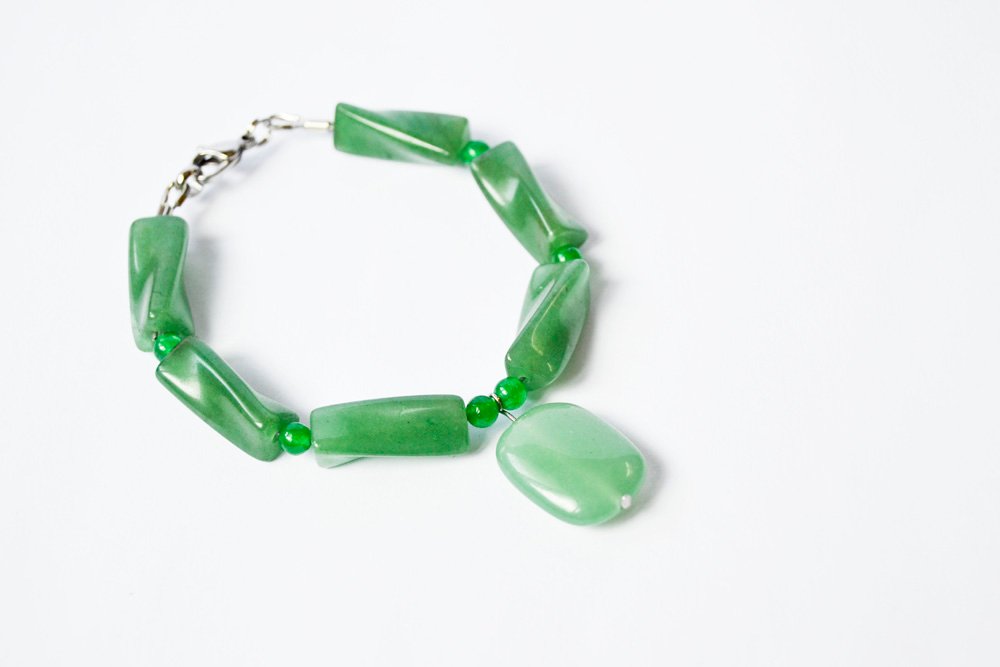
- Green aventurine is quartzite (tightly packed quartz grains) containing tiny green, chrome-rich mica crystals called fuchsite, which give it a fine sparkle (“aventurescence”). It is common and inexpensive. The trade name “Indian jade” usually means green aventurine (International Gem Society).
- Jade means two different minerals: jadeite and nephrite. Both are dense, very tough aggregates (GIA).
- Emerald (panna) is green beryl, usually transparent to translucent and almost always included and clarity-enhanced.
- Look-alikes include serpentine (sometimes sold under “jade” names), dyed quartz and chalcedony (“green onyx”), and glass.
- A laboratory separates them easily by refractive index and specific gravity. At home, sparkle points to aventurine, transparency and inclusions to emerald, and a smooth, dense, waxy-to-glassy look to jade.
The materials compared
| Green aventurine | Jadeite jade | Nephrite jade | Emerald (panna) | Serpentine | |
|---|---|---|---|---|---|
| What it is | Quartzite with fuchsite mica | Pyroxene aggregate | Amphibole aggregate | Beryl crystal | Serpentine-group mineral |
| Typical look | Opaque to translucent green with tiny glittering flecks | Translucent to opaque; even to mottled green and other colours | Usually opaque; spinach to dark green | Transparent to translucent vivid green, with inclusions | Waxy, often yellowish green, can look like jade |
| Refractive index | About 1.54–1.55 (quartz) | 1.666–1.680 | 1.606–1.632 | 1.577–1.583 | Varies (1.57 in one IGS example) |
| Specific gravity | 2.64–2.69 | 3.34 | 2.95 | 2.72 | Varies (2.69 in one IGS example) |
| Mohs hardness | About 7 | 6.5–7 | 6–6.5 | 7.5–8 | Low (most varieties); up to about 6 for bowenite |
| Toughness | Good | Exceptional | Exceptional | Fair to good | Low |
| Treatments to ask about | Dyeing | Jade (either kind) may be dyed, bleached and impregnated, coated or heated (GIA) | As jadeite | Oil or resin clarity enhancement | Dyeing |
| Typical price level | Low | Low to extremely high | Low to high | High for good stones | Low |
Sources: GIA, jade and jade care; GIA, emerald and emerald care; International Gem Society, quartz (aventurine; “Indian jade”; density) and serpentine. Serpentine figures vary between varieties; the IGS example “Styrian jade” (actually serpentine) has RI 1.57 and SG 2.69.
Green aventurine
The International Gem Society describes aventurine as quartzite that “contains small crystals that reflect light”, usually “green, chrome-rich mica called fuchsite”, with a density of about 2.64–2.69; India is one of its listed sources. Under a light, tilt a bead and look for tiny, flat, glittering flecks: that sparkle is the clearest home sign of aventurine.
Aventurine is a genuine natural stone. The issue arises only when it is sold under another name: “Indian jade” is a long-standing misnomer, and aventurine is sometimes offered as a cheap “emerald” or “panna” alternative without saying so.
Jade: two minerals, one name
GIA explains that “jadeite and nephrite have long been considered the materials that may be referred to as jade”, and that both are “metamorphic rocks made up of tiny interlocking mineral crystals” (GIA, jade description). That interlocking structure is why GIA describes both as having “exceptional toughness”: they resist breaking even when thin.
- Jadeite is denser (SG 3.34) and is the material of the most valuable “imperial” green jade.
- Nephrite (SG 2.95) is common in carvings and bangles.
Treatments. GIA notes that “jade might be treated by dyeing, bleaching and impregnation, coatings, or heat treatment” (GIA, jade care). In the trade, untreated jadeite is often called “Type A”, bleached and polymer-impregnated jadeite “Type B”, and dyed jadeite “Type C”. Only a laboratory can reliably tell them apart, and the price difference is large.
“Jade” that is not jade. Many green stones are sold with “jade” in the name, including serpentine, aventurine (“Indian jade”), dyed quartzite and glass. IGS gives the example of “Styrian jade”, which is actually an aluminous serpentine with hardness 2.5. Our guide to whether a crystal bracelet is real lists more trade names.
Emerald (panna)
Emerald is the green to bluish-green variety of beryl (refractive index 1.577–1.583, specific gravity 2.72, hardness 7.5–8). It is usually included and almost always clarity-enhanced with oil or resin; GIA rates its toughness only “fair to good” (GIA, emerald care). See our guide to ruby, emerald and sapphire treatments.
Emerald beads in bracelets are usually lower-grade, heavily included material. That is legitimate if described honestly; a bright, clean, transparent “emerald” bead at a low price is more likely glass, dyed quartz or another green stone.
How to tell them apart at home
| Check | Aventurine | Jade | Emerald | Glass or dyed stone |
|---|---|---|---|---|
| Tilt under a light | Fine glittering flecks | No glitter; smooth, even lustre | Transparency; internal inclusions | Glass: bubbles or swirls. Dyed stone: colour in cracks |
| Translucency | Usually opaque to slightly translucent | Translucent to opaque | Transparent to translucent | Often too clear and too even |
| Weight for size | Like quartz | Jadeite feels noticeably heavy | Similar to quartz | Varies |
| Colour pattern | Even green with sparkle | Even or mottled; can be veined | Vivid; often included | Dye collects in cracks and drill holes |
These are clues, not proof. Weight is the most underused clue: jadeite (SG 3.34) is about a quarter denser than aventurine (about 2.66), so two beads of the same size feel different in the hand.
What a laboratory checks
A laboratory measures refractive index and specific gravity, which separate all five materials in the table above. It also uses magnification and spectroscopy to detect dye, polymer impregnation in jadeite, and clarity enhancement in emerald. For any jade or emerald piece sold at a meaningful price, a report from a recognised laboratory, verified online, is the only reliable confirmation.
Value at a glance
- Green aventurine: low cost; pay for good colour, even sparkle and good polish, not for a “jade” name.
- Nephrite: modest to high, depending on colour, translucency and carving.
- Jadeite: the widest range of any stone here, from inexpensive to extremely valuable; treatment status matters as much as colour.
- Emerald: high for good colour and clarity; value depends heavily on the degree of clarity enhancement.
Buying checklist
- The stone named precisely: green aventurine, nephrite, jadeite, emerald, serpentine
- Any dye, bleaching, impregnation or clarity enhancement disclosed
- For jade or emerald at a meaningful price, a laboratory report that names the material and treatment
- Weight and size stated, so you can compare like with like
- No reliance on names such as “Indian jade”, “new jade” or “jade stone” alone
FAQ
What is the difference between green aventurine and jade?
Aventurine is quartzite with sparkling fuchsite mica; jade is jadeite or nephrite, a dense, very tough interlocking aggregate. Aventurine sparkles when tilted; jade does not. A laboratory confirms by refractive index and density.
Is “Indian jade” real jade?
No. “Indian jade” is a trade name usually used for green aventurine, which is a natural quartz-family stone but not jade.
Is green aventurine a substitute for emerald (panna)?
Some sellers offer it as one. It is a different and much less expensive stone. If you want emerald, buy emerald with a report; if you choose aventurine, buy it under its own name.
How can I test whether jade is real?
At home, look for a smooth, even lustre without glitter and notice the weight (jadeite is dense). Reliable confirmation, including whether jadeite is bleached and impregnated, needs a laboratory.
What is green onyx?
In the bead trade, “green onyx” is usually chalcedony (a fine-grained quartz) coloured green. IGS notes that onyx found in stores “is almost always dyed”. Ask whether it is dyed.
Sources
- GIA: Jade (refractive index, specific gravity, hardness), Jade description (jadeite and nephrite) and Jade care and cleaning (treatments; toughness), checked 11 October 2026.
- GIA: Emerald (data) and Emerald care and cleaning (toughness; fillers), checked 11 October 2026.
- International Gem Society: Quartz (aventurine, fuchsite, density, “Indian jade”), Serpentine (low hardness; “Styrian jade”) and Chalcedony (onyx usually dyed), checked 11 October 2026.