The short answer
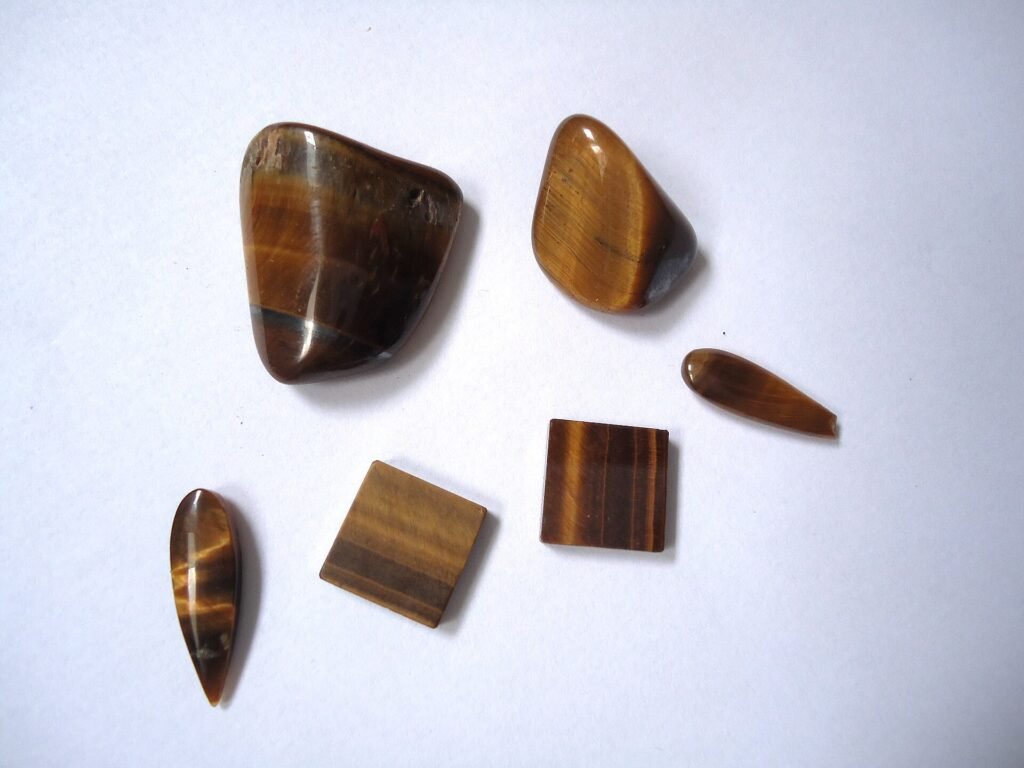
- Tiger’s eye is quartz with a silky, moving band of light (chatoyancy). GIA explains that fibres of the mineral crocidolite were “encapsulated by quartz”, and that iron oxides trapped by the quartz “imparted a golden color” (GIA).
- Real tiger’s eye is common and inexpensive. It does not need to be faked often; the usual problems are dyed colours and glass with a similar shimmer.
- Red tiger’s eye is often heat-treated golden tiger’s eye; Geology.com notes that the red colour of a typical example “was probably produced with heat treatment” (Geology.com). Blue material (“hawk’s eye”) occurs naturally, but bright unnatural colours are dyed.
- Tiger’s eye is not cat’s eye (lehsunia). Lehsunia, the Navratna stone for Ketu, is chrysoberyl: harder (8.5), much denser and far more valuable.
- Check: the shimmer should move smoothly across the bead as you turn it, the bands should vary naturally between beads, and the price should match a common quartz.
What causes the shimmer
GIA’s description of a large tiger’s-eye slab from Western Australia explains the structure: fractures in an iron-rich rock “became infilled with the fibrous mineral crocidolite. As the fibers were crystallizing, they were encapsulated by quartz. Iron oxides were also trapped by the quartz and imparted a golden color. Like the sheen seen in silk, light reflecting off the golden quartz fibers produces a chatoyancy known as tiger’s-eye” (GIA, tiger’s-eye quartz).
Geologists still debate exactly how the fibrous texture forms, but the practical point is clear: the light follows parallel fibres, so a well-cut bead shows bands of light that roll as you turn it.
Because it is quartz, tiger’s eye has a hardness of about 7 and a specific gravity close to quartz, and it is durable for daily wear.
The colours you will see
| Colour | What it usually is | What to ask |
|---|---|---|
| Golden brown | Natural tiger’s eye | The standard material |
| Red, “red tiger’s eye” | Often heat-treated golden tiger’s eye | Ask whether it is heated; this is a stable, widely used treatment |
| Blue-grey, “hawk’s eye” | Sold as a natural colour variety | Muted blue-grey is typical; bright blue suggests dye |
| Bright blue, pink, green or purple | Dyed tiger’s eye | Ask whether it is dyed; dye can fade or bleed |
| “Pietersite” | A related, brecciated chatoyant material with swirling patterns | A different trade material, usually priced higher |
Real, dyed or glass?
| Check | Natural tiger’s eye | Dyed tiger’s eye | Glass imitation (“cat’s eye glass”, “fibre optic glass”) |
|---|---|---|---|
| Shimmer | Silky bands that move smoothly; vary from bead to bead | Same as natural; colour unusual | Often a very regular, intense line or grid of light |
| Colour | Golden to brown, red if heated, muted blue-grey | Bright, unnatural tones; colour concentrated in cracks and drill holes | Any colour, very even |
| Under a 10× loupe | Fibrous texture | Dye along fractures | Hexagonal or honeycomb pattern on the side; bubbles |
| Beads in a strand | Vary in banding | Vary | Often identical |
| Price | Low | Low | Low |
Fibre-optic “cat’s eye glass” is made from fused glass fibres and can show a strong, regular eye. Under magnification, its side can show a regular honeycomb-like pattern of fibres that natural tiger’s eye does not. If a bead looks too perfect, compare several beads in the strand and look at the side. Our guide to whether a crystal bracelet is real explains the general checks for glass and dye.
Tiger’s eye vs cat’s eye (lehsunia)
The words “cat’s eye” describe an optical effect that several stones can show. In the Indian gemstone trade, lehsunia usually means chrysoberyl cat’s eye, the Navratna stone associated with Ketu (see our Navratna guide).
| Tiger’s eye | Chrysoberyl cat’s eye (lehsunia) | |
|---|---|---|
| Mineral | Quartz | Chrysoberyl |
| Mohs hardness | About 7 | 8.5 |
| Refractive index | About 1.54–1.55 | 1.746–1.755 |
| Specific gravity | About 2.65 | 3.73 |
| Look | Broad, silky golden bands | A single sharp, narrow line of light over a honey to greenish body |
| Typical use | Beads, cabochons, carvings | Cabochons, set singly |
| Value | Low | Moderate to very high |
Source: chrysoberyl data from GIA, alexandrite (alexandrite is a variety of chrysoberyl, with the same mineral data); quartz data from GIA, amethyst.
If a stone is sold as lehsunia or “cat’s eye” at a gemstone price, it should be chrysoberyl, confirmed by a laboratory report. A “cat’s eye” bead in an inexpensive bracelet is more likely tiger’s eye, quartz cat’s eye or glass.
Price: what is reasonable
Tiger’s eye is one of the most common chatoyant materials, so plain tiger’s eye beads should be inexpensive. A bracelet’s price comes mainly from bead size and quality, findings (elastic or a 925 silver lock), labour and any report; see our bracelet price guide. Pay more for strong, even chatoyancy, good polish and matched beads, not for a name.
Care
- Durable for everyday wear (quartz, hardness about 7).
- Clean with warm, soapy water; dry the cord straight away.
- Dyed beads can lose colour with chemicals and long soaking; wipe rather than soak.
- See our crystal bracelet care guide.
FAQ
How can I tell if tiger’s eye is real?
Turn a bead under a light: natural tiger’s eye shows silky golden bands that move smoothly and vary between beads. Very regular, intense lines and a honeycomb pattern on the side suggest fibre-optic glass. Bright unnatural colours suggest dye.
What is the difference between tiger’s eye and cat’s eye?
Tiger’s eye is quartz with broad silky bands. Lehsunia (cat’s eye) in the gem trade is chrysoberyl, which is harder, denser and much more valuable, with a single sharp line of light.
What is red tiger’s eye?
Often golden tiger’s eye that has been heated to turn it red. It is a stable treatment, but it should be disclosed.
Is blue tiger’s eye natural?
Muted blue-grey “hawk’s eye” can be natural. Bright, saturated blues are usually dyed.
Why does tiger’s eye shimmer?
Light reflects off parallel fibres within the quartz, producing chatoyancy, a silky band of light that moves as the stone turns.
Sources
- GIA: Tiger’s-eye quartz exhibit (crocidolite fibres, quartz, iron oxides, chatoyancy), checked 11 October 2026.
- GIA: Alexandrite (chrysoberyl data) and Amethyst (quartz data), checked 11 October 2026.
- Geology.com: Tiger’s-eye (red colour “probably produced with heat treatment”), checked 11 October 2026.
Related reading
- How to tell if a crystal bracelet is real: 9 checks, dyes and trade names
- 25 crystal bracelet stones: mineral identity and traditional meanings
- Navratna gemstones: the nine stones, their traditions and a buying checklist
- Crystal bead bracelets: choosing stones, bead sizes, fit, construction and reports