The short answer
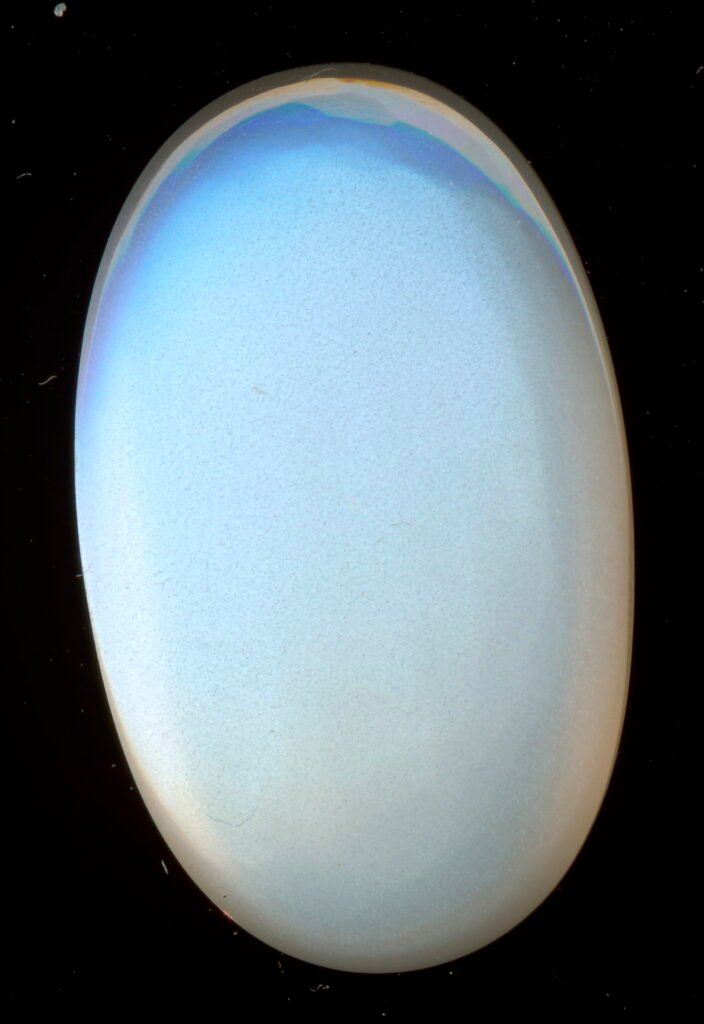
- Moonstone is a feldspar (mainly orthoclase with albite) that shows adularescence: a soft, billowing glow that seems to move across the stone (GIA).
- Rainbow moonstone is, according to GIA, “actually a variety of labradorite rather than orthoclase”: a light-coloured labradorite with a multicoloured glow.
- Labradorite is a different feldspar that shows labradorescence: flashes of blue, green, gold and other colours on a usually grey to dark body.
- Opalite is a trade name for man-made opalescent glass. It is not moonstone or opal.
- All three feldspars are fairly soft (about 6 to 6.5) and can split along cleavage planes, so protect them from knocks.
The four compared
| Moonstone | Rainbow moonstone | Labradorite | Opalite | |
|---|---|---|---|---|
| What it is | Orthoclase–albite feldspar | Light-bodied labradorite feldspar | Plagioclase feldspar | Glass |
| Optical effect | Adularescence: soft white to blue glow that moves | Multicoloured adularescence over a light body | Labradorescence: bright colour flashes | Even milky glow |
| Body colour | Colourless to white, grey, peach, green, brown | Near-colourless to white | Grey to dark grey, sometimes near-black | Translucent milky white |
| Mohs hardness | 6–6.5 | 6–6.5 | 6–6.5 | About 5.5–6 (glass, approximate) |
| Typical features | Natural internal features; fine cracks | As labradorite | Black needle-like inclusions, repeated twinning | Bubbles possible; very even |
| Price level | Low to high (fine blue-sheen stones are valued) | Low to moderate | Low to moderate | Low |
Sources: GIA, moonstone, moonstone description and quality factors; International Gem Society, labradorite (hardness 6–6.5; labradorescence; black needle-like inclusions; repeated twinning). Glass hardness is approximate.
Why moonstone glows
GIA explains that moonstone forms when orthoclase and albite “separate into stacked, alternating layers”. Light falling between these thin layers scatters, producing adularescence: “the light that appears to billow across a gemstone, giving its surface a glowing appearance” (GIA, moonstone description). The most valued moonstones show a blue sheen on a near-colourless body. GIA’s quality factors focus on body colour and the colour and orientation of the sheen (GIA, moonstone quality).
How to see it: tilt a cabochon under a single light source. The glow should float and move across the dome, centred when the stone is well cut.
Rainbow moonstone is a labradorite
GIA states that a labradorite found in Madagascar “has a multicolored adularescence over a light bodycolor” and that it is “known in the trade as rainbow moonstone, despite the fact that it’s actually a variety of labradorite rather than orthoclase” (GIA).
That does not make rainbow moonstone fake. It is a natural feldspar, sold under a long-established trade name. It does mean that “moonstone” and “rainbow moonstone” are different minerals, and that a laboratory report may name rainbow moonstone as labradorite.
Labradorite
Labradorite typically shows a grey to dark body with bright flashes of colour that appear at certain angles: labradorescence. The International Gem Society lists its hardness as 6–6.5 and its identifying features as “labradorescence, repeated twinning, black needle like inclusions” (IGS, labradorite).
Moonstone vs labradorite at a glance: moonstone’s light is a soft glow across a pale stone; labradorite’s is a sharper flash of colour across a dark one.
Opalite is glass
“Opalite” in the bead trade is a man-made opalescent glass with an even, milky glow. Our guide to whether a crystal bracelet is real lists it among common trade names that hide an imitation. Opalite is fine as fashion jewellery sold as glass. It should never be sold as moonstone, opal or a “natural crystal”.
How to spot it: very even, uniform milkiness in every bead; possible round bubbles under a loupe; no natural inclusions; and a low price.
Moonstone vs opal and pearl
- Opal shows play of colour, patches of spectral colour that change with angle, from a quite different structure (ordered silica spheres). Moonstone shows a single-colour glow.
- Pearl is organic, much softer (GIA gives 2.5–3.0), and shows orient and lustre rather than a moving sheen (GIA, pearl).
Both are sometimes linked with moonstone in astrological substitutes for the Moon. Gemmologically they are entirely different materials.
Care
GIA’s moonstone data list a hardness of 6–6.5 (GIA, moonstone), softer than quartz. Feldspars also have cleavage, so a sharp knock can cause a split.
- Use protective settings (bezels) for rings worn daily.
- Clean with warm, soapy water; avoid ultrasonic and steam cleaners for included or cracked stones.
- Store separately from harder stones such as quartz beads.
- For bead bracelets, see our crystal bracelet care guide.
Buying checklist
- The stone named correctly: moonstone, rainbow moonstone (labradorite), labradorite, or glass
- Sheen checked in a video under a single light, not only in a studio photo
- No “opalite” sold as moonstone or opal
- For a valuable blue-sheen moonstone, a laboratory report
- A protective setting for rings
FAQ
What is the difference between moonstone and rainbow moonstone?
Moonstone is an orthoclase–albite feldspar with a white to blue glow. Rainbow moonstone is a light-coloured labradorite with a multicoloured glow. GIA describes rainbow moonstone as “actually a variety of labradorite”.
Is opalite a real gemstone?
No. Opalite is a trade name for man-made opalescent glass. It is not natural moonstone or opal.
Labradorite vs moonstone: which is which?
Moonstone has a soft glow across a pale stone. Labradorite usually has a darker grey body with bright flashes of blue, green or gold at certain angles.
Is rainbow moonstone fake?
No. It is a natural feldspar (labradorite) sold under a trade name. It should not be confused with orthoclase moonstone.
Why does moonstone glow?
Its thin, alternating layers of orthoclase and albite scatter light, producing adularescence, a glow that seems to move across the stone.
Sources
- GIA: Moonstone (data), Moonstone description (adularescence; rainbow moonstone as labradorite) and Moonstone quality factors, checked 11 October 2026.
- International Gem Society: Labradorite (hardness, labradorescence, identifying features), checked 11 October 2026.
- GIA: Pearl (hardness 2.5–3.0), checked 11 October 2026.
Related reading
- How to tell if a crystal bracelet is real: 9 checks, dyes and trade names
- 25 crystal bracelet stones: mineral identity and traditional meanings
- How to care for a crystal bead bracelet: cleaning, water, storage and restringing
- Crystal bead bracelets: choosing stones, bead sizes, fit, construction and reports