The short answer
Updated buyer resources: GemKrishna review · GemKrishna lab-report verification · GemKrishna prices and payment options.
Update, 25 October 2026: The live gemstone bracelet builder lists 8 mm at ₹949 prepaid or ₹999 partial payment, and 10 mm at ₹1,149 prepaid or ₹1,249 partial payment, before paid additions. It supports choosing exact bead counts. Screenshots and other builder walkthroughs below document the earlier interface; recheck their current options and totals before ordering.
GemKrishna, an online seller based in New Delhi, runs four separate design tools and one guided finder:
- Custom Bracelet Builder: a gemstone or mixed gemstone-and-Rudraksha bracelet, sized to your wrist, from ₹999.
- Custom Rudraksha Bracelet Builder: you choose each Rudraksha by mukhi, origin and size, from ₹999 with free base beads.
- Custom Jaap Mala Builder: a 27-, 54- or 108-bead counting mala, from ₹1,099.
- Custom Rudraksha Kantha Builder: a Siddh (16 main beads) or Indra (23 main beads) Rudraksha necklace, with some beads quoted on request.
- Find Your Bracelet: a questionnaire that suggests stones and passes them to the bracelet builder.
GemKrishna states that a GJSPC laboratory report is included with each builder; the builders themselves offer no option to select a different laboratory. This guide sets out what each tool lets you choose, how its sizing and pricing work, what the report covers and where the limits are. It is useful even if you buy elsewhere: the same questions apply to any custom bead jewellery.
How we checked these tools
On 10 October 2026 we went through each builder on gemkrishna.com step by step. We read the options shown on screen, the product data that the pages load, the prices returned by the store for each base product, and each page’s own questions and policies. Screenshots in this guide were captured that day.
What this guide is, and is not:
- Seller statements are labelled as such. Where GemKrishna says something we cannot check from outside, such as that every Rudraksha is X-rayed, we say “GemKrishna states”.
- This guide documents the builders themselves. Its options, prices and policies come from GemKrishna’s live pages, checked on 10 October 2026. It does not report the results of individual orders, which vary.
- Prices change. GemKrishna changed several Rudraksha prices in early October 2026. Treat every price here as correct on 10 October 2026 only, and check the builder’s total before you pay.
- Traditional meanings are traditions. The builders show intentions such as “calm” or “prosperity” next to stones and mukhis. These are traditional and astrological beliefs, not tested effects. GemKrishna’s own pages say the same.
The four builders at a glance
| Gemstone bracelet | Rudraksha bracelet | Jaap Mala | Rudraksha Kantha | |
|---|---|---|---|---|
| What you make | Wrist bracelet | Wrist bracelet | Counting mala | Neck mala (kantha) |
| Starting price | ₹999 (8 mm), ₹1,249 (10 mm) | ₹999 | ₹1,099 (27 beads, 8 mm, thread) | Making from ₹1,999, plus beads |
| Bead sizes | 8 or 10 mm | Base beads 8, 10 or 12 mm; main beads by size range | 8 or 10 mm | Each main bead by size range; back chain 8, 10 or 12 mm |
| Sizing | Wrist 4–9 in | Wrist size | 27, 54 or 108 beads + guru bead | Length 18–36 in, or “no preference” |
| Fastening or build | Elastic, GemSnap magnetic lock, 925 silver clasp | Elastic, GemSnap, 925 silver clasp; thread, knotted, German silver or 925 silver capping | Thread (knotted or not), German silver or 925 silver capping | Thread with basket, silver capping on thread or wire, all-silver |
| Report stated | Free GJSPC report for the bracelet | GJSPC report for every Rudraksha bead | GJSPC report included | GJSPC Siddh or Indra report included |
| Ask-for-price items | A few beads (WhatsApp) | India-origin and some rare beads | Rudraksha with capping | Nepal 16–21 mukhi; some sizes |
| Builder page | Open | Open | Open | Open |
Builder 1: Custom Gemstone Bracelet Builder
What it is: a customisation tool for a stretch or clasped bead bracelet made from natural gemstones, small Rudraksha or both. GemKrishna hand-strings it in New Delhi and sends a photo for approval before dispatch.
Step-by-step walkthrough (9 steps)
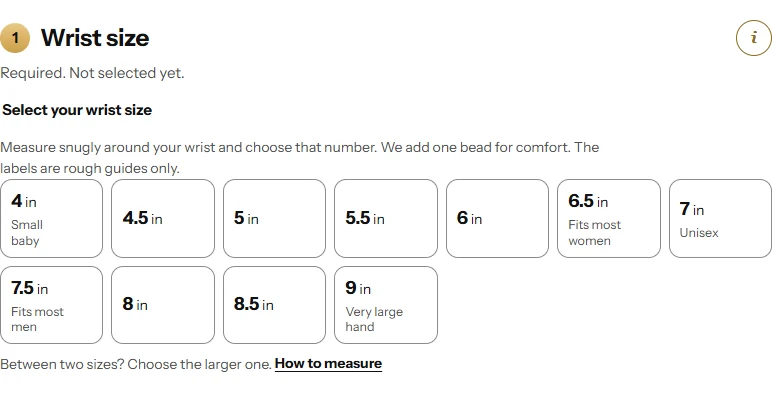
- Wrist size. Choose from 4 to 9 inches in half-inch steps. Nothing is pre-selected. Labels such as “fits most women” (6.5 in) and “fits most men” (7.5 in) are described as rough guides. You enter your snug, skin-to-skin measurement; the builder adds one bead for comfort. A printable A4 wrist ruler is offered.
- Bead size. 8 mm (₹999, “recommended”) or 10 mm (₹1,249, “bolder look”).
- Stones. Pick at least 2 and up to 12 “included” types at no extra cost, from the available included gemstone and small Rudraksha options; the live catalogue changes. Premium beads are added one at a time at a per-bead price and do not count towards the 12 types.
- Lock. Stretchable elastic, a GemSnap magnetic lock or a 925 silver clasp (details below).
- Spacers and charms. Optional, priced on each card.
- Arrangement. Classic equal groups, alternating, centre stone, or “leave it to us”. With 7 or more included stones, or with Flower Agate, GemKrishna’s team arranges the design.
- Engraving. Up to 20 characters on a GemSnap lock, ₹249, adding about 3 business days.
- Free gift. One gift per bracelet; a raw selenite plate if you do not choose, according to the builder checked on 25 October 2026.
- Review and order. A summary of every choice, the report line and the total, with Buy now or Save draft to cart, and an optional 200-character note.
How the bead count is worked out
GemKrishna publishes its formula: wrist inches × 25 ÷ bead size in mm, rounded, plus one bead for comfort. A lock then takes the place of beads: a GemSnap replaces one bead and a 925 silver clasp replaces two.
| Wrist | 8 mm beads, elastic | 8 mm, GemSnap | 10 mm beads, elastic | 10 mm, GemSnap |
|---|---|---|---|---|
| 6 in | 20 | 19 | 16 | 15 |
| 6.5 in | 21 | 20 | 17 | 16 |
| 7 in | 23 | 22 | 19 | 18 |
| 7.5 in | 24 | 23 | 20 | 19 |
| 8 in | 26 | 25 | 21 | 20 |
Our arithmetic, using the same formula and rounding as the builder’s code. Large premium Rudraksha change the count, because the builder uses their real diameter.
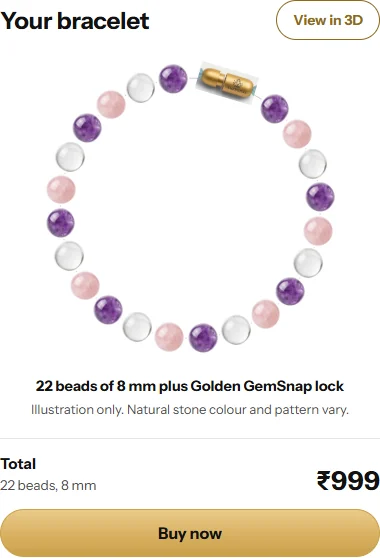
We checked this on the live builder: a 7-inch wrist with 8 mm beads and a GemSnap lock gave 22 beads (7 × 25 ÷ 8 = 21.9, rounded to 22, plus 1 comfort bead, minus 1 for the lock), at ₹999.
Included and premium beads
- Included (no extra charge): available gemstone types, including amethyst, citrine, rose quartz and tiger’s eye, alongside small Rudraksha options. Check the live Included filter rather than assuming the total catalogue is included at the base price. You can mix up to 12 types without changing the price.
- Premium (per bead): yellow sapphire ₹2,500; emerald ₹1,000; blue sapphire, ruby and opal ₹500 each; hessonite and cat’s eye ₹200 each; natural Japanese red coral (8 mm only) ₹7,500; dyed red coral ₹250; cultured South Sea pearl ₹2,500; cultured freshwater pearl ₹300; Irani firoza ₹1,500.
- Premium Rudraksha: Nepal, Indonesia and India beads priced individually. The builder uses each bead’s real size when counting.
Disclosed exceptions. The builder states that its beads are natural unless a card says otherwise, and it labels the exceptions. The Evil Eye bead is decorative, not a gemstone. The “Howlite option” is dyed magnesite. Dyed red coral is dyed. The pearls are cultured. That is more disclosure than many bead sellers give, but a label is still a seller statement: the laboratory report is what documents it.
Elastic, GemSnap or 925 silver?
| Option | What it is | Beads replaced | Price | Engravable |
|---|---|---|---|---|
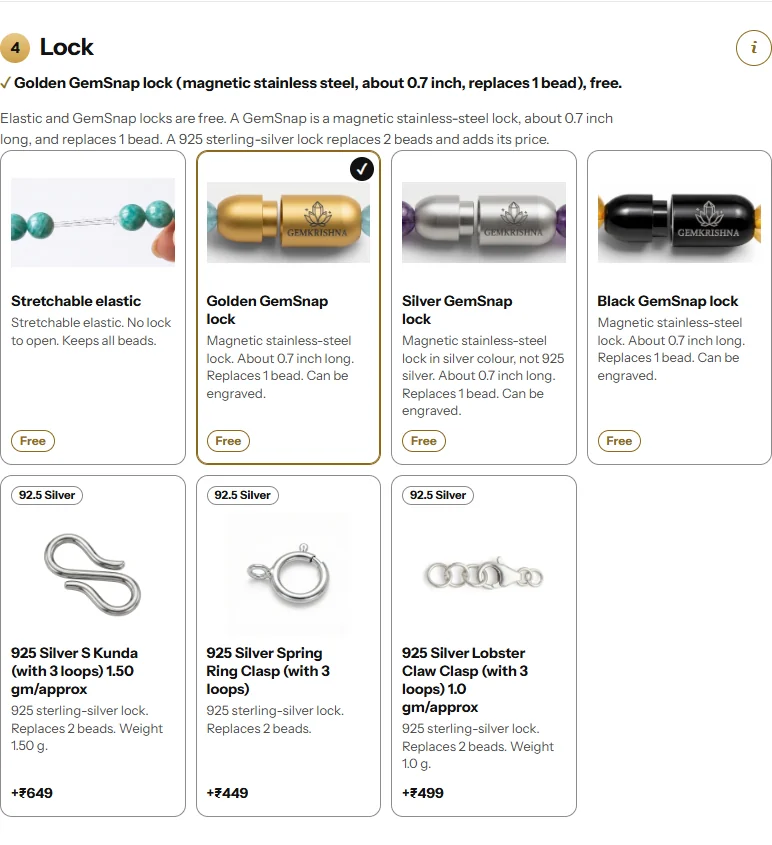
| Stretchable elastic | No clasp; slips over the hand | 0 | Free | No |
| GemSnap (gold, silver or black colour) | Magnetic stainless-steel lock, about 0.7 in long | 1 | Free | Yes (₹249) |
| 925 silver S kunda, about 1.5 g | Sterling silver hook | 2 | ₹649 | No |
| 925 silver spring ring clasp | Sterling silver clasp | 2 | ₹449 | No |
| 925 silver lobster claw, about 1.0 g | Sterling silver clasp | 2 | ₹499 | No |
Two points that buyers often miss:
- The “silver” GemSnap is silver-coloured stainless steel, not 925 silver. The builder says this plainly.
- Elastic is the easiest to put on but the most likely to need restringing over time. A clasp lets the bracelet sit snug without stretching over the hand. Our crystal bead bracelet guide compares fastenings in more detail.
Spacers and charms
A brass spacer set costs ₹99 for the bracelet, and GemKrishna matches the count to the design. Sterling silver spacers cost from ₹50 (3 mm, 40 mg) to ₹960 (a 7 × 5 mm textured bead, 1 g), and a 925 silver bead (₹999) takes the place of one gemstone bead. There are over 50 charms, most at ₹70, some silver charms at ₹499–699, and zinc animal charms at ₹99. Item weights are printed on many silver cards, which helps you judge value.
Report, energisation, dispatch and returns (as stated by GemKrishna)
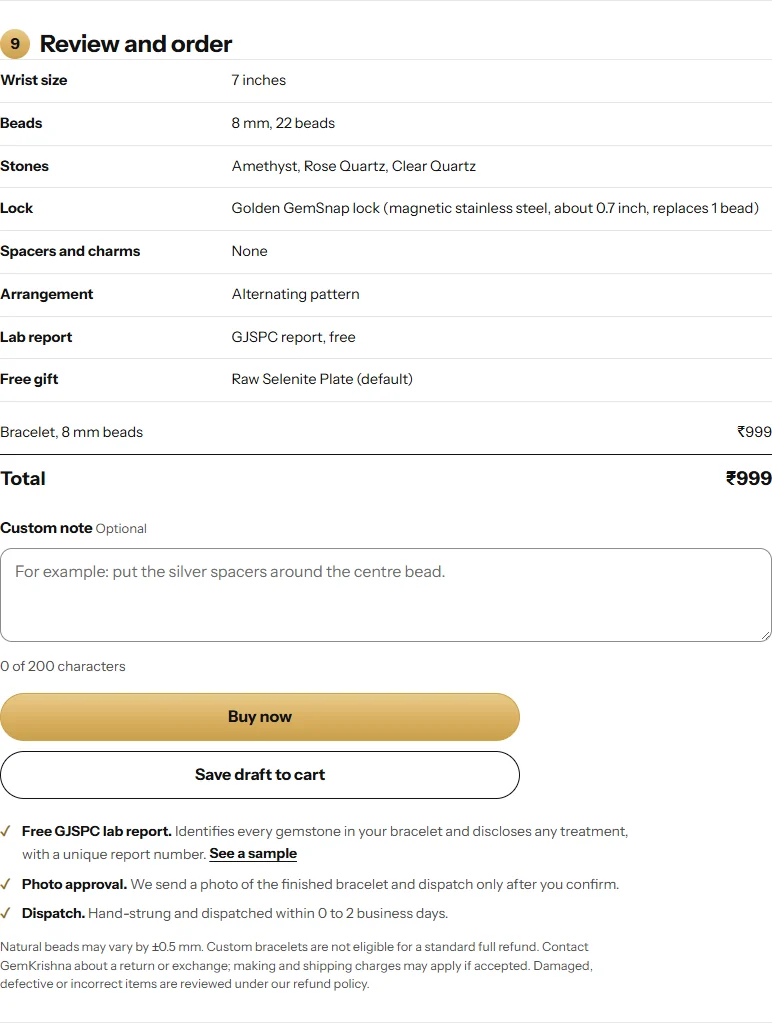
- Report (checked 25 October 2026): GemKrishna states that one free GJSPC report identifies each gemstone variety in the bracelet and includes its photograph, total bracelet weight and unique report number. Treatments identified within the laboratory’s testing scope are stated; this is not a guarantee that every possible treatment can be detected. Match the delivered bracelet to the report and verify its number online. GemKrishna also supplies its own authenticity card, a separate seller-issued document.
- Energisation: every bracelet is energised “using traditional Vedic practices” at no extra charge. GemKrishna adds that the effect is “not scientifically established”. A longer energisation with video is available on request.
- Dispatch (checked 25 October 2026): GemKrishna states 0–2 business days after required payment and photo approval; engraving adds about 3 business days. Courier transit is separate. Confirm delivery charges and any extra-work timeline in your final order summary.
- Returns: custom bracelets are not eligible for a standard full refund. A return or exchange is at GemKrishna’s discretion, and making and courier charges may apply. Damaged, defective or wrong items fall under its refund policy.
- Preview: an illustrated preview and an optional 3D view, both described by GemKrishna as illustrations, not exact appearance. The real check is the photo of your finished bracelet, sent before dispatch.
Strengths and limits
| Strengths | Limits |
|---|---|
| Published bead-count formula; you can check the arithmetic | Base sizes only 8 and 10 mm (no 6 or 12 mm gemstone beads) |
| Up to 12 stone types at one price | Custom pieces are not normally refundable |
| Exceptions (dyed, cultured, decorative) are named on the cards | Traditional “intentions” shown next to stones may be read as promises |
| Lock materials stated precisely, including what is not silver | Premium bead quality grades are not described beyond the name |
| Photo approval before dispatch | Check the finished piece and its report number on your own order |
Open the GemKrishna Custom Bracelet Builder
Builder 2: Custom Rudraksha Bracelet Builder
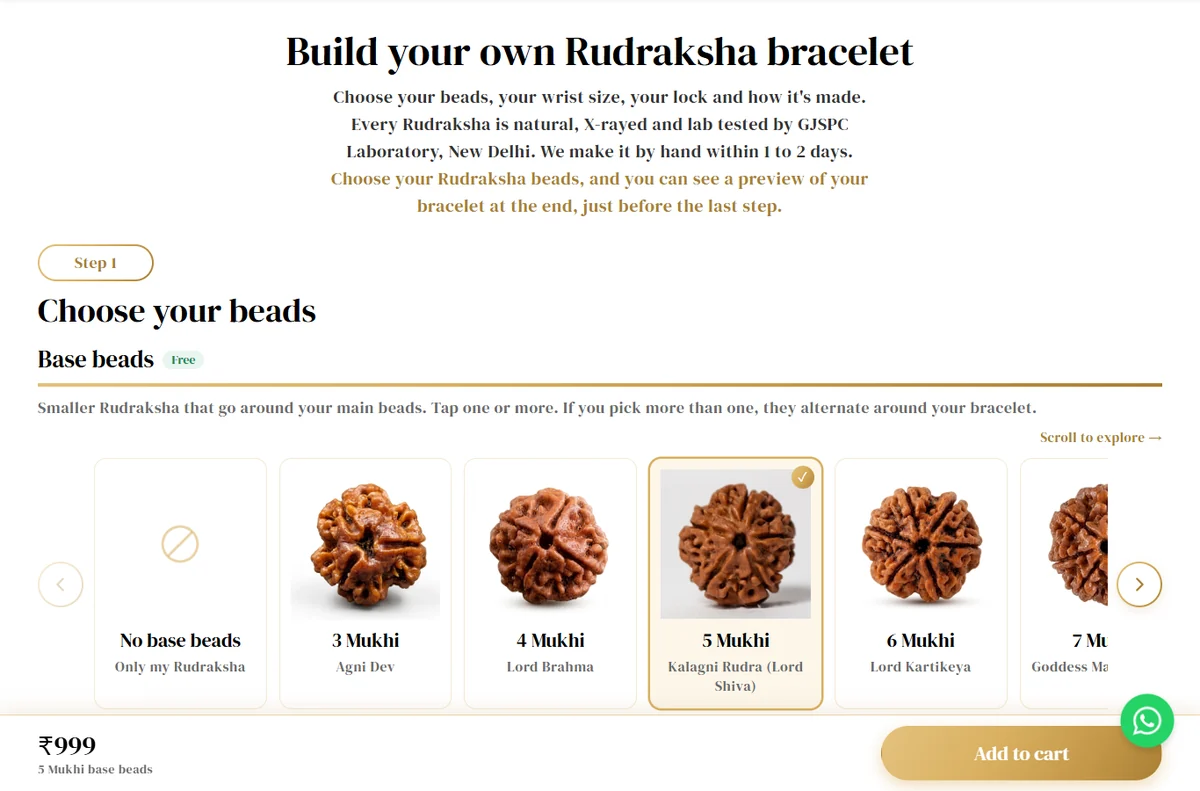
What it is: a five-step builder in which you choose each Rudraksha individually, by mukhi, origin and size, around optional free base beads.
Step-by-step walkthrough (5 steps)
- Choose your beads. First choose free base beads (3, 4, 5, 6 or 7 mukhi, or none) in one size for all: 8, 10 or 12 mm. If you pick more than one type, they alternate. Then add main Rudraksha from three groups: India (1 mukhi half-moon, 2 mukhi Rameshwaram, 3 mukhi Himalayan: ask for price), Indonesia (Java) 1–21 mukhi plus Gauri Shankar and Garbh Gauri, and Nepal and Himalayan beads. Each main bead is priced by size range. Silver spacers and charms are optional.
- Wrist size. Measure skin to skin; GemKrishna adds room for comfort. Between two sizes, choose the larger.
- Lock and stringing. Locks as in the gemstone builder: elastic, GemSnap or 925 silver clasps. Stringing: GemSnap stainless-steel core (looped twice), strong braided thread or knotted thread (all free); German silver caps and fittings (+₹999); 925 silver capping on thread for small Rudraksha (+₹2,000 for the bracelet) or for big Rudraksha (+₹300 per bead); or 925 silver wire with capping, priced after the order at the day’s silver rate.
- Energisation. Basic energisation free; a pooja or pran pratishtha for ₹499 (+3 days) or with video for ₹1,999 (+7 days); or none.
- Note. An optional note to the karigars about placement.
Mukhi, origin and size
The builder lists each bead with its origin, an approximate diameter and the deity and intention traditionally associated with it. Some examples of the published per-bead prices on 10 October 2026:
| Bead | Origin | Size listed | From (per bead) |
|---|---|---|---|
| 5 mukhi | Nepal | 15–17 mm | ₹15 |
| 5 mukhi | Indonesia | 6–8 mm upwards | ₹15 |
| 7 mukhi | Nepal | 17–20 mm | ₹75 |
| 11 mukhi | Indonesia | 6–8 mm upwards | ₹225 |
| 14 mukhi | Nepal | 18–22 mm | ₹22,500 |
| 1 mukhi | Indonesia | 6–8 mm upwards | ₹975 |
| 1 mukhi | Nepal | 15–17 mm | ₹8,250 |
| Gauri Shankar | Nepal | 25–30 mm | ₹2,250 |
| 21 mukhi | Indonesia | listed by size | ₹37,500 |
The large price spread by origin and mukhi is normal in the trade. It is also where buyers are most exposed, because higher mukhis and some origins are faked by carving or joining. GemKrishna’s page says Nepal beads are larger with deeper lines and Indonesian beads smaller and denser, and that tradition treats the mukhi, not the country, as what matters. That is a fair summary of common belief. Our Nepali vs Indonesian rudraksha guide explains the differences you can check yourself.
How to assess what you are offered
- Count the mukhis yourself on the photo of each bead, which GemKrishna says it shows you before stringing. Lines should run continuously from one end to the other.
- Check size against the range listed. A 1 mukhi Nepal bead listed at 15–17 mm should measure in that range.
- Look up the report number. GemKrishna states that every bead is X-rayed and tested by GJSPC Laboratory, with an individual report giving photo, weight, dimensions, description and origin. Premium beads get a “premium, big-size” certificate. Check any report number on the laboratory’s own site (GJSPC publishes a report check at gjspc.in), not through a link from the seller.
- Think about comfort. Large beads (18 mm and above) are heavy on the wrist. A few large main beads with 8 or 10 mm base beads is often more wearable than a bracelet of large beads.
Fit and remakes
GemKrishna states that the bracelet is made within 1 to 2 days, cleansed and energised before dispatch, and that if the size does not fit it remakes it free while you pay the shipping. Custom bracelets are otherwise outside the standard return policy.
Strengths and limits
| Strengths | Limits |
|---|---|
| Every bead chosen individually, with origin and size range | Many rare beads are “ask for price” |
| Report per bead stated, including origin | Origin and X-ray claims are seller statements until you check the report |
| Clear separation of German silver (no silver) and 925 silver options | 925 wire construction is priced only after ordering |
| Free remake for a wrong size (shipping paid by you) | Bead quality and stringing vary by order; check the photo before dispatch |
Open the GemKrishna Rudraksha Bracelet Builder
Builder 3: Custom Jaap Mala Builder
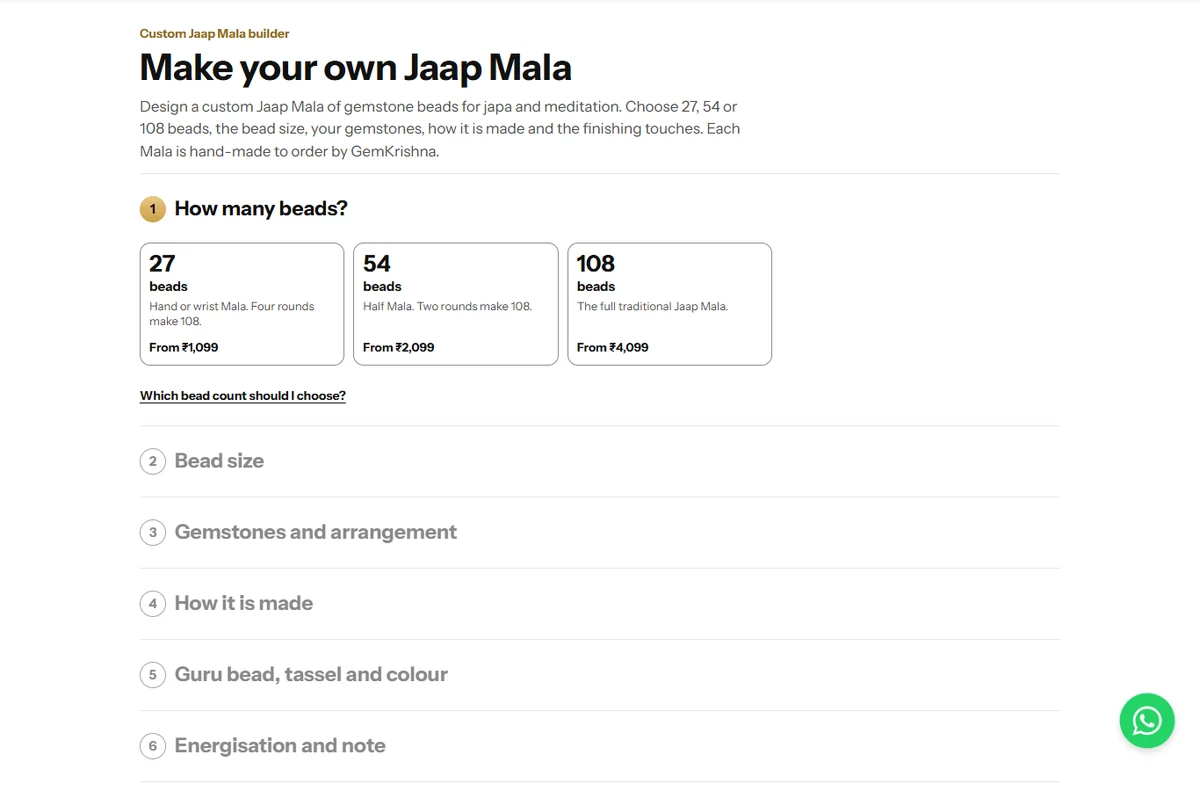
What it is: a seven-step builder for a counting mala of gemstone beads, with optional premium beads and Rudraksha.
Step-by-step walkthrough (7 steps)
- How many beads? 27 (a hand or wrist mala; four rounds make 108), 54 (two rounds) or 108 (the full traditional mala). The guru bead is extra and not counted.
- Bead size. 8 mm, described as the traditional japa size and lighter, or 10 mm, which makes a longer mala.
- Gemstones and arrangement. One stone for a single-stone mala, or up to 12 included stones sharing the counting beads, from what GemKrishna describes as more than 60 included options, including 4–7 mukhi Rudraksha. Premium beads (ruby, emerald, sapphires, pearls, coral, opal, firoza and others) and natural Rudraksha by size are charged per bead, and each replaces one counting bead. Arrangements: equal groups, alternating, a guru-side highlight, or GemKrishna’s own design (always used with more than 6 stones or with Flower Agate).
- How it is made. Thread only (hand-knotted or unknotted), German silver capping, or 925 sterling silver capping. Capped malas are linked on wire, so they are not knotted.
- Guru bead, tassel and colour. The guru bead is made from one of your included stones; you choose the thread and tassel colour.
- Energisation and note. Basic energisation, pooja or pran pratishtha (₹499, +3 days), pooja with video (₹1,999, +7 days), or none.
- Preview and order. An illustrated preview with approximate proportions, then add to cart. GemKrishna states that a GJSPC laboratory report is included. There is no option to choose a different laboratory.
What the configurations cost
Base prices for the mala, before premium beads, Rudraksha or a paid pooja (store prices on 10 October 2026):
| Beads | 8 mm thread | 8 mm German silver | 8 mm 925 silver | 10 mm thread | 10 mm German silver | 10 mm 925 silver |
|---|---|---|---|---|---|---|
| 27 + guru | ₹1,099 | ₹3,999 | ₹8,999 | ₹1,399 | ₹4,999 | ₹11,199 |
| 54 + guru | ₹2,099 | ₹7,999 | ₹17,999 | ₹2,599 | ₹9,999 | ₹22,499 |
| 108 + guru | ₹4,099 | ₹13,499 | ₹35,999 | ₹5,099 | ₹16,899 | ₹44,999 |
27, 54 or 108: how they differ in the hand
- Length. Using only bead diameters, a 108-bead mala of 8 mm beads is about 86 cm (34 in) of beads end to end, and about 108 cm (43 in) with 10 mm beads. GemKrishna says hand-knotting adds roughly 10–15%. A 27-bead mala of 8 mm beads is about 22 cm, which is why it can be worn on the wrist. These are our estimates from bead size × count; finished length also depends on the guru bead, knots and tassel.
- Handling. 8 mm beads are easier to move one by one with the thumb. 10 mm beads are easier to feel but make a long, heavier strand.
- Construction. Knotting stops beads rubbing and keeps them in place if the thread breaks; it is the traditional build for japa. Capping looks finished and protects bead ends, but a wire-linked mala is stiffer and heavier.
- German silver vs 925 silver. GemKrishna states correctly that German silver is a nickel-brass alloy with no silver in it. 925 is 92.5% silver. If you react to nickel, avoid German silver. See our 925 vs German silver guide.
- Rudraksha with capping is not available online; GemKrishna asks you to message it on WhatsApp.
Strengths and limits
| Strengths | Limits |
|---|---|
| All three traditional counts at two sizes, with prices published per build | No spacers, charms or clasps (by design) |
| Up to 12 stones at no extra cost | Report laboratory fixed to GJSPC |
| German silver clearly described as containing no silver | Rudraksha plus capping only by enquiry |
| Option of no energisation at no charge | Only illustrative preview before ordering |
For bead counts, lengths, weights and construction choices that apply to any maker, see our guide to custom japa mala configurations.
Open the GemKrishna Jaap Mala Builder
Builder 4: Custom Rudraksha Kantha Builder
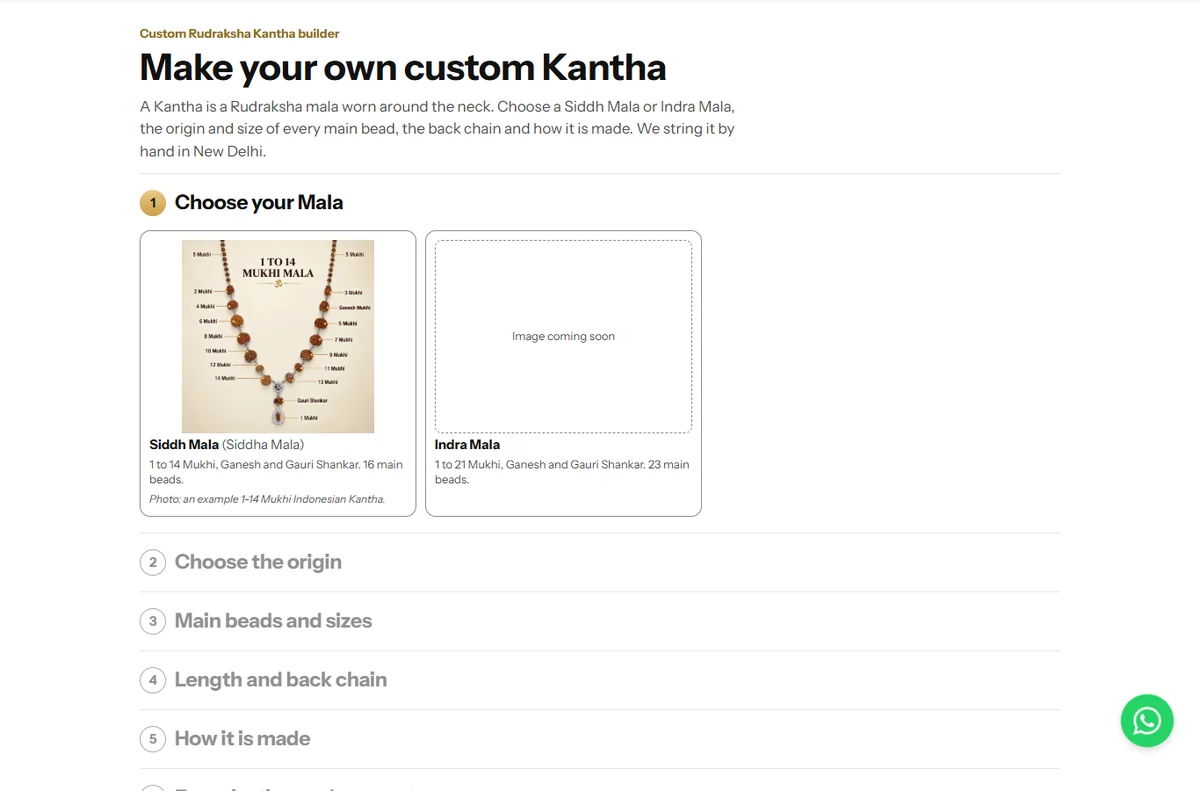
What it is: a seven-step builder for a Rudraksha necklace made as a Siddh Mala or an Indra Mala, with every main bead chosen by origin and size.
Step-by-step walkthrough (7 steps)
- Choose your Mala. A Siddh Mala (Siddha Mala): one each of 1 to 14 mukhi, plus a Ganesh and a Gauri Shankar Rudraksha, 16 main beads. An Indra Mala: one each of 1 to 21 mukhi, plus Ganesh and Gauri Shankar, 23 main beads. When we checked, the Indra Mala card had no example photo yet (“Image coming soon”).
- Choose the origin. Indonesian, Nepal, Indonesian with Nepal, Nepal with Indian, or a mix of every origin stocked. With two origins you still choose one bead for each place, so you do not pay for two sets.
- Main beads and sizes. Every place needs one bead and a size you pick; none is pre-selected. Sizes run from smallest to largest with a per-bead price. Some show “Ask for price” or “Ask for availability”.
- Length and back chain. Length from 18 in (46 cm, close to the neck) to 36 in (91 cm), or “no preference”. A back chain of smaller beads (8, 10 or 12 mm, up to two kinds) or a plain thread with no back-chain beads.
- How it is made. Dhaga (thread) with the 1 mukhi in a basket fitting; 925 silver caps on thread; 925 silver caps joined with silver wire (quoted at the day’s silver rate); or all-silver construction (quoted).
- Energisation and note. Pooja or pran pratishtha (₹499) or with video (₹1,999); a note; and an optional upload of your own design (image or PDF, up to 10 MB).
- Preview and order. A labelled preview with approximate proportions. If every part has a price you can order online. If anything is on request, the builder shows the known subtotal and sends your design to GemKrishna on WhatsApp for a quotation.
Back chain, making price and special beads
The kantha’s making price depends on the back chain. On 10 October 2026 the store listed “Kantha mala” making at ₹1,999 with no back-chain beads, ₹2,999 with 5 mukhi or sacred beads (Tulsi, chandan and others), ₹3,499 with 3, 4 or 6 mukhi or two kinds combined, and ₹3,999 with 7 mukhi. Silver capping and the main beads are added on top.
Special beads. Ganesh and Gauri Shankar Rudraksha are part of both malas. Nepal 16 to 21 mukhi are sold on request only, so any Indra Mala that uses them is always quoted personally. Some very small (12–14 mm) and very large (32 mm and up) Nepal sizes are also quoted on request.
What the report covers
GemKrishna states that every kantha includes a GJSPC Laboratory report “documenting the identifying characteristics of the Rudraksha examined”. It values the report at ₹1,500 for a Siddh Mala and ₹3,000 for an Indra Mala, compared with ₹350 for a basic report. GemKrishna’s page also says the report “does not test or promise spiritual benefits”. That is the right expectation: a report can identify a bead, count its mukhis and examine its interior. It cannot measure any spiritual effect.
How the options change appearance and value
- Origin drives most of the cost. A Nepal Indra Mala can cost many times an Indonesian one because of the rare high-mukhi Nepal beads.
- Size changes both look and price. Larger beads of the same mukhi are rarer and dearer; a kantha of evenly matched sizes looks more balanced.
- Construction. Thread is light and traditional. Silver caps protect the bead ends and make the piece look like jewellery, but add weight and silver cost.
- Length. 24 in sits at the collarbone; 28–32 in falls to the upper or middle chest.
Strengths and limits
| Strengths | Limits |
|---|---|
| Both classic combination malas, every bead chosen by origin and size | Nepal 16–21 mukhi and some sizes only by quotation |
| Report included, with what it does and does not cover stated | Wire and all-silver builds priced only on quotation |
| Option to upload your own design | Made within about 7 days, longer than the bracelets |
| Origins can be mixed without paying for two sets | No example photo for the Indra Mala when checked |
For how Siddh and Indra kanthas are structured and what drives their price with any maker, see our guide to how a custom rudraksha kantha is built.
Open the GemKrishna Rudraksha Kantha Builder
Find Your Bracelet: the guided finder
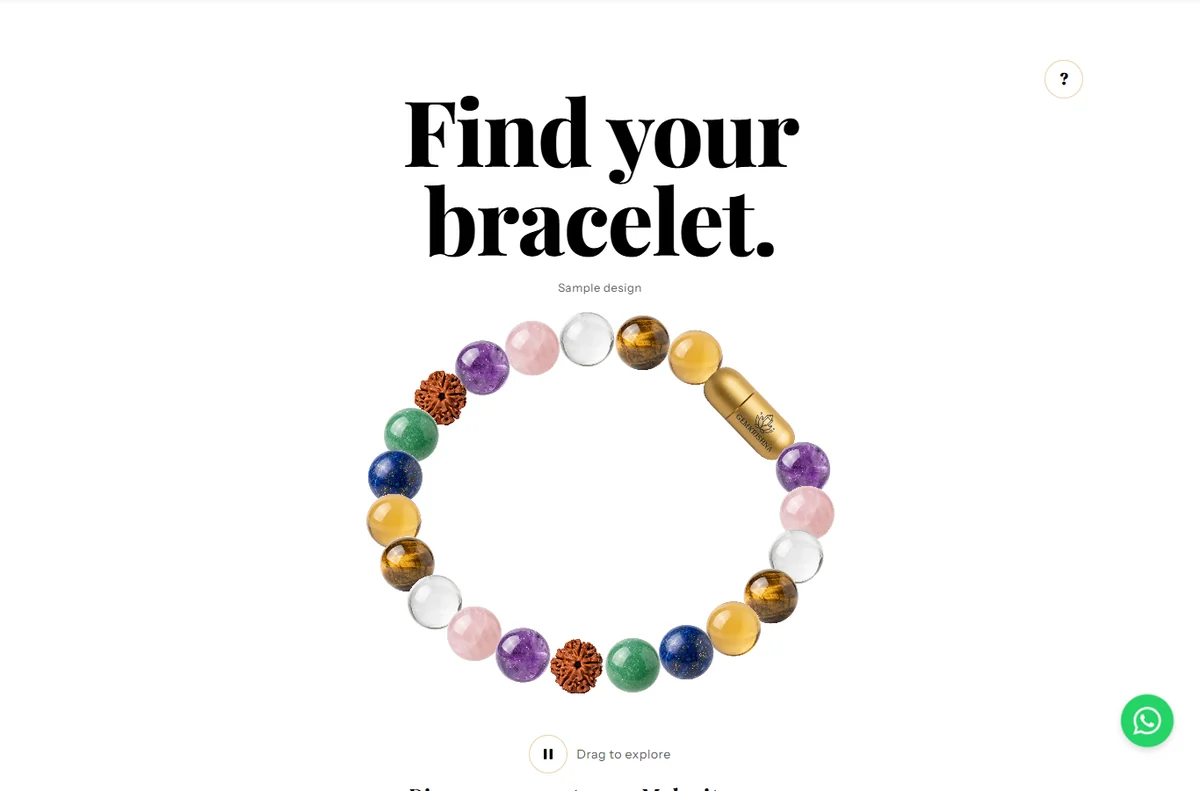
Find Your Bracelet is not a fifth builder. It is a short questionnaire that suggests stones, then hands them to the Custom Bracelet Builder.
What it asks
You choose one of three routes:
- By concern. Pick one or two of seven: calm and stress relief; confidence and courage; love and relationships; abundance and prosperity; focus and clarity; protection and grounding; spiritual practice. With two concerns, it blends stones from both, and every suggestion has at least two bead types.
- By rashi. Your Vedic moon sign, its ruling planet (graha) and that planet’s traditional stones.
- By birth dates. Two dates of birth, one crystal for each, using common Western zodiac date ranges. The tool says plainly that this is not a Vedic calculation.
There are also routes to ask for free help on WhatsApp, to go straight to the builder, or to ask about a ring, pendant or other piece.
How suggestions are made
The suggestions come from fixed tables in the tool, not from any analysis of you. For example, “calm” suggests amethyst, blue lace agate, moonstone and lepidolite; “focus” suggests clear quartz, fluorite, blue apatite and tiger’s eye. The rashi route uses the traditional planet-to-stone pairings:
| Rashi | Graha | Stones suggested |
|---|---|---|
| Mesh, Vrishchik | Mangal (Mars) | Carnelian, red jasper |
| Vrishabh, Tula | Shukra (Venus) | Clear quartz, milky quartz |
| Mithun, Kanya | Budh (Mercury) | Green aventurine, green jade |
| Karka | Chandra (Moon) | Moonstone |
| Singh | Surya (Sun) | Garnet, sunstone |
| Dhanu, Meen | Guru (Jupiter) | Citrine, yellow aventurine |
| Makar, Kumbh | Shani (Saturn) | Amethyst, lapis lazuli |
These are presented as uparatna (traditional substitutes) for the main planetary gems. The finder’s own FAQ advises against choosing a main ratna such as blue sapphire from the rashi alone, without the full birth chart.
From suggestion to order
After the suggestion, you choose your wrist size, bead size and lock. Then Continue in Bracelet Builder opens the Custom Bracelet Builder with your wrist, bead size, elastic or GemSnap lock, stones and arrangement already selected. We confirmed this: the builder reads them from the link. A 925 silver clasp is not carried over; you choose it in the builder. Price is shown only in the builder. The finder uses the same bead-count formula, and its preview uses product photos, with natural variation and approximate clasp proportions noted.
If you choose the WhatsApp route with birth details, GemKrishna states the details go only into the WhatsApp message and are not saved on the page.
What the finder does and does not establish
- It does: turn a preference into a concrete, editable stone list; size the bracelet for your wrist; and explain the traditional associations it used.
- It does not: show that any stone will produce calm, confidence, prosperity or protection. Crystal intentions and astrological pairings are traditions, and associations vary between traditions and astrologers. The finder says so itself.
- A fair way to use it: treat it as a shortcut to a colour palette and a set of names you can research. Then judge the stones on what is checkable: identity, treatment, bead size and the report.
For how bracelet finders work in general, and how to check any finder’s suggestion, see our guide to bracelet finders.
Open GemKrishna’s Find Your Bracelet
What every GemKrishna report claim means for you
All four builders rely on GJSPC, a laboratory in New Delhi, which GemKrishna describes as independent. RudrAAAksh has not audited the relationship between the two businesses. Whichever seller you use:
- Ask for the report number before or at delivery, and look it up on the laboratory’s own website.
- Match the report to your item: photo, weight, dimensions, bead count and any treatment line.
- Read what the report covers. A bracelet report that “identifies every gemstone” is about identity and treatment. It is not a grading of quality, and it says nothing about spiritual effect.
Our guide to rudraksha and gemstone laboratories explains what different reports establish.
Who these tools suit, and who they may not
- They suit buyers who know what they want, like to see the bead count and price before paying, and value named stones, stated treatments and a report.
- They may not suit buyers who want to handle beads before buying, need an easy return, need a laboratory other than GJSPC confirmed before ordering, or want gemstone beads other than 8 or 10 mm.
- Compare before buying. Use our seller evidence checklist on GemKrishna and on any alternative: documentation, treatment disclosure, sizing, returns and support.
FAQ
Are GemKrishna’s four builders one tool or four?
Four separate builders, each on its own page: gemstone bracelets, Rudraksha bracelets, Jaap Malas and Rudraksha Kanthas. Find Your Bracelet is a separate guided finder that feeds the gemstone bracelet builder.
How many beads will my bracelet have?
Wrist inches × 25 ÷ bead size in mm, rounded, plus one comfort bead. A GemSnap lock replaces one bead and a 925 silver clasp two. A 7-inch wrist with 8 mm beads and a GemSnap gives 22 beads.
Is the silver GemSnap lock made of silver?
No. All three GemSnap locks are stainless steel. The silver one is silver-coloured. The 925 silver clasps are a separate, paid choice.
Can I choose the laboratory for my report?
Not within the builders, which each state a GJSPC report. GemKrishna’s site also says customers “are given a variety of Independent Laboratories to choose from” and lists GJSPC, IGI, GRS, IIGJ, GSI and GIA (checked 11 October 2026). Ask GemKrishna before ordering whether a different laboratory is available for a custom piece, and at what cost.
Is German silver capping real silver?
No. German silver is a copper-nickel-zinc alloy with no silver. GemKrishna’s builder says so. 925 silver capping costs more because it is 92.5% silver.
Can I return a custom piece?
Custom pieces are not eligible for a standard full refund. For bracelets, GemKrishna states a free remake if the wrist size is wrong, with shipping paid by you. Damaged, defective or wrong items are handled under its refund policy.
Does energisation do anything?
Energisation is a religious practice. GemKrishna itself states that its effect is not scientifically established, and it offers a “no energisation” option.
Sources
- GemKrishna: Custom Bracelet Builder, checked 10 October 2026
- GemKrishna: Custom Rudraksha Bracelet Builder, checked 10 October 2026
- GemKrishna: Custom Jaap Mala Builder, and the store’s prices for each base mala product, checked 10 October 2026
- GemKrishna: Custom Rudraksha Kantha Builder, checked 10 October 2026
- GemKrishna: Find Your Bracelet, checked 10 October 2026
- GemKrishna: FAQs, checked 10 October 2026
- GJSPC Laboratory, checked 10 October 2026
Related reading
- Crystal bead bracelets: choosing stones, bead sizes, fit, construction and reports
- Rudraksha buying guide: mukhi, origin, size, testing and custom jewellery
- Rudraksha and gemstone testing laboratories: GJSPC, IIGJ Lab and GSI compared
- How to assess a jewellery seller: a consistent evidence checklist
- Bracelet size chart for India: how to measure your wrist for bead bracelets and bangles
- 6 mm vs 8 mm vs 10 mm beads: size, weight and bead count for bracelets
- Rudraksha size guide: millimetres, mukhi, origin and comfort
- Rudraksha silver capping: designs, 925 vs German silver, cost and care
- How to verify a gemstone or rudraksha report online (GJSPC, IGI, GIA, GRS, IIGJ)
- Custom crystal bracelet brands in India: features, fit and reports