The short answer
Nepali and Indonesian rudraksha are the same kind of seed. The difference is in how they look and how they are sold. Sellers describe Nepali beads as larger, with deep, thorny furrows and clearly cut mukhi lines. Indonesian beads, often sold as “Java”, are usually smaller and smoother, with fine, thread-like lines. Nepali beads usually cost more because large, well-formed ones are scarcer. Neither origin makes a bead genuine. What matters is that the mukhi count is natural, that the size and weight are stated, and that a laboratory report you can verify yourself names the same bead. An X-ray can confirm the internal structure, but it cannot, on its own, prove which country a bead grew in.
This guide sits alongside our rudraksha buying guide, which covers mukhi, size and testing in general. Here we look only at the Nepal–Indonesia question, which affects price more than almost anything else on a listing.
What “Nepali” and “Indonesian” actually mean
Rudraksha beads are the dried, grooved stones (endocarps) of the fruit of an Elaeocarpus tree. Each groove on the surface marks a segment, and each segment normally contains its own seed compartment. The number of natural segments is the bead’s mukhi, or face count.
Botanists do not agree on a single name for the rudraksha tree:
- Plants of the World Online (Royal Botanic Gardens, Kew) treats Elaeocarpus ganitrus Roxb. ex G.Don as a synonym of Elaeocarpus sphaericus (POWO). Other databases group the names differently, and some fold them into E. angustifolius.
- For a buyer, the practical point is this: “Nepali” and “Indonesian” are trade origins, not separate species on a label. A listing that names a different botanical species for Java beads is making a claim it would need to support.
The two trade origins are:
- Nepali beads, sold as Himalayan or Nepal origin, mostly from the eastern hills of Nepal.
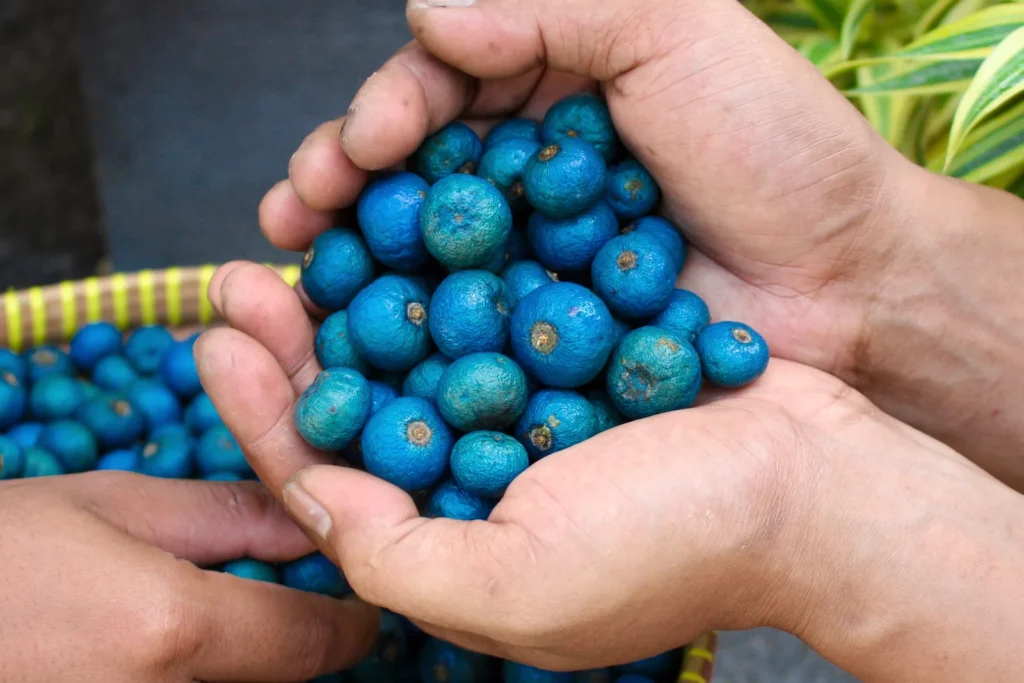
- Indonesian beads, sold as Java or Indonesian origin. In Indonesian the fruit is called jenitri, and the blue fruits are harvested and cleaned to expose the stone.
Many sellers also offer a few Indian beads, such as particular forms of 1, 2 or 3 mukhi.
Size: what sellers say, and why the ranges overlap
Most of the price gap between the two origins comes from size, and size figures come from sellers, not from published measurement studies. We could not find a peer-reviewed study that measured large samples of beads of known origin. The figures below are therefore seller statements, quoted so that you can see how wide and how overlapping the ranges are.
| Source (checked 9 October 2026) | Nepali beads | Indonesian (Java) beads |
|---|---|---|
| Rudra Centre, “Nepal and Java Rudraksha” | 14–40 mm, average about 21 mm; above 30 mm described as collector size | 2–30 mm, average about 15 mm; japa-mala beads 2–14 mm |
| GemKrishna rudraksha bracelet builder | Larger than Indonesian beads of the same mukhi | Most single beads about 9–19 mm |
| Devi Bhagavata Purana, Book 11, ch. 7 (traditional text) | Size is not tied to origin. A seed “of the size of an Âmalakî is the best”, a plum-sized one “middling” and a gram-sized one “the worst” | Same |
Sources: Rudra Centre, GemKrishna builder, Devi Bhagavatam, trans. Swami Vijnanananda.
Three things follow from this table.
- The ranges overlap. A 16 mm bead could be either origin. So “it is big, so it must be Nepali” is not evidence.
- Averages are not specimens. You are buying one bead, not an average. Ask for that bead’s diameter in millimetres, measured across the widest point between the faces, and its weight in grams.
- Mukhi changes size. Higher-mukhi beads are generally larger in both origins, so compare like with like: a 5 mukhi Nepali bead with a 5 mukhi Indonesian bead, not a 5 mukhi with a 12 mukhi.
Why size changes weight much more than you expect
A useful rule for malas and bracelets: weight rises with the cube of the diameter. Beads are roughly spherical, so a bead twice as wide holds about eight times the material. This is geometry, not a seller claim, and it holds for any origin.
| Bead diameter | Volume relative to a 6 mm bead |
|---|---|
| 6 mm | 1.0× |
| 8 mm | about 2.4× |
| 10 mm | about 4.6× |
| 12 mm | 8.0× |
So a 108-bead mala of 10 mm beads carries roughly four to five times the bead material of a 6 mm mala. That matters for daily japa and for a necklace worn all day. Real beads vary in density and shape, so weigh an actual strand before you decide. Ask the seller for the weight of the strand you are buying, not a typical figure.
Surface: why photographs mislead
Sellers consistently describe Nepali beads as having a “thorny” surface with projections and deep, clear furrows, and Indonesian beads as smoother, with mukhi lines that look like “white thread like lines” (Rudra Centre). That description fits what most buyers see. But a product photo is a poor way to judge it:
- Lighting changes everything. Low, side-on light deepens furrows. Flat, front-on light makes a Nepali bead look smoother.
- Close-ups hide scale. A macro shot of a 9 mm bead can look like a 20 mm bead.
- One face is not all faces. A photograph shows one side. Mukhi lines must run from one end to the other, all the way round, and you cannot check that in a single picture.
- Oil, polish and dye change colour and contrast. Many beads are oiled after cleaning. Colour is not an origin test.
What to ask for instead: photographs of the actual bead from both ends and at least two sides, with a millimetre scale or ruler in the frame, plus its weight. Reputable sellers send these on request, and some builders send a photo of the finished piece before dispatch.
Mukhi: do Indonesian beads have natural faces?
Yes. Both origins grow natural mukhis, and the internal structure is the same. Each natural face corresponds to a seed compartment inside. Even sellers who favour Nepali beads say so: Rudra Centre states that both types have the same internal structure, with the seed count matching the mukhi number (Rudra Centre). The difference is visibility. Fine Indonesian lines are harder to count by eye, which makes small Indonesian beads easier to misdescribe, deliberately or not.
The most common ways the mukhi count is faked are carving extra lines, gluing beads together, and filling or sealing a bead to hide a missing segment. These apply to both origins. They are explained in our guide to real and fake rudraksha.
What an X-ray can and cannot tell you
X-ray imaging is the standard non-destructive check on the inside of a bead. Hinduism Today‘s investigation of fake rudraksha explains the logic: if the number of seed compartments on the X-ray does not match the number of outward faces, the bead has probably been tampered with; if there are no compartments at all, it is a complete fake (Hinduism Today, 2016). Researchers have also used X-ray imaging to look inside the rudraksha endocarp and detect whether seeds are present (Singh & Singh, Journal of Non-Timber Forest Products, 2020).
| Question | Can an X-ray answer it? |
|---|---|
| Does the internal compartment count match the surface faces? | Yes, this is its main purpose |
| Has the bead been glued together from two or more pieces? | Usually: joins and missing compartments show up |
| Is it a moulded or resin imitation? | Yes: there is no natural compartment structure |
| Is it Nepali or Indonesian? | Not by itself. Compartments look the same in both |
| Will it bring a particular spiritual result? | No. That is a matter of belief, not testing |
Laboratories that issue origin statements combine the X-ray with an examination of size, shape, surface and line form. The Indian laboratory GJSPC, for example, states that each of its rudraksha reports carries “size, shape, weight, origin, modifications, enhancements, radiography”, and that each bead receives at least two opinions before results are issued (GJSPC). Read an origin line as that laboratory’s finding for that bead, based on those features. It is not a geographic test like a soil or isotope analysis. Our comparison of rudraksha and gemstone testing laboratories explains how to check a report number on the laboratory’s own website.
Provenance and identity are different questions
- Identity: is it a natural rudraksha, and is the mukhi count natural? A laboratory can answer this for the bead in front of it.
- Provenance: where it was grown and how it reached the seller. That depends on the supply chain, and a seller can only document it with purchase records.
A report can support the first. For the second, you are relying on the seller and on the laboratory’s stated assessment.
Price: compare identical specifications
Nepali beads generally cost more. Even sellers of both say so, because large, well-formed Nepali beads are rarer (Rudra Centre). We do not quote prices here: they move with every season’s harvest and differ widely by mukhi. Instead, line up quotes on the same specification:
| Specification | Write down for each quote |
|---|---|
| Mukhi | The number, confirmed on the report |
| Origin | As stated by the seller and by the report |
| Diameter | In mm, measured across the widest point |
| Weight | In grams, for the single bead or the whole strand |
| Shape and surface | Round or oval; complete lines end to end |
| Report | Laboratory name, report number, online lookup |
| Fittings | Thread, capping metal (silver, German silver, none) |
| Making | Knotting, stringing, guru bead, tassel |
| Return terms | Days, conditions, custom-item exclusions |
If two quotes differ, the difference should be explained by one of these lines. If it is not, ask.
Which is better for japa, wearing or collecting?
Neither origin is spiritually “better” in any testable sense. Traditional texts set out preferences for well-formed, hard, clearly lined beads, not for a country. The Devi Bhagavata, for instance, describes the best seeds as “nicely circular, smooth, hard” with distinct points (Devi Bhagavatam, Book 11, ch. 7). The practical differences are size, weight, feel and budget.
| Reader | Practical choice | Why |
|---|---|---|
| Beginner, daily japa | Indonesian 108 + 1 mala, about 6–8 mm, or a small Nepali 5 mukhi strand | Light in the hand, affordable, easy to count |
| Practitioner wearing a single bead | Nepali single bead, about 18–25 mm, capped or on thread | Large, clearly lined beads are easy to inspect; the size suits a pendant |
| Bracelet for all-day wear | Indonesian beads, or small Nepali beads, about 8–12 mm | Weight rises with the cube of the diameter (see above) |
| Collector of rare mukhi | Either origin, chosen bead by bead with a report for each | The report and the specific bead matter more than the label |
| Tight budget | Indonesian for higher mukhi | The same mukhi usually costs less |
Example: choosing origin bead by bead
Some sellers now let you choose the origin and approximate size of each bead rather than buying a fixed strand. One example is GemKrishna’s rudraksha bracelet builder. According to the builder (checked 9 October 2026), you can:
- choose main beads by origin: Indonesia (1–21 mukhi, plus Gauri Shankar, Garbh Gauri and Ganesh), Nepal (1–21 mukhi and more, with 19–21 mukhi and Trijuti quoted on WhatsApp) and India (1 mukhi half-moon, 2 mukhi Rameshwaram and 3 mukhi Himalayan)
- see an approximate size on every bead card, with a note that natural beads vary and that Nepali beads are larger than Indonesian beads of the same mukhi
The builder also states that every rudraksha is natural, X-rayed and tested by GJSPC, with an individual report per bead showing a report number, photo, weight, dimensions and origin. We looked up one GJSPC report number published on a GemKrishna listing, a 15 mukhi Nepali bead (RDGJ622595), on GJSPC’s own report-check page, and the record was found.
For a full strand, the kantha builder offers origin combinations of Indonesian, Nepali, Indonesian and Nepali, Nepali and Indian, or a mix of every origin stocked. Our builder comparison describes these tools in more detail.
Other sellers take different approaches.
- Rudra Centre sells both origins and offers a free authentication service for beads bought anywhere (Rudra Centre).
- RudraKailash says every bead is X-rayed at its own laboratory (RKRTL) and certified with online verification (RudraKailash).
Note the difference between a seller’s in-house laboratory and an independent one: either can be accurate, but you should know which you are relying on.
Buyer’s checklist
- The listing states mukhi, origin, diameter in mm and weight in g for the actual bead or strand.
- You have photos of both ends and two sides with a scale in the frame.
- The mukhi lines run from end to end, all the way round, with no breaks, joins or tool marks under a 10× loupe.
- The laboratory report names the same bead (photo, weight, size) and its number looks up on the laboratory’s own website.
- The report’s origin line is read as the laboratory’s finding, not as proof of supply chain.
- Two quotes are compared on identical specifications (table above).
- You know the return terms, especially for custom-strung pieces, which are often excluded from full refunds.
FAQ
Can you identify origin from a photograph?
Not reliably. Surface texture suggests origin, deep thorny furrows for Nepali and fine lines for Indonesian, but lighting, scale, oiling and the angle of the shot all change how a bead looks, and the size ranges overlap. Use photographs with a scale to check condition and lines, and rely on a verifiable report and the seller’s records for origin.
Does an X-ray prove that a bead is from Nepal?
No. An X-ray shows the internal compartments and reveals glued, carved or moulded beads. The compartments of Nepali and Indonesian beads look alike. When a laboratory report states origin, that is the laboratory’s assessment of the bead’s external features alongside the X-ray, so read it as its finding for that bead.
Why are Nepali beads usually more expensive?
Mainly because large, well-formed Nepali beads are scarcer, and because demand for them is high. Prices also vary with mukhi, diameter, shape, the completeness of the lines and the season’s harvest. Compare quotes on identical specifications before concluding that one seller is cheaper.
Which is better for japa?
For counting, comfort matters most. Many people find an Indonesian 108 + 1 mala of about 6–8 mm beads light and easy to handle for long sessions, but a small-bead Nepali mala works just as well. Traditional texts describe preferred bead qualities, such as round, hard and clearly lined, not a preferred country.
Do Indonesian rudraksha have natural mukhis?
Yes. Natural Indonesian beads have the same internal structure, with one seed compartment per natural face. Their lines are finer and harder to count by eye, so a report matters more for small Indonesian beads of higher mukhi.
Is an Indonesian bead a “lower grade” rudraksha?
Not in itself. It is usually smaller and smoother. Grade depends on the individual bead: whether the lines are complete and natural, its shape, whether it is damaged, and whether it has been treated or filled.
What should a report for a single bead show?
At a minimum:
- the laboratory’s name and a unique report number that can be looked up online
- a photograph of the bead
- weight and dimensions
- the mukhi count
- whether an X-ray was performed
- any modification or treatment found
An origin statement, where given, is the laboratory’s finding.
Sources
- Royal Botanic Gardens, Kew, Plants of the World Online: Elaeocarpus ganitrus Roxb. ex G.Don, synonym of E. sphaericus (checked 9 October 2026).
- Singh, P. & Singh, A. N.: Morphometric characteristics of endocarp, seed and embryo of Elaeocarpus ganitrus, Journal of Non-Timber Forest Products 27(3), 2020.
- Hinduism Today: How common are fake rudrakshas?, October–December 2016.
- Srimad Devi Bhagavatam, Book 11, chapter 7, trans. Swami Vijnanananda: sacred-texts.com.
- GJSPC Laboratory: rudraksha testing and certification (checked 9 October 2026).
- Rudra Centre (seller): Nepal and Java rudraksha and fake rudraksha, checked 9 October 2026.
- GemKrishna (seller): rudraksha bracelet builder and kantha builder, checked 9 October 2026.
- RudraKailash (seller): homepage and certificate statement, checked 9 October 2026.
Next steps
Read our rudraksha buying guide for mukhi and sizing basics, learn to spot fake rudraksha, or email us with a question about a specific bead.