The short answer
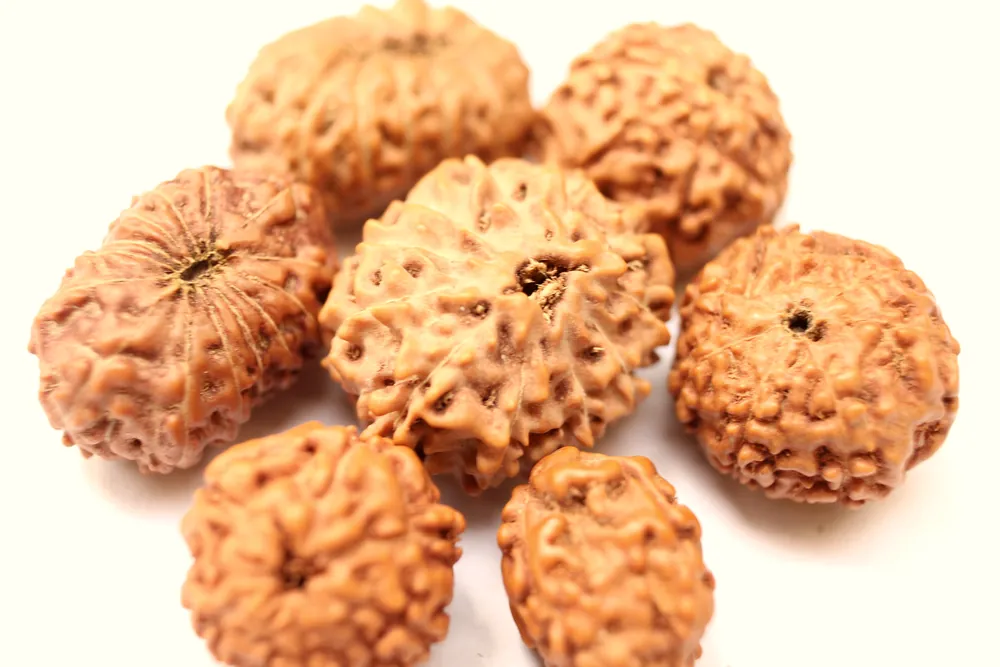
A rudraksha is the stone (endocarp) of the fruit of Elaeocarpus trees. Inside, it is divided into seed compartments (locules). In a natural bead, the number of compartments normally matches the number of mukhis (the lines on the surface).
An X-ray (radiograph) lets a trained examiner count those compartments and look for glue lines, inserts and fillings. That makes it the most useful single test for higher-mukhi and rare beads, which are the beads most often faked.
It has limits:
- the compartments can be close together and hard to read;
- an X-ray does not establish the country of origin by itself;
- it says nothing about spiritual effect.
Use it through an independent laboratory, and check the report number online.
What the X-ray is looking at
Each mukhi line on a rudraksha runs over one internal compartment. A 5 mukhi bead normally has five, a 7 mukhi seven, and so on. Fakers work on the outside:
- carving extra lines into a lower-mukhi bead to “upgrade” it;
- gluing two beads together (common with two-bead forms such as Gauri Shankar);
- filling cracks or holes;
- moulding imitation beads from resin or wood paste.
The inside is much harder to alter. That is why an X-ray is useful.
An article on India’s Indian Gemological Laboratory (IGL) work with rudraksha set out the logic (Hinduism Today, 2016):
- if the compartments on the X-ray do not match the outward faces, the bead has probably been tampered with;
- a bead with no compartments at all is a complete fake.
The same article warns that compartments are often very close together and the seeds inside may not be visible. Reading the image takes an experienced eye.
What an X-ray can and cannot reveal
| Problem | Can an X-ray help? | Why |
|---|---|---|
| Carved extra lines | Usually yes | Line count exceeds compartment count |
| Two beads glued into one (fake Gauri Shankar, Trijuti) | Usually yes | Joints and adhesive show differently from natural tissue |
| Inserted metal, stone or weights | Yes | Dense materials show clearly |
| Moulded resin or paste imitations | Usually yes | No natural internal structure |
| Filled holes or cracks | Often | Filling may differ in density |
| Country of origin (Nepal vs Indonesia) | Not on its own | Origin is judged from size, form and other features, not from the X-ray alone |
| Age, “energy” or spiritual potency | No | Not measurable |
| A natural bead with faint or undeveloped lines | Partly | It can show compartments, but whether a faint line “counts” is a grading judgement |
Some laboratories add CT scanning for difficult beads. Ask what the laboratory uses for the bead you are testing.
Which beads are worth X-raying
- Worth it: higher-mukhi beads (roughly 10 mukhi and up), any “1 mukhi” sold as round, Gauri Shankar, Garbh Gauri, Trijuti and other multi-bead forms, any bead whose price is high relative to the test, and beads that will be capped in silver (capping hides the ends). See also our guide to Gauri Shankar, Garbh Gauri and Ganesh beads.
- Usually not worth it: a common 5 mukhi bead or mala bead costing less than the test, unless you are buying in quantity and want a sample tested.
Where to get it done
- A laboratory that lists rudraksha testing. For example, GJSPC in New Delhi lists rudraksha identification. It says its reports give size, shape, weight, origin, modifications and enhancements, and mentions radiography among its tests (GJSPC). Our laboratory comparison lists others and what they state they test.
- Through the seller. Many sellers supply a report. Ask which laboratory issued it, whether it is independent of the seller, and whether radiography was used on your bead, not on a sample.
- Before capping. If you are having a bead capped in silver, test it first.
Cost. Laboratories rarely publish rudraksha prices, and prices vary by bead type and report format: a single bead, a mala or a kantha. Ask for a written quote. Some sellers include a report in the price; one builder we reviewed values a basic report at ₹350 and a full combination-kantha report at ₹1,500–3,000, as its own statement.
Reading a rudraksha report
A useful report should give:
- a photograph of the bead;
- weight and dimensions;
- the mukhi count and the method used, ideally including radiography;
- comments on modification or enhancement, such as “no evidence of artificial lines” or “joined”;
- origin, if stated, and on what basis;
- a report number you can check on the laboratory’s own website.
Our laboratory comparison lists how each laboratory lets you check a report.
Why home tests are not a substitute
Popular home tests do not tell you whether a bead is genuine:
- Floating or sinking in water: density varies with age, moisture and oil, so genuine beads can float and fakes can sink.
- Spinning between copper coins: a myth with no physical basis.
- “Colour should not run” in water: this catches only the crudest dyed fakes.
Our real vs fake rudraksha guide explains the checks you can do at home: line continuity, surface texture, natural holes and weight for size.
FAQ
Does an X-ray damage the rudraksha?
There is no reason to expect that an X-ray dose used for examination damages a dry seed. Handling and shipping are the bigger risks; ask the laboratory how beads are packed.
Can an X-ray tell Nepali from Indonesian rudraksha?
Not by itself. Origin is judged from the bead’s size, form, surface and other features, and even then it is an opinion. See our rudraksha buying guide.
My report says the bead is natural but the mukhi count differs from what I was sold. What now?
The report is evidence about your bead. Tell the seller in writing and ask for the difference to be resolved: a refund, an exchange or a price adjustment.
Is a report without X-ray worthless?
Not worthless, but weaker for high-value beads. Surface examination can catch many fakes, but internal tampering is what the X-ray is for.
Does a test prove a rudraksha’s benefits?
No. A laboratory can identify a bead and detect tampering. Benefits described in texts and by sellers are matters of belief.
Sources
- Hinduism Today, How common are fake rudrakshas?, October–December 2016, checked 10 October 2026.
- GJSPC Laboratory, Rudraksh testing and certification, checked 10 October 2026.
- GemKrishna, Custom Rudraksha Kantha Builder (report values as stated by the seller), checked 10 October 2026.
Related reading
- Real or fake rudraksha? Common fakes, popular myths and the checks that actually work
- Rudraksha buying guide: mukhi, origin, size, testing and custom jewellery
- Rudraksha and gemstone testing laboratories: GJSPC, IIGJ Lab and GSI compared
- How to verify a gemstone or rudraksha report online (GJSPC, IGI, GIA, GRS, IIGJ)
- Rudraksha size guide: millimetres, mukhi, origin and comfort