The short answer
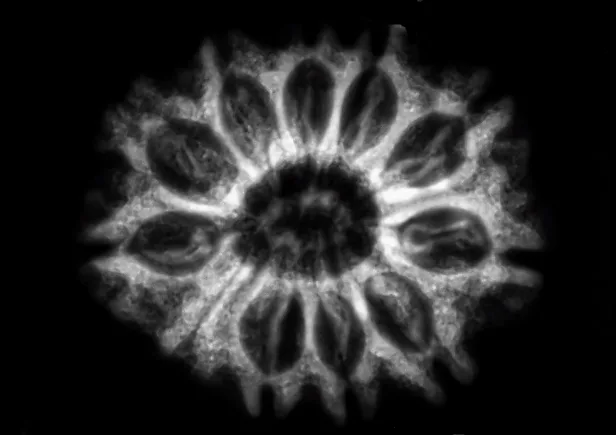
- A 14 mukhi has fourteen natural lines running from one end of the bead to the other. An X-ray should show seed compartments matching that count.
- It is valuable enough to be a common target for faking, mainly by carving extra lines into a lower-mukhi bead. Insist on an X-ray-based laboratory report for this bead, and verify the report number online.
- Nepali and Indonesian 14 mukhi beads are the same kind of seed but sell at very different prices. Nepali beads are generally larger and priced far higher.
- On 11 October 2026, one large seller listed Nepali 14 mukhi beads of 18–21 mm at ₹36,000 each, while its page text gave a range of ₹55,000–₹93,750 for Nepali beads. Price depends heavily on origin, size and quality.
- Traditional associations differ by source: the Devi Bhagavata links it with health, the Rudrakshajabala Upanishad summary with Shiva as Rudra, and sellers often name Hanuman and Mars. These are beliefs, not properties of the bead.
What a 14 mukhi is
A rudraksha’s mukhi is the number of natural grooves running end to end. Each groove normally marks a segment with its own seed compartment (locule) inside. See our 1 to 21 mukhi guide for how faces are counted.
The 14 mukhi is the highest face count described in the two texts most often cited:
- The Devi Bhagavata Purana (Book 11, ch. 7) associates it with health.
- The Rudrakshajabala Upanishad summary links it to Shiva as Rudra.
Beads with 15–21 faces are described only by modern sellers’ conventions. One large seller lists the 14 mukhi’s “Ruling Deity” as Lord Hanuman and “Ruling Planet” as Mars (Rudra Centre). As our mukhi guide explains, sellers’ attributions often differ from the texts and from each other. Higher counts are covered in 15 to 21 mukhi rudraksha: prices and precautions.
How to count the faces yourself
- Use daylight and a 10× loupe. Photograph the bead from both ends and from four sides, with a ruler in the frame.
- Find the lines at one end. Natural lines converge towards the two ends. Mark a starting line with a dot of washable ink, or use a photo.
- Count round the bead, following each line from end to end. Lines that stop short, branch or wander are not full faces.
- Count again from the other end. The count should agree.
- Compare with the seller’s photos and the report. The seller’s count, your count and the report’s count should match.
Common counting mistakes:
- Counting a deep natural fold or crack as a face.
- Missing a shallow natural line that is clear on X-ray.
- Double-counting where two lines meet near an end.
How 14 mukhi beads are faked
| Method | What to look for | How it is confirmed |
|---|---|---|
| Carving extra lines into a 10–13 mukhi bead | Lines that stop short, have sharp, tool-smooth walls, or interrupt the bead’s natural surface texture | X-ray: fewer compartments than faces |
| Gluing pieces or filling | Seams, adhesive, filler in grooves or the hole | Magnification; X-ray |
| Misdescribed origin (Indonesian sold as Nepali) | Size and surface character that do not fit the claim | Origin is a judgement; read the report wording |
| Wrong count (honest error) | Your count differs from the listing | Recount; X-ray |
Hinduism Today‘s investigation describes laboratory checks under a microscope for “alterations, such as glue or carving strokes”. It also notes that if “the number of seed compartments shown by x-ray does not match the number of outward faces”, the bead has been tampered with (Hinduism Today, 2016). Our mukhi guide notes that the 14 mukhi “is valuable enough to be a common target for carving extra lines into a lower bead”.
The documentation to insist on
For a bead at this price, documents are part of what you are buying.
| Document | What it should show | Why |
|---|---|---|
| Laboratory report with a verifiable number | Identification, mukhi count, size, weight, photograph, and any modification | Lets you check the bead against the record; see verifying a report online |
| X-ray (radiography) | Internal compartments, with the count stated | The strongest evidence that the faces are natural |
| Seller’s invoice | Mukhi, stated origin, size (mm), weight, price, return terms | Your evidence if anything is disputed |
| Your own photographs | Both ends, four sides, scale in frame | Lets you match the bead to the report and detect a swap |
The Indian laboratory GJSPC states that its rudraksha grading report assesses ten factors, including mukhi appearance, modification, treatment and contamination (GJSPC), and that each rudraksha report records any radiography (X-ray) and other tests performed (About GJSPC). One large seller charges ₹500 extra per bead for an X-ray certificate (Rudra Centre, checked 11 October 2026). For what an X-ray can and cannot show, see our X-ray guide.
What a report cannot settle:
- Exact origin. Nepal or Indonesia is a judgement from features. Read the exact wording.
- Energisation or spiritual claims.
- Future value.
Nepali vs Indonesian 14 mukhi
Both are the same kind of seed. The differences that matter for price are size and surface character:
- Sellers describe Nepali beads as larger, with deep, thorny furrows and clearly cut lines.
- Indonesian (Java) beads are described as smaller and smoother, with finer lines.
- Rudra Centre’s Nepal and Java page gives size ranges of about 14–40 mm for Nepali beads and 2–30 mm for Java beads (summarised in our Nepali vs Indonesian guide).
- The ranges overlap. Size alone does not prove origin. See Nepali vs Indonesian rudraksha.
The same seller says Nepal beads are “larger and better formed than Java variety beads”, with identical internal structure (Rudra Centre).
Why prices vary tenfold
On 11 October 2026, one large seller’s 14 mukhi page:
- listed twelve Nepali beads graded “Tiny”, of 18–21 mm, at ₹36,000 each;
- stated in its body text a general range of ₹55,000 to ₹93,750 for Nepali 14 mukhi, and a Nepali size range of 24–30 mm.
Indonesian 14 mukhi beads generally sell for far less than Nepali ones. We did not find a dated Indonesian 14 mukhi listing on the day of checking, so we do not quote a figure.
What moves the price:
| Factor | Effect |
|---|---|
| Origin (Nepali vs Indonesian) | The largest single factor |
| Size | Larger beads of the same mukhi and origin cost more |
| Line clarity and symmetry | Clear, evenly spaced, complete lines command a premium |
| Condition | Cracks, insect holes, broken teeth or repairs reduce value |
| Documentation | An X-ray report adds cost but protects value |
| Seller margin and service | Returns, after-sales, capping and consultation |
Worked comparison (seller figures, 11 October 2026): a 20 mm Nepali bead listed at ₹36,000 costs about ₹1,800 per mm of diameter. If the same seller’s upper stated figure of ₹93,750 applies to a 30 mm bead, that is about ₹3,125 per mm. Larger beads are priced far more than proportionally. Volume rises with the cube of diameter, so a 30 mm bead has about 3.4 times the volume of a 20 mm bead (size guide).
Collector considerations
Sellers use grades such as “small”, “regular”, “large”, “collector” and “super collector”, mainly for size and form. They are not standard industry grades, so ask what each seller means. Practical collector checks:
- Complete, well-defined lines on every face, end to end.
- Symmetry: lines evenly spaced and a well-rounded shape.
- Intact surface: no cracks, chips, insect holes or filled areas.
- The hole: natural or drilled, centred, with no splitting around it.
- Documentation that names the bead’s size and weight, so it can be matched to the bead years later.
- Storage: keep it dry, oil it lightly if the seller advises, and avoid soaking it; see how to clean rudraksha.
Wearing a 14 mukhi
- Capping: a valuable bead is usually capped in 925 silver or gold for a pendant or bracelet. Capping must not hide the lines you need to see; see rudraksha capping.
- Combination malas: the 14 mukhi appears in traditional Siddh (1–14 mukhi plus Ganesh and Gauri Shankar) and Indra layouts; see how a custom kantha is built.
- “Can anyone wear 14 mukhi?” There is no physical restriction. Customs and beliefs about who should wear which bead vary between traditions and teachers.
Buying checklist
- Count the faces yourself from photos before paying.
- Ask for a laboratory report with X-ray, and verify the number online.
- Get origin, size (mm) and weight on the invoice.
- Compare price like for like: same origin, similar size, similar quality, with or without report.
- Check return terms in case a second lab finds carving or a different count.
- Keep your own photographs with a scale.
FAQ
How can I tell if my 14 mukhi rudraksha is original?
Count the faces end to end under magnification, look for carving or glue, and get a laboratory report with an X-ray showing compartments that match the face count.
What is the price of a 14 mukhi rudraksha?
It varies with origin, size and quality. On 11 October 2026, one large seller listed Nepali 18–21 mm beads at ₹36,000, and stated a range of ₹55,000 to ₹93,750 for Nepali beads. Indonesian beads generally cost far less.
Is Indonesian 14 mukhi fake?
No. Indonesian beads are genuine rudraksha of the same kind, usually smaller. They must be described honestly as Indonesian.
Which deity is associated with 14 mukhi?
Texts differ: the Devi Bhagavata associates it with health, the Upanishad summary with Shiva as Rudra, and sellers often name Hanuman. These are traditional beliefs.
Can a 14 mukhi be used in a bracelet?
Yes. It is often capped as a central bead in a bracelet or used in a combination mala. Check that capping does not hide or damage the lines.
Sources
- Rudra Centre (seller): 14 mukhi rudraksha listings, stated price range, size range, deity and planet attribution, and X-ray fee, checked 11 October 2026. Seller statements are quoted as such.
- Rajiv Malik, Hinduism Today: How common are fake rudrakshas?, October–December 2016, checked 11 October 2026.
- GJSPC Laboratory: Rudraksha testing and certification and About, checked 11 October 2026.
- Srimad Devi Bhagavatam, Book 11, chapter 7, trans. Swami Vijnanananda: sacred-texts.com; Rudrakshajabala Upanishad (Wikipedia summary), checked 11 October 2026.