The short answer
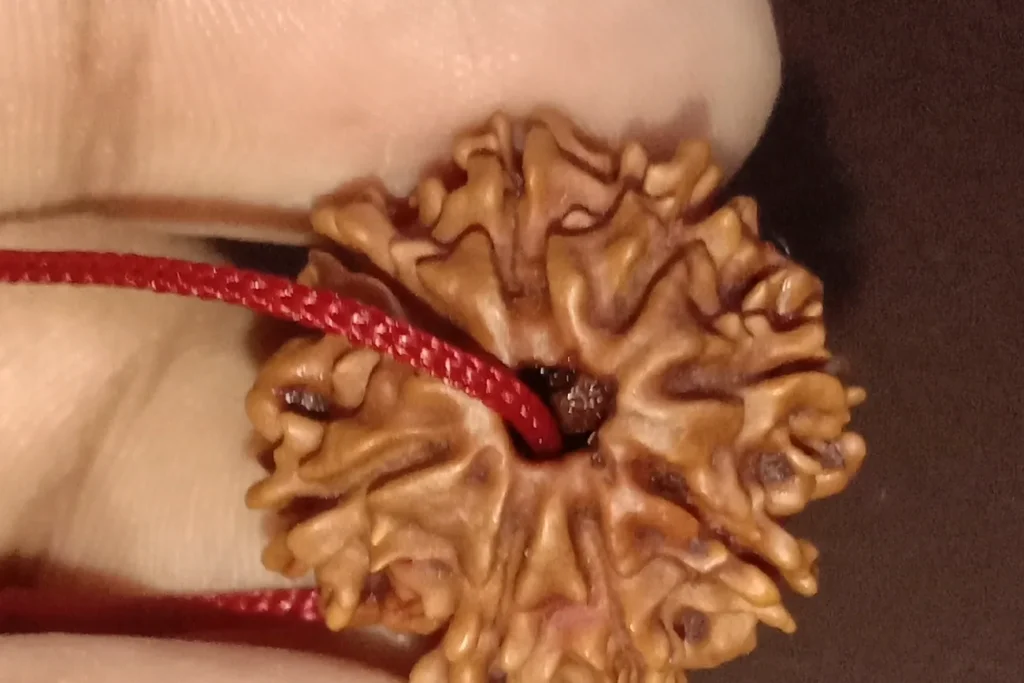
A rudraksha’s mukhi is the number of natural grooves running from one end of the bead to the other. Each groove normally marks a segment with its own seed compartment inside. Traditional texts name deities and merits for 1 to 14 faces, but they do not all agree. The associations usually given for 15 to 21 faces come from modern sellers and astrologers, not from those texts. More faces does not mean better. Higher counts are rarer and more often faked. For any bead, the useful questions are physical: are the lines complete and natural, does an X-ray show the same number of compartments, and can you verify the report?
This is a reference guide to every face count. For buying basics, such as size, origin and how to read a laboratory report, start with our rudraksha buying guide.
What a natural mukhi is
A rudraksha bead is the hard, grooved stone (endocarp) left after the fleshy fruit of an Elaeocarpus tree is removed. Kew’s Plants of the World Online treats the rudraksha name Elaeocarpus ganitrus as a synonym of Elaeocarpus sphaericus (POWO). The stone is divided into segments, called locules. Each one usually contains a seed and shows on the surface as a groove, or “face”.
Three practical points follow:
- A natural mukhi runs the whole length of the bead, from the stalk end to the opposite end, without breaks.
- The faces and the compartments should match. A 5 mukhi bead should show five compartments when X-rayed. Researchers have used X-ray imaging to look inside the endocarp and detect seeds (Singh & Singh, 2020).
- A compartment can be empty. An undeveloped seed does not make a bead fake. The question is whether the segment structure is natural.
Where the traditional associations come from
Two widely cited sources give face-by-face associations for 1 to 14 mukhi:
- The Devi Bhagavata Purana, Book 11, chapter 7. Here we quote the English translation by Swami Vijnanananda (1921–22), published online at sacred-texts.com.
- The Rudrakshajabala Upanishad, checked against an English rendering published at shastras.com (translator not named) and the summary in its Wikipedia article. Translations differ, so treat the column as a guide to where the two texts disagree, not as a definitive reading.
Many other lists circulate, including ones attributed to the Shiva Purana and lists that assign ruling planets. They often disagree with these two and with each other. Where we could not trace an association to a named text, we label it as a seller or modern attribution.
Everything in this section describes belief and tradition. None of it is a testable property of the bead, and nothing here is a promise of health, wealth or any other outcome.
Quick chart: 1 to 21 mukhi
Column key. “Devi Bhagavata” is quoted from Book 11, ch. 7. “Rudrakshajabala” is the Upanishad as summarised. “Seller attribution” is the deity given on a Rudra Centre listing (checked 9 October 2026). The availability notes are general trade observations; check any specific bead.
| Mukhi | Devi Bhagavata (Bk 11, ch. 7) | Rudrakshajabala (summary) | Notes on availability and risk |
|---|---|---|---|
| 1 | “reveals Paratattva (the highest Tattva)” | The Supreme Truth | Round Nepali 1 mukhi is extremely rare and heavily faked. Most “1 mukhi” sold is a different, crescent-shaped bead |
| 2 | “Ardhanârîs’vara” | Ardhanarishvara | Common in Indonesian beads |
| 3 | “Fire made manifest” | The three sacred fires | Common |
| 4 | “Brahmâ Himself” | Four-headed Brahma | Common |
| 5 | “the five faced S’iva Himself” | Pancha-Brahman (five aspects of Shiva) | The most widely sold; the usual mala bead |
| 6 | Kârtikeya | Kartikeya and Ganesha | Common |
| 7 | The seven Mâtrikâs, the Sun and the seven Risis | Seven Matrikas | Fairly common |
| 8 | Brâhmî, the eight Mâtrikâs | Eight-fold Nature, or the eight Vasus | Less common; the two lists differ |
| 9 | Yama | Nine Shaktis | Less common; the two lists disagree |
| 10 | Not clearly stated in this translation (the text appears garbled) | Ten Yamas | Less common |
| 11 | The eleven Rudras and Indra | Eleven Rudras | Less common |
| 12 | Vishnu; the twelve Âdityas | Vishnu and the twelve Adityas | Less common |
| 13 | No form named; “Kâma Deva becomes pleased” with the wearer | Kamadeva | Uncommon |
| 14 | No form named; associated with health | Shiva as Rudra | Rare; frequently faked |
| 15 | Not in this text | Not in this text | Seller attribution: Pashupatinath. Rare |
| 16 | Not in this text | Not in this text | Seller attribution: Mahamrityunjaya Shiva. Rare |
| 17 | Not in this text | Not in this text | Seller attribution: Katyayani Devi. Very rare |
| 18 | Not in this text | Not in this text | Seller attribution: Bhumi Devi. Very rare |
| 19 | Not in this text | Not in this text | Seller attribution: Narayana. Very rare; often quoted individually |
| 20 | Not in this text | Not in this text | Seller attribution: Brahma. Very rare |
| 21 | Not in this text | Not in this text | Seller attribution: Kubera. Extremely rare; collector item |
Read the chart this way. Where the two texts agree, as on 2, 4, 6, 11 and 12, the association is long-standing. Where they differ, as on 9 and 14, neither is “the” meaning. For 15 to 21, what you will see on listings is a convention among sellers, and it varies from seller to seller.
1 to 7 mukhi in detail
1 mukhi. The single-faced bead has the highest status in the texts: the Devi Bhagavata says it “reveals Paratattva”. It is also where buyers most often lose money. Even sellers say that round 1 mukhi from Nepal is “extremely rare and the most faked”, and Rudra Centre states that a round 1 mukhi is usually an underdeveloped 5 mukhi (Rudra Centre). The bead most often sold as “1 mukhi” is a crescent-shaped (half-moon) bead from South India, which sellers list separately. Buy any 1 mukhi only with an X-ray report that you can look up. Our guide to 1 mukhi rudraksha compares round, half-moon and Java beads and what sellers say about each.
2 mukhi. Associated in both texts with Ardhanarishvara, the united form of Shiva and Parvati. Do not confuse it with Gauri Shankar, which is two beads naturally joined; it should be X-rayed to check that it is not two beads glued together. Our guide to Gauri Shankar, Garbh Gauri, Ganesh and 2 mukhi rudraksha explains how to tell these forms apart.
3 mukhi. Associated with fire (Agni) in both sources. Indian “Himalayan” 3 mukhi beads are sold separately by some sellers alongside Nepali and Indonesian ones.
4 mukhi. Associated with Brahma in both lists. One modern seller lists Brihaspati (Jupiter) instead (Rudra Centre listing). A common bead.
5 mukhi. Associated with five-faced Shiva (Pancha-Brahman). It is by far the most widely sold face count, and the usual choice for 108 + 1 japa malas and kanthas. Because it is common, it is rarely worth faking, which makes it the safest beginner bead.
6 mukhi. Associated with Kartikeya (Skanda); the Upanishad summary adds Ganesha. Widely available.
7 mukhi. The Devi Bhagavata gives a composite association: the seven Matrikas, the Sun and the seven Rishis. A modern seller listing names Laxmi, which is not in either text.
8 to 14 mukhi in detail
8 mukhi. Linked to Brahmi and the eight Matrikas in the Devi Bhagavata, but to eight-fold Nature or the eight Vasus in the Upanishad. A modern seller listing gives Ganesh (Rudra Centre listing), an attribution we could not trace to either text.
9 mukhi. This is a clear case of disagreement: Yama in the Devi Bhagavata translation, but the nine Shaktis in the Upanishad summary. A modern seller listing gives Durga, which is closer to the second reading.
10 mukhi. The Vijnanananda translation is confused at this point. It names “ten quarters” under what appears to be the eleven-faced bead. The Upanishad summary associates ten faces with the ten Yamas. A modern seller listing gives Krishna.
11 mukhi. Associated with the eleven Rudras in both sources, and with Indra in the Devi Bhagavata.
12 mukhi. Associated with Vishnu and the twelve Adityas in both. A modern seller listing gives the Sun, which is consistent with the Adityas (solar deities).
13 mukhi. The Devi Bhagavata names no form, only that Kamadeva is “pleased” with the wearer, and the Upanishad summary also gives Kamadeva.
14 mukhi. The Devi Bhagavata associates it with health. The Upanishad summary links it to Shiva as Rudra, and a modern seller listing names Hanuman. The 14 mukhi is valuable enough to be a common target for carving extra lines into a lower bead, so a report with an X-ray is essential. Our 14 mukhi guide covers identification, documents and prices in detail.
15 to 21 mukhi: a conservative account
Neither of the texts above describes beads with more than 14 faces. What sellers attach to 15–21 mukhi is a modern convention: Pashupatinath, Mahamrityunjaya, Katyayani, Bhumi Devi, Narayana, Brahma and Kubera on one large seller’s listing (Rudra Centre). Other sellers give other names. Treat these as sellers’ descriptions, not scripture. For prices, fakes and documents for these beads, see rare rudraksha, 15 to 21 mukhi.
Physically, these beads are rare, large and expensive. They are often sold individually, priced on request rather than listed, and sometimes only through WhatsApp or private sale. That is exactly the setting where a buyer has least information. Specifically:
- Each bead should have its own report, with a photograph, weight, dimensions and the X-ray finding, and the report number should look up on the laboratory’s website.
- Ask for the X-ray images themselves, not just the summary. More faces mean more compartments to count, and partial or merged compartments need interpretation.
- Insist on dimensions. A very small “21 mukhi” should raise questions, because the higher counts are generally found in larger beads.
Variation between traditions
Rudraksha has been written about for centuries in Shaiva and Purana literature, and practice varies by lineage, region and teacher. Three things vary most:
- The deity or form linked to a face count (as the chart shows).
- Recommended numbers of beads. The Devi Bhagavata mentions 108 beads worn as a sacred thread, 50 suspended to the belly, and other counts for neck, arms and wrists (Book 11, ch. 7). Japa practice commonly uses 108 + 1 (the guru bead), with 54 and 27 as shorter forms.
- Ruling planets. Many modern astrological guides assign a planet to each mukhi. These assignments are not in the texts quoted here and differ between sellers; see which rudraksha for which planet or rashi.
If an association matters to you, ask the person advising you which text and verse it comes from.
Checking that the faces are natural
Most fakes are made in one of four ways:
- carving extra lines into a real bead
- filling lines to reduce the count
- gluing beads or pieces together
- carving a lookalike from wood, other seeds or plaster
Hinduism Today‘s investigation names two reliable non-destructive checks: examining the bead under a microscope for glue or carving strokes, and X-raying it to compare compartments with faces (Hinduism Today, 2016). The popular water test is unreliable: immature real beads can float, and fakes can be weighted.
What you can check yourself, with a 10× loupe and good daylight:
| Check | Natural lines | Warning signs |
|---|---|---|
| Line path | Runs from end to end, following the bead’s curve | Stops short, wavers, or starts mid-bead |
| Line depth | Varies naturally; the bead’s surface texture continues into the groove | Uniform, sharp-edged cut; smooth tool-like walls |
| Surface | Projections and texture are continuous | Smoothed or polished patches, especially near one line |
| Ends | The lines converge at both ends | Lines that do not meet, or a plugged or filled end |
| Joins | None (except a naturally joined bead) | A seam, colour change or glue line |
For more on fakes and home tests, see real or fake rudraksha.
How X-ray imaging is used, and its limits
An X-ray image shows the compartments as darker or lighter internal shapes. A careful laboratory images the bead from more than one angle, because compartments can overlap in a single view. One seller, for example, describes “three-angle X-ray imaging” at its own laboratory (RudraKailash). When reading a report:
- Count method: check that the report says an X-ray was performed, not only “visual inspection”.
- Match: the compartment count should equal the surface mukhi.
- Modification: look for any note of filling, joining or carving. The Indian laboratory GJSPC states that its rudraksha reports record “modifications, enhancements, radiography”, with at least two opinions per bead (GJSPC).
- Limits: an X-ray does not show a bead’s age, its spiritual “energy”, or, on its own, its country of origin. Our rudraksha buying guide explains how to read an origin statement.
Combining face counts
Combining beads of different mukhi is common and traditional. Two familiar forms are:
- Siddha mala: typically one bead each of 1 to 14 mukhi, plus Ganesh and Gauri Shankar beads.
- Indra mala: typically 1 to 21 mukhi, plus the same two special beads.
A combination raises two practical issues:
- Fit and balance. Higher-mukhi beads are larger, so a strand of mixed counts can be lopsided or heavy. A good maker orders beads by size and checks the drape.
- Documentation. Every expensive bead in a combination needs its own report, because a strand-level report can hide one doubtful bead.
Some sellers let you specify each bead. GemKrishna’s rudraksha kantha builder, for example, offers a Siddh Mala (1–14 mukhi with Ganesh and Gauri Shankar, 16 main beads) and an Indra Mala (1–21 mukhi with Ganesh and Gauri Shankar, 23 main beads). Each main bead is chosen by size, and the higher Nepali beads are quoted personally. It states that a GJSPC report is included (seller states; checked 9 October 2026). Whatever seller you use, check the reports bead by bead.
Collector’s evidence checklist
- The listing states mukhi, origin, diameter (mm) and weight (g) for the specific bead.
- You have photographs of both ends and two sides, with a scale in the frame.
- The report is from a named laboratory, includes an X-ray, and its number looks up on the laboratory’s own website.
- The report’s photograph, weight and size match the bead you receive.
- Any modification found is stated, and none is acceptable on a rare face count.
- For 1, 14 and 15–21 mukhi, you have seen the X-ray images, not just a summary.
- The return terms cover a bead that turns out not to match its report.
Safe choices for beginners
For a first bead, choose a 5 mukhi. It is the common, affordable bead of japa malas, and it is rarely faked. If you want a different face count, choose from 2 to 7 mukhi, which are widely available in both origins, and buy with a verifiable report. Our comparison of 5, 6 and 7 mukhi rudraksha explains how to count and check each, and what they cost.
FAQ
Which mukhi is best for a beginner?
Most teachers and sellers suggest a 5 mukhi bead or a 5 mukhi mala. It is the most widely available face count, it is inexpensive, and because it is common it is rarely faked. Any spiritual preference beyond that comes from tradition or personal guidance, not from testing.
Does more mukhi mean a better rudraksha?
No. A higher face count is rarer and costs more. But “better” in a traditional sense depends on what the face count is associated with, and physical quality depends on the individual bead: complete natural lines, sound condition, no modification. Rare counts are also faked more often.
Can two different mukhi be worn together?
Yes. Combinations are long-standing, from pairs of beads to the Siddha and Indra malas. Practically, plan the order by size so the strand hangs evenly, and get each valuable bead reported individually.
What should a mukhi report show?
At a minimum:
- the laboratory’s name and a unique report number you can look up online
- a photograph of the bead, with its weight and dimensions
- the mukhi count
- a statement that an X-ray was performed, with the finding
- any modification, filling or joining found
An origin line, where given, is the laboratory’s finding for that bead.
Is a round 1 mukhi always real?
No. Round 1 mukhi beads are extremely rare, and they are a classic target for fraud. Even a major seller says a round 1 mukhi “doesn’t exist” and is usually an underdeveloped 5 mukhi. Do not buy one without an X-ray report that you can verify, and be sceptical of any low price.
Are the 15 to 21 mukhi associations from scripture?
Not from the two texts most often cited, the Devi Bhagavata Purana and the Rudrakshajabala Upanishad, which describe 1 to 14 faces. The deities attached to 15–21 mukhi are modern seller conventions and differ between sellers.
Does an empty compartment mean the bead is fake?
No. A compartment can be empty if a seed did not develop. What matters is that the number of natural segments matches the number of faces, and that there is no sign of carving, filling or joining.
Sources
- Srimad Devi Bhagavatam, Book 11, chapter 7, trans. Swami Vijnanananda (1921–22): sacred-texts.com.
- Rudrakshajabala Upanishad: summary and cited translations (Wikipedia), checked 9 October 2026.
- Rudraksha Jabala Upanishad, English rendering at shastras.com (translator not named), checked 10 October 2026.
- Royal Botanic Gardens, Kew, Plants of the World Online: Elaeocarpus ganitrus.
- Singh, P. & Singh, A. N.: Morphometric characteristics of endocarp, seed and embryo of Elaeocarpus ganitrus, Journal of Non-Timber Forest Products 27(3), 2020.
- Hinduism Today: How common are fake rudrakshas?, 2016.
- GJSPC Laboratory: rudraksha testing and certification, checked 9 October 2026.
- Rudra Centre (seller): 1 to 21 mukhi Java rudraksha listing, checked 9 October 2026.
- GemKrishna (seller): rudraksha kantha builder, checked 9 October 2026.
- RudraKailash (seller): homepage, checked 9 October 2026.
Next steps
Learn how to spot a fake rudraksha, read our rudraksha buying guide, or see how testing laboratories compare.