The short answer
- The difference is the number of natural lines (faces) running from end to end: five, six or seven. Each face normally corresponds to an internal compartment.
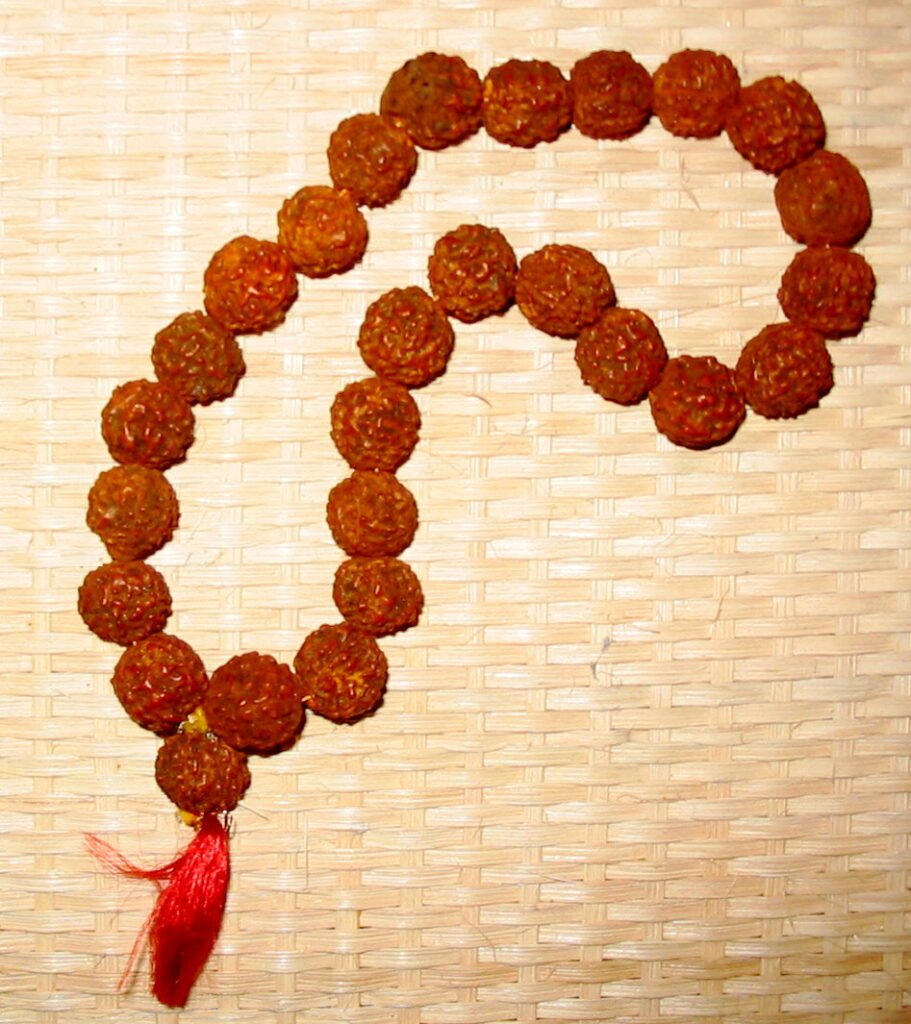
- 5 mukhi is by far the most common rudraksha. A Government of India agricultural profile notes that almost 99% of beads are five-compartment “panch mukhi” (Vikaspedia). That is why it is inexpensive, and why it is rarely worth faking.
- 6 and 7 mukhi are less common and cost more, so a carved extra line on a 5 or 6 mukhi bead is the main fake to watch for.
- Prices (one large seller, 11 October 2026): Nepali 5 mukhi from ₹45 (18 mm), 6 mukhi from ₹90, 7 mukhi from ₹495, with larger and collector beads much higher (Rudra Centre).
- A laboratory report can cost more than a small 5 mukhi bead. It is usually worth it for a single 7 mukhi or a larger bead, and rarely for an ordinary 5 mukhi.
- Traditional associations differ between the texts and sellers. They are beliefs, not properties of the bead, and there are no physical “side effects”.
How the three compare
| 5 mukhi (panch mukhi) | 6 mukhi | 7 mukhi | |
|---|---|---|---|
| Faces | Five natural lines, end to end | Six | Seven |
| How common | The great majority of all beads | Much less common | Less common still |
| Typical use | Japa malas, single beads, bracelets | Single beads, bracelets, combination malas | Single beads, pendants, combination malas |
| Main fake risk | Low (too cheap to fake) | A carved line on a 5 mukhi | A carved line on a 5 or 6 mukhi |
| Devi Bhagavata (Book 11, ch. 7) | “The five faced Śiva Himself” | Presiding deity Kārtikeya; “some Pundits take Gaṇapati” | The seven Mātṛkās, the Sun and the seven Ṛṣis; “prosperity is increased, health and the pure knowledge are established” |
| Rudrakshajabala Upanishad (summary) | Pancha-Brahman, five aspects of Shiva | Kartikeya and Ganesha | Seven Matrika goddesses |
| Seller attribution (Rudra Centre) | Kalagni Rudra; Jupiter | Kartikeya; Mars | Goddess Lakshmi; Venus |
Sources: Devi Bhagavata, trans. Swami Vijnanananda (sacred-texts.com); Rudrakshajabala Upanishad (Wikipedia summary); Rudra Centre product pages for 5, 6 and 7 mukhi, checked 11 October 2026.
The texts and the seller do not agree on everything. The Devi Bhagavata chapter does not assign planets to these beads; the planetary pairings used today come from other sources and seller conventions, and they vary. Our 1 to 21 mukhi guide sets out the traditions for every face.
Why faces and compartments matter
The lines on a rudraksha bead follow its internal compartments (locules). The Vikaspedia profile explains that the sculpturing of the bead is associated with the locules, that five is the norm, and that “abnormal” beads may have from one to eight. Hinduism Today describes the laboratory logic: “Each segment of a rudraksha contains a seed compartment”, and if the compartment count on an X-ray “does not match the number of outward faces, it’s likely there has been tampering” (Hinduism Today, 2016).
So a genuine 7 mukhi should show seven complete natural lines and seven compartments. A 5 mukhi with two carved lines shows seven lines but only five compartments.
How to count and check at home
- Use daylight and a 10× loupe. Photograph both ends and four sides.
- Start at one end. Natural lines converge towards the ends. Mark a starting line with washable ink.
- Follow each line from end to end. A full face runs the whole length. Lines that stop short, branch or wander are not full faces.
- Count again from the other end. The counts should match.
- Look closely at each line. Carved lines tend to be straighter, more even and sharp-walled, and they cut across the bead’s natural surface texture instead of following it.
- Ignore the water, coin and boiling tests. They prove nothing, and boiling can damage a bead; see real or fake rudraksha.
Common counting mistakes:
- Counting a deep natural fold as a face.
- Missing a shallow line that an X-ray shows clearly.
- Double-counting where two lines meet near an end.
Prices: what one large seller charged
Rudra Centre’s product pages on 11 October 2026 listed these Nepali beads:
| Bead | Smallest listed | Regular | Large | Higher grades |
|---|---|---|---|---|
| 5 mukhi | ₹45 (18 mm) | ₹150 (20 mm) | ₹250 (22 mm) | ₹945 (23–24 mm “Large”) |
| 6 mukhi | ₹90 (18 mm) | ₹300 (20 mm) | ₹450 (22 mm) | ₹2,100 (26 mm collector beads) |
| 7 mukhi | ₹495 (18 mm) | ₹950 (20 mm) | ₹1,800 (22 mm) | ₹3,500 (23 mm collector) |
The same pages state general price ranges of ₹10 to ₹1,600 for 5 mukhi, ₹90 to ₹1,500 for 6 mukhi and ₹495 to ₹2,100 for 7 mukhi, and Nepali size ranges of about 18 to 29 mm. Listings and ranges do not always agree, which is common on seller pages. Use them as a guide, not a quote.
What moves the price: origin (Nepali beads are generally larger and priced higher than Indonesian ones; see Nepali vs Indonesian rudraksha), size, line clarity, condition and documentation. Size matters more than it looks, because volume rises with the cube of the diameter; see our rudraksha size guide.
In custom bracelets, some builders treat small 4 to 7 mukhi beads as standard. GemKrishna’s custom bracelet builder, for example, lists 4, 5, 6 and 7 mukhi rudraksha among its “included” beads at no charge above the base bracelet price (₹999 for 8 mm beads on 11 October 2026), with larger “premium” beads priced separately.
When is a laboratory report worth it?
Compare the cost of the report with the cost of the bead.
| Bead | Typical price (examples above) | Is an individual report worth it? |
|---|---|---|
| Small 5 mukhi | Tens to a few hundred rupees | Rarely. A report can cost more than the bead. Buy from a seller who states mukhi and origin honestly and accepts returns |
| 5 mukhi japa mala | Depends on bead size and stringing | Ask whether one report covers the strand, and what it says |
| 6 mukhi, regular to large | A few hundred to about ₹2,000 | Optional; worthwhile for larger beads |
| 7 mukhi, single bead | About ₹500 to ₹3,500 and above | Usually yes, especially above the smallest sizes |
For scale: GJSPC’s charges supplied by the laboratory in October 2026 were ₹350 per piece for a 2 to 17 mukhi origin report, or ₹200 per piece for 2 to 14 mukhi submitted in bulk; these charges are not published on its website and have not been independently verified, so confirm the current fee with GJSPC. Our X-ray guide explains what such a report should show, and how to verify a report online explains how to check its number.
Questions readers ask
How many 7 mukhi beads should be worn? Traditions and teachers differ: a single bead, a small number on a bracelet or a full mala are all common. The texts cited above do not set a number for daily wear. Choose for comfort and budget.
Can women wear 5, 6 or 7 mukhi? There is no physical restriction. Customs about who may wear rudraksha, and when, vary between traditions and teachers.
Are there side effects? A rudraksha bead is a dried fruit stone. It has no pharmacological effect. “Side effects” described by sellers are beliefs about spiritual consequences, not physical ones. If a bead irritates your skin, the cause is usually the thread, metal capping or a surface treatment.
Buying checklist
- Count the faces yourself from end-to-end photos before paying
- Mukhi, origin, size (mm) and weight stated in writing
- For a single 7 mukhi or a larger 6 mukhi, a report with X-ray and a verifiable number
- Compare like with like: same origin and similar size
- Return terms in case a second check finds a carved line
- Stringing or capping that does not hide the lines; see rudraksha silver capping
FAQ
What is the difference between 5, 6 and 7 mukhi rudraksha?
The number of natural lines (faces) running end to end, which normally matches the number of internal compartments. 5 mukhi is the most common and least expensive; 6 and 7 mukhi are less common and cost more.
How do I check that a 5 mukhi rudraksha is original?
Count five complete natural lines from end to end under magnification, and look for carving, glue or filler. Because 5 mukhi beads are so common and inexpensive, they are rarely faked; the bigger risk is a lower-quality bead sold at a premium.
What does “certified 5 mukhi” mean?
Usually that a laboratory or the seller has issued a document. Check which laboratory issued it, whether it covers that exact bead, and whether its number can be verified on the laboratory’s own website.
What is the price of an original 7 mukhi rudraksha?
On 11 October 2026, one large seller listed Nepali 7 mukhi beads from ₹495 (18 mm) to ₹3,500 (23 mm collector beads). Indonesian beads generally cost less.
Which rashi or planet is 6 mukhi associated with?
That depends on the seller’s convention. The Devi Bhagavata names Kartikeya (or, for some, Ganapati) as the presiding deity and does not assign a planet. One large seller pairs 6 mukhi with Mars. These are beliefs, not properties of the bead.
Sources
- Srimad Devi Bhagavatam, Book 11, chapter 7, trans. Swami Vijnanananda: sacred-texts.com, checked 11 October 2026.
- Wikipedia: Rudrakshajabala Upanishad (summary of face–deity associations), checked 11 October 2026.
- Vikaspedia (Government of India): Elaeocarpus sphaericus (locules; about 99% five-loculed beads), checked 11 October 2026.
- Rajiv Malik, Hinduism Today: How common are fake rudrakshas?, October–December 2016, checked 11 October 2026.
- Rudra Centre (seller): 5 mukhi, 6 mukhi and 7 mukhi listings, ranges and attributions, checked 11 October 2026.
- GemKrishna (seller): Custom bracelet builder (included rudraksha, base price), checked 11 October 2026.