The short answer
| Name | What it physically is |
|---|---|
| 2 mukhi | One bead with two natural face lines |
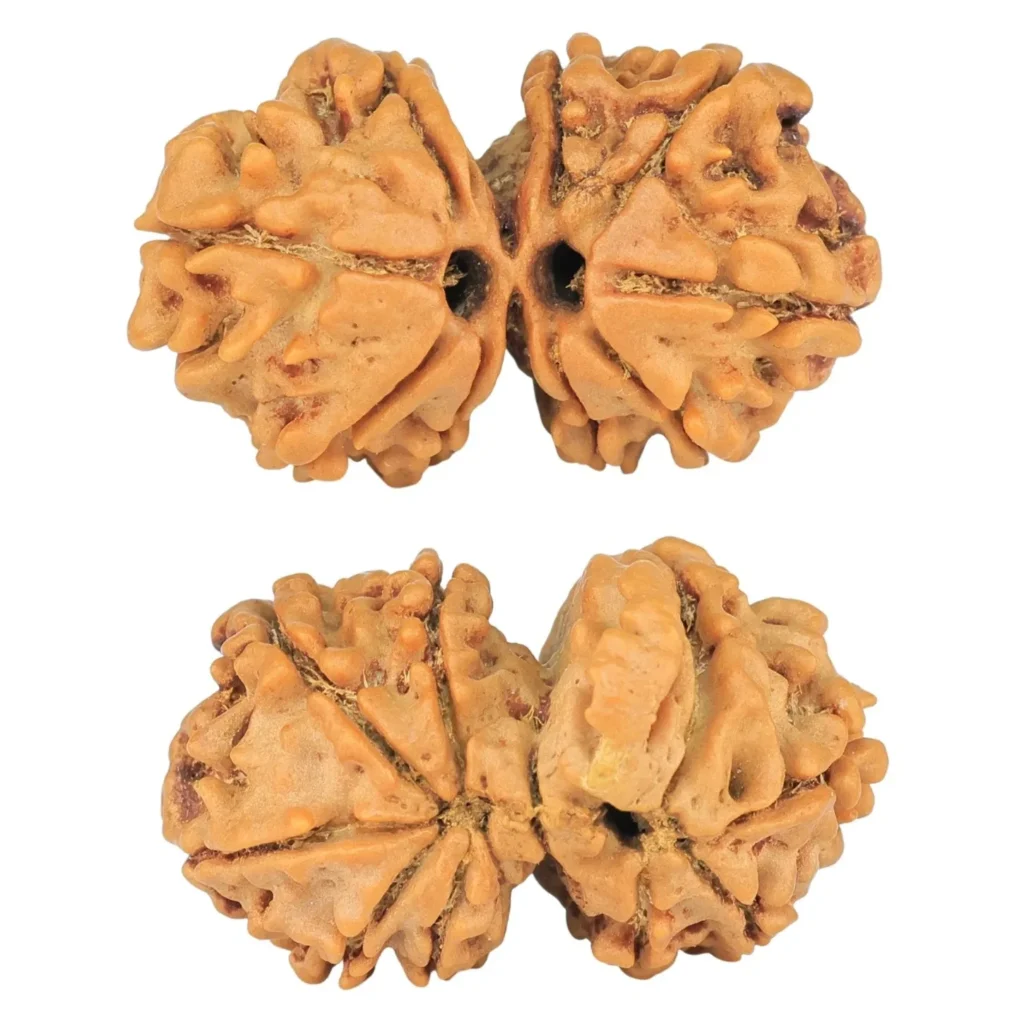
| Gauri Shankar | Two beads naturally joined, of roughly similar size |
| Garbh Gauri | Two beads naturally joined, one clearly smaller than the other |
| Ganesh | One bead with a natural trunk-like protrusion |
These definitions are from the descriptive literature cited by Wikipedia (Rudraksha, citing Seetha, Power of Rudraksha, 2005).
The main frauds are gluing two beads together to make a “Gauri Shankar” or “Garbh Gauri”, and carving extra lines or a “trunk”. Inspection under magnification and an X-ray from a laboratory are the reliable checks. Home tests such as floating in water are not.
Why these four get confused
All four are tied to themes of union or of Ganesha, and all four are sold as “rare” or “special” beads.
- A 2 mukhi is associated in the Devi Bhagavata Purana and the Rudrakshajabala Upanishad with Ardhanarishvara, the united form of Shiva and Parvati. See our 1 to 21 mukhi guide.
- A Gauri Shankar is described by sellers as the “unified form of Shiva and Shakti” (Rudra Centre listing).
The meaning sounds similar, so buyers mix up the objects. Physically, one is a single bead and the other is two beads joined. That difference matters, because it determines how each can be faked and checked.
Side-by-side comparison
| 2 mukhi | Gauri Shankar | Garbh Gauri | Ganesh | |
|---|---|---|---|---|
| Number of beads | One | Two, joined | Two, joined | One |
| Shape | Usually oval or slightly flattened | Two similar beads side by side | One large and one small bead | Bead with a protruding “trunk” |
| How mukhi is described | 2 faces | Often as the total faces of the pair (for example “9 mukhi Gauri Shankar”) | As above | Often stated with the bead’s own mukhi |
| Main fraud | Lines carved on, or lines filled in | Two beads glued; join hidden | Small bead glued to a large one | Trunk carved or attached |
| Key check | Natural lines run end to end; X-ray compartments match faces | Junction under magnification; X-ray of both halves | Same as Gauri Shankar | Trunk is continuous with the bead’s surface |
| Traditional association (belief) | Ardhanarishvara (texts) | Shiva and Parvati as one (seller description) | Parvati and Ganesha (seller description) | Ganesha |
Traditional associations are listed so that you can identify what is being sold. They are beliefs, not physical properties, and texts and sellers differ. See Where the traditional associations come from in our mukhi guide.
2 mukhi rudraksha
A 2 mukhi is a single bead whose surface is divided by two natural lines (clefts) running from one end to the other. In the descriptive literature, each face is “separated by a line or cleft along the bead” (Wikipedia). Inside, a natural bead has seed compartments (locules); an X-ray of a natural bead typically shows the compartments corresponding to its faces.
Indonesian and Nepali 2 mukhi: small Indonesian (Java) 2 mukhi beads are common. Larger Nepali beads are scarcer and priced higher. Origin claims cannot be confirmed by appearance alone; see Nepali vs Indonesian rudraksha.
Main risk: a bead with more faces has lines filled in, or a bead has extra lines carved. Check that each line runs the full length, end to end, and that the bead’s natural surface texture continues into the groove.
Gauri Shankar
What it is: two beads “naturally conjoined”, with both “somewhat of similar sizes” (Wikipedia, citing Seetha 2005). Sellers often state the combined faces of the pair. One seller’s listings, for example, include “Gauri Shankar 9 Mukhi from Nepal” and “Gauri Shankar 11 Mukhi Large from Nepal” (Rudra Centre, checked 11 October 2026).
What to check:
- The junction. In a natural pair, the surface texture flows continuously from one bead into the other at the join, without a seam, adhesive line, smoothed patch or filler. Look under a 10× loupe in daylight, all the way round.
- The holes. Ask whether the piece is drilled, through which bead or beads, and look closely at every entry point. A drill channel can also hide filler.
- The faces. Each bead’s lines should run end to end on that bead.
- The X-ray and report. The report should cover the pair, describe it as a joined bead, and record any modification. Laboratories such as GJSPC list “modification” among the factors in their rudraksha grading report (GJSPC).
Seller prices, for scale (not a market survey): on 11 October 2026, one large seller listed Nepali Gauri Shankar beads of 25–34 mm at ₹6,500–₹9,000 each. It stated that an X-ray certificate costs an additional ₹500 per bead (Rudra Centre). Other sellers will differ, so compare with full disclosure, not on price alone.
Garbh Gauri
What it is: “also naturally joined two beads but one bead is smaller and other is larger” (Wikipedia, citing Seetha 2005). One seller also calls it “Ganesh Gauri” and describes it as “ruled by Goddess Parvati and Lord Ganesha” (Rudra Centre, Garbh Gauri).
The specific fraud: a small bead glued onto a larger one, with the join disguised. The checks are the same as for a Gauri Shankar, with extra attention to the junction: the surface texture should run continuously from the smaller bead into the larger one, with no seam, adhesive or filler.
Seller prices, for scale: the same seller listed Nepali Garbh Gauri beads of 28–40 mm at ₹6,500–₹18,000 on 11 October 2026 (Rudra Centre).
Ganesh rudraksha
What it is: a bead with “a trunk-like protrusion on their bodies” (Wikipedia, citing Seetha 2005). It is a natural growth feature on an otherwise ordinary bead.
Fraud to watch for: a “trunk” carved from the bead’s own surface, or a separate piece attached. Check that:
- the protrusion’s surface texture is continuous with the rest of the bead;
- there are no tool marks, smoothed facets or adhesive lines where it meets the bead;
- the bead’s own face lines are natural, running end to end.
Ganesh and Gauri Shankar beads both appear in traditional combination malas. The Siddh layout uses one bead each of 1 to 14 mukhi plus a Ganesh and a Gauri Shankar; the Indra layout uses 1 to 21 mukhi plus the same two. See how a custom kantha is built.
How fakes are made, and how they are caught
| Technique | What it produces | How it is detected |
|---|---|---|
| Gluing two beads | Fake Gauri Shankar or Garbh Gauri | Magnification at the junction (“glue or carving strokes”); X-ray |
| Carving extra lines | Higher mukhi than the bead has | Lines that stop short or have sharp tool walls; X-ray compartments do not match faces |
| Carving or attaching a trunk | Fake Ganesh | Tool marks, discontinuous texture |
| Filling lines | Lower mukhi (rarer for some faces) | Magnification; X-ray |
Hinduism Today‘s investigation describes laboratory examination under a microscope for “alterations, such as glue or carving strokes”. It also describes X-ray: if “the number of seed compartments shown by x-ray does not match the number of outward faces”, tampering is indicated (Hinduism Today, 2016). The same article found that fakes were less widespread than it had been led to believe. Testing remains worthwhile for expensive special beads.
The limits of an X-ray
- An X-ray shows internal compartments. It is strong evidence about faces, and can reveal joins and inserts. It is not a certificate of origin, age or “energy”.
- One seller notes that seeds in the X-ray “may be compressed and not all visible” (Rudra Centre). Interpretation needs experience, which is why the report matters more than the image.
- Origin (Nepal or Indonesia) is generally a judgement from shape, size and features. Read exactly what a report says about origin. See our X-ray guide.
Home checks that work, and those that do not
Useful at home:
- A 10× loupe in daylight: junctions, line paths, tool marks, filler.
- Photographs of every side, both ends and the junction, with a ruler in the frame. These are useful if you need a second opinion or a return.
- Weighing and measuring: compare against the seller’s stated size and weight.
Not reliable: the water float test, the “copper coin” test and the “two coins rotation” test. Immature real beads can float and fakes can be weighted. Our real vs fake guide explains why.
Buying checklist
- Know which object you want: a single 2 mukhi bead, or two joined beads (Gauri Shankar or Garbh Gauri).
- Ask for photographs of the junction from several angles, with a scale.
- Ask whether the price includes an X-ray and a laboratory report, which laboratory, and whether the report number can be verified online. See verifying a report online.
- Ask how the mukhi is stated: per bead or combined for a pair.
- Get the origin, size and weight in writing.
- Read the return terms in case a laboratory finds a join or carving.
- If the bead is going into a mala, kantha or capping, ask whether drilling or capping could damage the junction.
FAQ
Is a 2 mukhi rudraksha the same as a Gauri Shankar?
No. A 2 mukhi is one bead with two face lines. A Gauri Shankar is two beads naturally joined. Texts associate the 2 mukhi with Ardhanarishvara; sellers describe the Gauri Shankar as the union of Shiva and Shakti.
What is the difference between Gauri Shankar and Garbh Gauri?
Both are naturally joined pairs. In a Gauri Shankar the two beads are of similar size. In a Garbh Gauri one bead is clearly smaller than the other.
How can I tell if a Gauri Shankar is glued?
Examine the junction under magnification: look for a seam, adhesive, filler or a break in the surface texture. For a costly bead, rely on a laboratory examination with X-ray, and a report that states the bead is unmodified.
What does “9 mukhi Gauri Shankar” mean?
Sellers often describe a joined pair by the total number of faces across both beads. Ask the seller to confirm how they count, and make sure the report describes the same piece.
Are Ganesh rudraksha beads natural?
A genuine Ganesh bead has a natural trunk-like protrusion. Carved or attached “trunks” exist, so check for tool marks and continuous surface texture.
Is there a “side effect” of wearing 2 mukhi or Gauri Shankar?
There is no evidence of physical side effects from wearing a rudraksha bead, beyond those of any bead jewellery, such as skin irritation from thread, metal or dyes. Claims of spiritual harm or benefit are beliefs and differ between traditions.
Sources
- Wikipedia: Rudraksha (definitions of Gauri Shankar, Garbha Gauri and Ganesha beads, citing Seetha, N. K., Power of Rudraksha, 2005), checked 11 October 2026. The descriptions rest on a single devotional-market book, so they are cited as definitions in use, not as scientific classification.
- Malik, R. / Hinduism Today: How common are fake rudrakshas?, October–December 2016, checked 11 October 2026.
- GJSPC Laboratory: Rudraksha testing and certification, checked 11 October 2026.
- Rudra Centre (seller): Gauri Shankar rudraksha and Garbh Gauri rudraksha listings, descriptions, prices and X-ray fee, checked 11 October 2026. Seller statements are quoted as such.
- Devi Bhagavata Purana (Book 11, ch. 7) and Rudrakshajabala Upanishad, as cited in our 1 to 21 mukhi guide.
Related reading
- 1 to 21 mukhi rudraksha: a guide to faces, beliefs and authenticity
- Rudraksha X-ray test: what it shows, what it costs and where to get it
- Real or fake rudraksha? Common fakes, popular myths and the checks that actually work
- How a custom rudraksha kantha is built: Siddh vs Indra mala, back chain, length and construction