The short answer
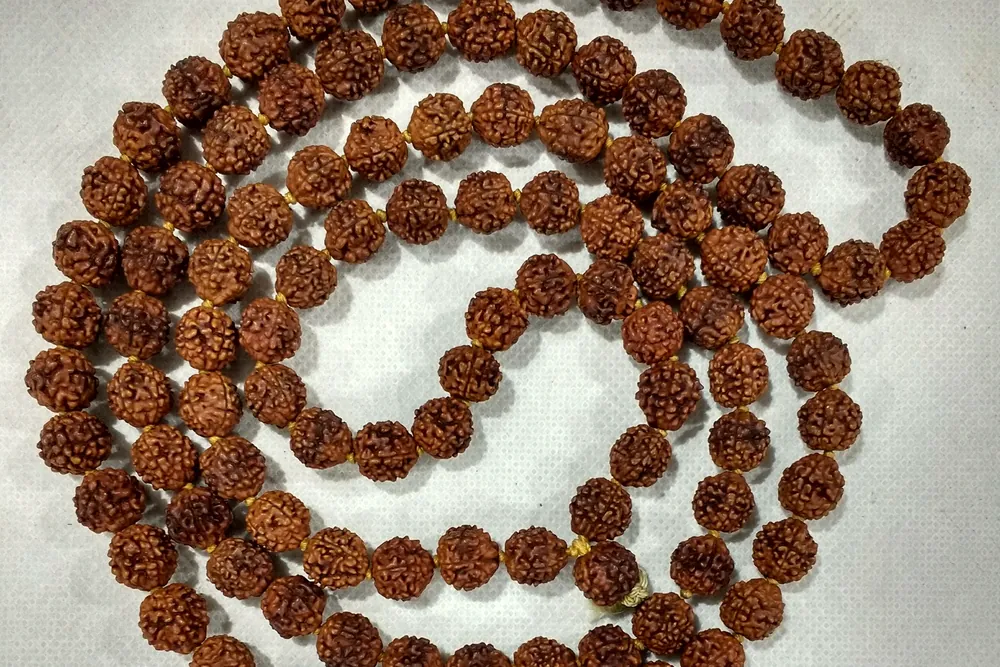
Rudraksha size is the bead’s diameter in millimetres, measured across its widest point. It is usually sold as a range, such as “15–17 mm”.
- Nepali beads are generally larger, often about 15–25 mm for common mukhis.
- Indonesian (Java) beads are generally smaller, from about 6 mm upwards.
Larger beads of the same mukhi and origin are rarer and cost more. For everyday wear, comfort matters more than size:
- 5–8 mm suits a 108-bead japa mala;
- 8–12 mm suits most bracelets;
- larger beads are usually worn singly or as the main beads of a kantha.
The Devi Bhagavata ranks larger beads higher, but that is a traditional preference, not a measure of authenticity.
How rudraksha is measured
- Use a calliper (a plastic vernier calliper is cheap and accurate enough).
- Measure across the widest part of the bead, at right angles to the hole. This is the “size” sellers quote.
- Optionally, measure the length along the hole too. Many beads are slightly oval, so the two figures differ.
- Weigh it on a jewellery scale (0.01 g). Weight for a given size is a useful check for both freshness and fakes. Moulded imitations often feel wrong for their size.
Ranges, not exact sizes. Natural beads vary, so sellers grade them into bands such as 6–8 mm or 8–10 mm. A bead at the top of a band can cost noticeably more than one at the bottom.
Size by origin: typical published ranges
Size ranges published by sellers are seller statements, but they show the general pattern. One builder we reviewed lists the following on 10 October 2026:
- Indonesian beads in bands from 6–8 mm up to 18–20 mm or more, depending on mukhi;
- Nepali beads mostly at 15–17 mm for 2–6 mukhi, 17–20 mm for 7, 8, 10, 12 and 13 mukhi, and 18–22 mm and above for 14 mukhi and higher.
| Nepali | Indonesian (Java) | Indian (e.g. half-moon 1 mukhi, Rameshwaram) | |
|---|---|---|---|
| Typical size | Larger, often 15–25 mm | Smaller, from about 6 mm | Varies; often sold “size on request” |
| Lines (mukhis) | Deep, prominent | Shallower, finer | Varies by type |
| Weight for size | Heavier, more open texture | Denser, smoother | Varies |
| Price for the same mukhi | Usually higher | Usually lower | Often quoted individually |
Origin is a common place for mislabelling. Our rudraksha buying guide explains how to judge it.
Does size matter?
In tradition. The Devi Bhagavata Purana (Book 11, ch. 7) says:
“The Rudrâksam seed that is of the size of an Âmalakî is the best; which is of the size of a plum, is middling; and which is of the size of a gram is the worst.”
trans. Swami Vijnanananda, sacred-texts.com
So texts prefer larger beads. The same tradition values small beads for japa malas, because a 108-bead strand of large beads is heavy and long.
In price. For a given mukhi and origin, a larger bead is rarer and dearer.
In authenticity. Size proves nothing. A large bead can be a carved or joined fake, and a small Java bead can be perfectly genuine. Check mukhi lines and documentation; see our real vs fake rudraksha guide.
Which size for which use
| Use | Common bead size | Why |
|---|---|---|
| 108 + 1 japa mala | 5–8 mm (Java), sometimes up to 10 mm | Light, easy to move bead by bead; a reasonable length |
| 54 or 27 bead mala | 6–10 mm | Shorter strand; wearable on the wrist (27) |
| Bracelet | 8–12 mm base beads; main beads up to about 18 mm | Fits the wrist; large beads feel bulky and catch on sleeves |
| Kantha (necklace) | Main beads 10–25 mm or more; smaller back-chain beads | Main beads are seen at the front; smaller beads complete the back |
| Single pendant | Any, often a larger premium bead | Worn alone, often capped in silver |
Length and weight: a worked example
The length of a strand is roughly bead count × bead diameter, plus knots and fittings:
- 108 beads × 6 mm ≈ 65 cm of beads;
- 108 beads × 8 mm ≈ 86 cm;
- 108 beads × 10 mm ≈ 108 cm.
Knotting between beads adds roughly 10–15%, depending on thread thickness. That is why 108-bead malas of large beads are worn long or doubled.
For a bracelet, a common formula is wrist circumference in mm ÷ bead size, plus one bead for comfort. A 7-inch (178 mm) wrist with 10 mm beads needs about 18 + 1 = 19 beads. Large main beads take the space of more than one base bead, so builders adjust the count.
Size and comfort: practical points
- Bigger beads are heavier on the neck and wrist. A Nepali 25 mm bead weighs several times a 10 mm Java bead.
- Mixed sizes look deliberate when graded. In a kantha, matching sizes in pairs left and right looks balanced.
- Thread and hole size. Large beads with small holes may need thinner thread or wire. Ask how the maker will string them.
- Capping adds size. Silver caps add a few millimetres at each end.
Buying checklist
- Ask for the size in mm of the actual bead, or the band it falls in.
- Ask for the weight in grams.
- Compare the price against the band, not against the mukhi alone.
- For high-value beads, ask for a report that states size, weight and mukhi, and check it online. Our laboratory guide explains how.
- For a strand, ask for the finished length.
FAQ
Which size rudraksha is best?
There is no single best. Tradition prefers larger beads. In practice, choose by use: small for japa, medium for bracelets, larger for kanthas and pendants. Then choose by budget, because larger beads of the same mukhi cost more.
Is a small rudraksha fake?
No. Indonesian beads are naturally small. Size alone says nothing about authenticity.
What is the smallest rudraksha size?
Sellers commonly list Indonesian beads from about 5–6 mm. Very small beads are used in fine malas.
Do Nepali and Indonesian beads of the same mukhi have the same effect?
That is a question of belief. Many sellers and teachers say the mukhi, not the origin, is what matters traditionally. Physically, Nepali beads are larger and heavier.
How do I measure rudraksha size at home?
With a calliper, across the widest part of the bead at right angles to the hole. A ruler gives only a rough figure.
Sources
- Devi Bhagavata Purana, Book 11, chapter 7, trans. Swami Vijnanananda, sacred-texts.com, checked 10 October 2026.
- GemKrishna, Custom Rudraksha Bracelet Builder (published size bands, seller statements), checked 10 October 2026.
- Rudra Centre, Nepal and Java rudraksha (seller article), checked 10 October 2026.
Related reading
- Rudraksha buying guide: mukhi, origin, size, testing and custom jewellery
- Real or fake rudraksha? Common fakes, popular myths and the checks that actually work
- Crystal bead bracelets: choosing stones, bead sizes, fit, construction and reports
- Nepali vs Indonesian rudraksha: origins, size, testing and buying
- Rudraksha silver capping: designs, 925 vs German silver, cost and care