The short answer
A good combination bracelet starts with fit and material, not with a list of intentions.
- Choose a bead size that suits your wrist: 8 mm is subtle and 10 mm is bolder.
- Size it from a snug wrist measurement plus a comfort allowance.
- Pick two or three stones of similar hardness, so the harder beads do not scratch the softer ones.
- Choose the construction: elastic for ease, a lock for security.
- Arrange the stones in a simple repeating pattern.
The intentions people attach to stones, such as calm, focus or protection, are traditional and personal beliefs. They should never be sold as guaranteed health or money outcomes. Ask for every stone to be named, with any treatment, on a report.
For bead basics, see our crystal bead bracelet guide. To make it last, see how to care for a crystal bead bracelet.
Start with comfort and bead size
| Bead size | Look | Weight on the wrist | Typical wearer |
|---|---|---|---|
| 6 mm | Delicate; stacks well | Light | Small wrists; stacking several bracelets |
| 8 mm | Classic, understated | Light to moderate | Most wrists; everyday wear |
| 10 mm | Bold; shows each stone clearly | Moderate | Larger wrists; single statement bracelet |
| 12 mm | Very bold | Heavier | Large wrists; occasional wear |
Bead volume, and so weight, rises with the cube of the diameter. A 10 mm bead has about twice the volume of an 8 mm bead (10³ ÷ 8³ ≈ 1.95). That is why 10 mm bracelets feel noticeably heavier.
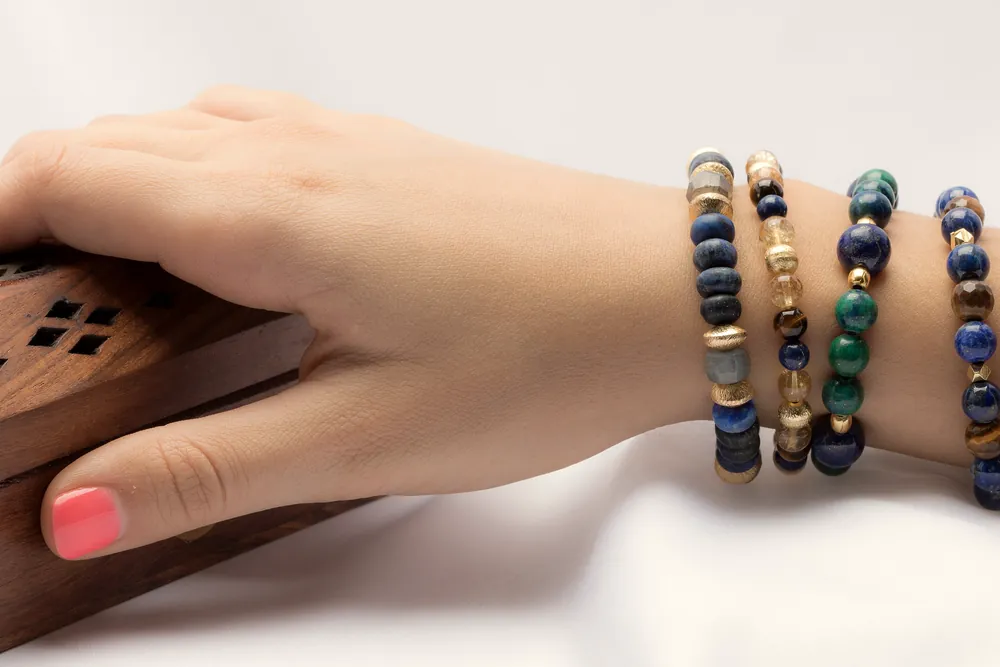
Two-stone and three-stone designs
Two stones give the cleanest look. Common patterns:
- Alternating: A–B–A–B all the way round.
- Blocks: 3 × A, then 1 × B, repeated.
- Feature: all A, with 1–3 B beads at the front.
Three stones need a little more discipline:
- Repeating triplet: A–B–C repeated.
- Base and accents: mostly A, with B and C as accents.
- Gradient: light to dark around the wrist, when the colours sit close together.
More than three works best as a random mix of similar sizes and finishes, or as a deliberately arranged pattern. Beyond six or seven types, many makers arrange the order themselves for balance.
Colour harmony
| Approach | Example combination | Effect |
|---|---|---|
| Tonal (one colour family) | Amethyst + lepidolite + clear quartz | Calm, coordinated |
| Contrast | Lapis lazuli + citrine | Striking blue and gold |
| Neutral + colour | Smoky quartz + tiger’s eye + one rose quartz feature | Understated |
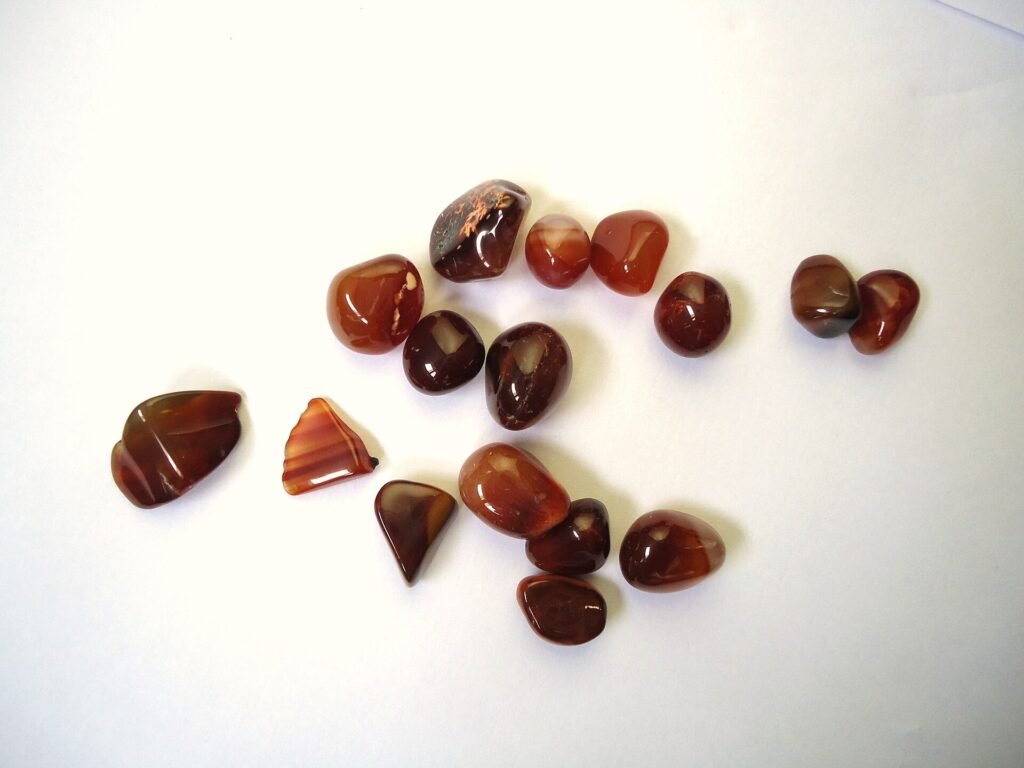
| Earth tones | Red jasper + carnelian + tiger’s eye | Warm |
| Monochrome | Black obsidian + hematite + clear quartz | Graphic |
Matte and polished beads can be mixed for texture. Faceted beads add sparkle, but they rub other beads harder.
Hard and soft stones: wear considerations
Beads rub against each other with every movement. A harder bead slowly scratches a softer one. Combine stones of similar hardness, or separate soft stones with spacers.
| Hardness group (Mohs) | Stones | Pair with |
|---|---|---|
| 6.5–7 | Quartz family (clear, rose, smoky, amethyst, citrine, tiger’s eye, aventurine), agate, carnelian, onyx, jasper | Each other; feldspars |
| 6–6.5 | Moonstone, sunstone, labradorite, amazonite, nephrite jade | Quartz family and each other |
| 5–6 | Lapis lazuli, sodalite, turquoise, obsidian, hematite | Each other; use spacers next to quartz |
| 3–4 | Fluorite, malachite, dyed howlite or magnesite | Keep separate, or separate with spacers; avoid next to quartz |
Hardness values are standard Mohs figures; our crystal bead bracelet guide covers stone identity in more detail.
Water and care also need to match. Pyrite, hematite, malachite and turquoise dislike water. If you combine them with stones you might rinse, the whole bracelet has to be cared for as if it were the most delicate stone.
Elastic, locks and spacers
| Option | For | Watch for |
|---|---|---|
| Elastic | Easy on and off; no clasp to fail | Loses stretch over time; roll it on rather than pulling; restring when slack |
| Magnetic lock | Quick, secure fastening on cord | A magnetic clasp can attach to metal objects. If you have an implanted medical device, ask your doctor about magnets near it |
| Metal clasp (e.g. 925 silver) | Traditional, secure | The clasp takes the place of one or two beads; check the metal |
| Spacers (silver, brass, steel) | Separating beads; adding a metal accent | Hard steel spacers can mark soft stones; silver is softer than most stones |
| Knotted cord | Traditional look; protects beads from rubbing | Thicker look; restringing costs more |
A worked sizing example: a 7-inch wrist
Bracelet sizing is arithmetic. Check the formula with your maker, because some add the comfort allowance for you.
- Snug wrist measurement: 7.0 inches = 7.0 × 25.4 = 177.8 mm.
- Beads to go round the wrist: 177.8 ÷ bead diameter. For 8 mm beads, 177.8 ÷ 8 = 22.2, so about 22 beads. For 10 mm beads, 177.8 ÷ 10 = 17.8, so about 18 beads.
- Comfort allowance: add about one bead, giving about 23 beads at 8 mm or about 19 beads at 10 mm.
- Clasp or lock: remove beads equal to the clasp’s length. For example, a lock that replaces one bead means 22 beads plus the lock at 8 mm.
- Spacers and charms add length; remove beads to compensate.
A tighter or looser fit is a personal choice: subtract or add one bead. Natural beads vary slightly, so the maker should check the finished length.
How one builder handles fit
GemKrishna’s custom bracelet builder states the following (checked 9 October 2026):
- It asks for the wrist from 4 to 9 inches in half-inch steps, measured “skin to skin”, and adds one bead for comfort.
- Beads come in 8 mm or 10 mm, and you can combine 2 to 12 stone types from its included options.
- You can choose a pattern for up to six stones; with seven or more, its team arranges them.
- Locks are elastic, a GemSnap magnetic stainless-steel lock (stated to replace one bead), or a 925 silver lock (stated to replace two beads).
- A photo of the finished bracelet is sent for approval before dispatch.
These are the same steps as the worked example above, applied in a tool. If you use any builder, check that the bead count it shows matches your measurement.
Traditional focus, protection and prosperity associations
Many people choose combinations around an intention. Commonly cited groupings in modern crystal practice include:
| Intention (as commonly described) | Stones often grouped | What you can rely on |
|---|---|---|
| Calm and sleep | Amethyst, lepidolite, moonstone | The colours and textures; the meaning is personal |
| Focus | Clear quartz, fluorite, tiger’s eye | As above; fluorite is soft, so space it |
| Protection | Black obsidian, black onyx, tiger’s eye, hematite | As above; onyx is usually dyed |
| Prosperity | Citrine, pyrite, green aventurine | As above; citrine is usually heated amethyst |
| Love and kindness | Rose quartz, rhodonite, moonstone | As above |
These associations come from tradition and modern belief. They are not evidence-based effects. No bracelet can guarantee health, wealth, success or protection, and none should be used in place of medical care or financial advice. A seller who promises outcomes is making claims they cannot support.
Reports and treatment disclosure
A combination bracelet should come with:
- The name of every stone, by mineral, not just colour.
- Every treatment: dyed (common for agate, onyx, howlite or magnesite, and some lapis), heated (citrine, some tiger’s eye), stabilised (turquoise), cultured (pearls).
- A report, where offered, that states whether it covers each bead or the bracelet as a whole, and whose number you can look up on the laboratory’s site. GemKrishna’s builder, for example, states that a free GJSPC report identifies every gemstone in the bracelet and discloses any treatment, with a unique report number. The builder itself offers no choice of laboratory (checked 10 October 2026).
See which laboratories test what.
Maintenance and restringing
- Roll elastic bracelets on and off; do not stretch them over the hand.
- Take it off for washing, bathing, swimming and the gym.
- Wipe it with a barely damp cloth; dry at once.
- Store it flat and separately, away from harder jewellery.
- Restring when the cord looks thin or frayed, or when gaps appear between beads. Ask for the same pattern to be kept. See restringing a bead bracelet.
FAQ
How many stones can I combine?
As many as you like. One builder we checked allows up to twelve types. For a clean look, two or three stones in a repeating pattern work best. With more, keep the bead sizes and finishes consistent, or let the maker arrange the order.
Does bead diameter affect fit?
Yes. Bigger beads take up more space on the inside of the bracelet, so a 10 mm bracelet needs a little more comfort allowance than an 8 mm one at the same wrist size. Fewer beads are needed for the same length: about 18 of 10 mm, against about 22 of 8 mm, for a 7-inch wrist before comfort.
Is elastic durable?
Good-quality elastic lasts well with care, but it gradually loses stretch, especially if it is pulled over the hand, worn in water, or exposed to lotion and sanitiser. Roll it on, keep it dry, and restring when it stays slack.
Do spacers damage softer stones?
They can. Hard steel spacers can mark soft stones such as fluorite, malachite and dyed howlite or magnesite. Softer metal spacers, such as silver, are gentler. Spacers also protect soft beads by stopping them rubbing against hard ones.
Can a bracelet be tested?
Yes. A laboratory can identify the stones and their treatments. Some reports cover each bead individually, and others cover the bracelet as a whole or a sample of beads. Ask which before you buy, and verify the report number online.
Can I combine stones with different traditional meanings?
Many people do. Practices differ on which stones “go together”, and these are matters of belief. Physically, what matters is similar hardness, compatible care, and a balanced pattern.
What wrist size do I give a maker?
Your snug wrist measurement, taken with a soft tape just above the wrist bone. Then ask whether the maker adds the comfort allowance or expects you to.
Sources
- GemKrishna (seller): custom bracelet builder, checked 9 October 2026.
- GIA: Citrine description, Jade, Turquoise, checked 9 October 2026, for hardness and treatments.
- Howlite and Magnesite, Wikipedia, for the soft porous bead materials.
Next steps
Read our crystal bead bracelet guide, learn how to care for a bead bracelet, or compare custom builders.