The short answer
There is no evidence-based “correct” hand. Different traditions give different answers:
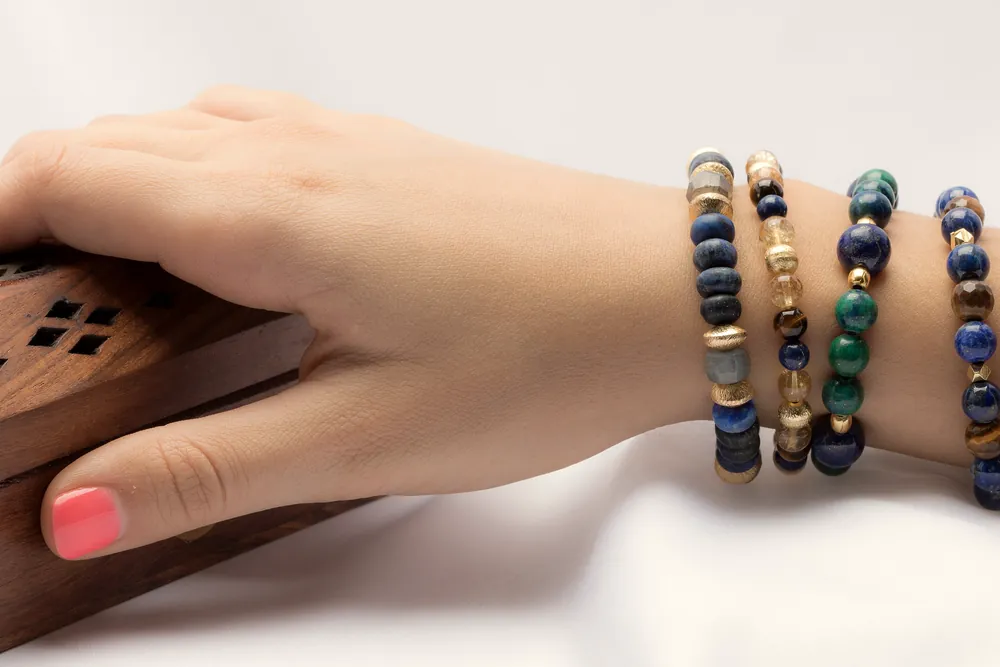
- Modern crystal practice often says the left hand “receives” and the right hand “gives”. So it suggests the left for calming or protective stones, and the right for stones associated with action.
- Feng shui sellers commonly advise wearing a pixiu bracelet on the left.
- Indian gem astrology focuses on rings and fingers, not bracelet wrists, and traditions differ.
Research on crystal healing has found no effect beyond placebo. So choose on practical grounds, mainly your non-dominant hand for fewer knocks, or follow the tradition that matters to you.
What different traditions say
| Tradition | What it says | Basis |
|---|---|---|
| Modern Western crystal practice | Left hand “receptive” (draws energy in); right hand “projective” (sends energy out). Calming or protective stones on the left; “action” stones on the right | A belief within modern crystal practice; untested |
| Feng shui (pixiu or “wealth” bracelets) | Commonly advised: wear on the left hand, so that wealth “comes in” | Seller and folk advice; varies |
| Indian gem astrology (Jyotish) | Gems are usually prescribed as rings on particular fingers, often of the working hand. Wrist rules for bead bracelets are not standard | Astrological tradition; practitioners differ |
| Rudraksha | Texts list where beads are worn on the body, including wrists, but do not fix a “correct” wrist for bracelets | Religious tradition |
| Personal or religious teacher | Varies | Follow your own tradition |
Because these rules contradict each other, no single one can be “the right answer” for everyone.
What is known
There is no peer-reviewed evidence that crystals have healing or energetic effects, and crystal healing is generally classed as a pseudoscience. In one test, presented to the British Psychological Society in 2001, Christopher French and colleagues found no evidence that crystals work “over and above a placebo effect”: volunteers reported similar sensations whether they held real crystals or look-alike fakes (Crystal healing, Wikipedia).
That does not stop a bracelet from being meaningful to you, as a reminder, a gift or part of a practice. But it means the wrist choice cannot change any physical effect.
Choosing on practical grounds
| Consideration | Left hand (for right-handed people) | Right hand (for right-handed people) |
|---|---|---|
| Knocks and chips | Fewer: the non-dominant hand does less | More: desk edges, doors, tools |
| Writing and typing | No interference | Beads drag on paper and keyboards |
| Watch | Clashes if you wear your watch on the left | Separates bracelet and watch |
| Washing hands, cooking | Less splashing | More water and oil on beads and elastic |
| Visibility | Less when you gesture | More visible |
Rule of thumb: wear it on your non-dominant wrist. Bracelets last longer there, especially soft or dyed stones, and elastic.
Stone-specific notes
- Soft or porous stones, such as turquoise, malachite, pyrite, hematite and lapis, are better on the hand that sees less water and knocking.
- Heavy bracelets (10 mm and up, or dense stones) are more comfortable on the non-dominant hand.
- Red coral, pearls and organic gems are sensitive to acids and cosmetics; keep them away from hand-washing splashes.
More than one bracelet?
There is no factual limit to how many you can wear. Practical limits:
- hard stones such as quartz (Mohs 7) scratch softer ones when they rub together;
- mixing metals (silver caps, brass spacers) can mark each other;
- many bracelets on one wrist strain elastic.
Some crystal practitioners advise against combining particular stones. That is a belief, and lists differ between practitioners.
Sleeping and bathing
- Sleeping: take it off. Elastic and beads last longer without overnight pressure.
- Bathing and swimming: take it off. Soap, chlorine and salt water damage many stones and all elastic. See our bracelet care guide.
FAQ
Which hand should a woman wear a crystal bracelet on?
The same considerations apply to everyone. Some traditions give gender-specific rules, but they differ. Practically, the non-dominant wrist protects the bracelet.
Which hand for a citrine or “money” bracelet?
Crystal practice often suggests the right hand for “action” stones, while feng shui advice for wealth bracelets says left. These conflict, which shows they are conventions. Choose the hand you prefer.
Which hand for a rudraksha bracelet?
Tradition does not fix one. Many people wear it on the right wrist, others on the left. Follow your teacher’s guidance if you have one. Practically, keep it dry.
Does wearing it on the “wrong” hand cause bad luck?
There is no evidence that it does.
Which hand for a lava stone bracelet?
The same: either. Lava stone is porous and often used with essential oils, which can stain or weaken elastic, so wipe it after oiling.
Sources
- Crystal healing, Wikipedia (evidence summary, including French et al., 2001), checked 10 October 2026.
- Devi Bhagavata Purana, Book 11, chapter 7, trans. Swami Vijnanananda, sacred-texts.com (where rudraksha may be worn), checked 10 October 2026.