The short answer
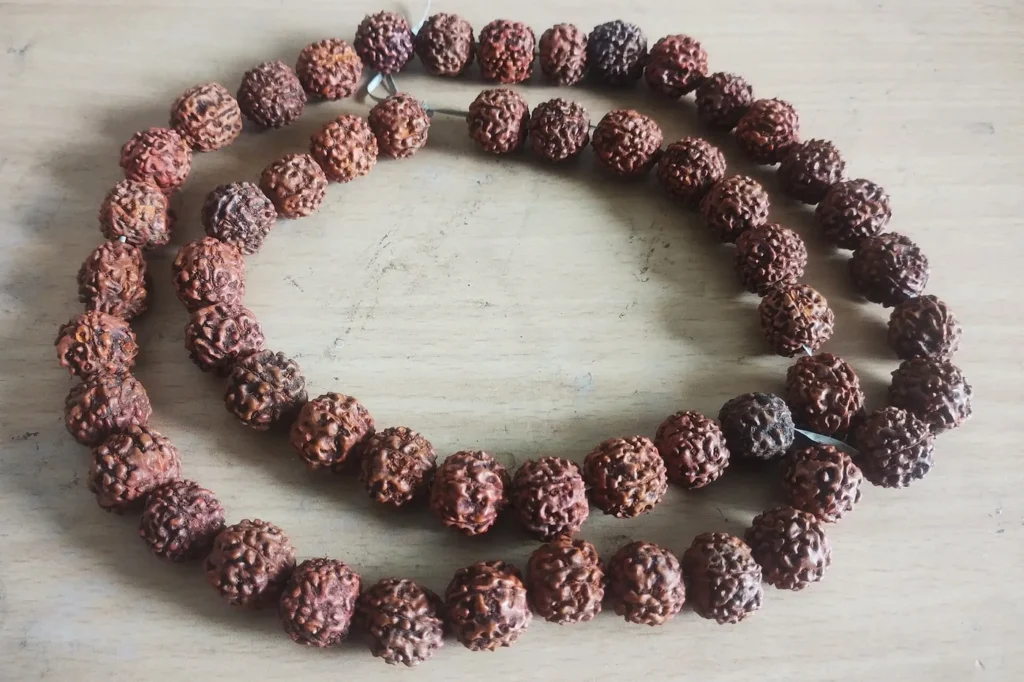
A combination kantha is a rudraksha necklace in which each main bead is a different mukhi:
- Siddh (Siddha) Mala: one each of 1 to 14 mukhi, plus a Ganesh and a Gauri Shankar bead, making 16 main beads.
- Indra Mala: one each of 1 to 21 mukhi, plus the same two, making 23 main beads.
The main beads sit at the front. A back chain of smaller beads, or a plain thread, completes the necklace. Origin (Nepal or Indonesia), bead size and construction (thread, silver caps on thread or wire, or all silver) drive most of the price. High mukhis are the most often faked, so each valuable bead needs a verifiable report.
The structure of a combination kantha
| Part | What it is | What to decide |
|---|---|---|
| Main beads | One bead per place: 1–14 or 1–21 mukhi, plus Ganesh and Gauri Shankar | Origin and size of every bead |
| 1 mukhi | Often set in a basket or pendant fitting at the centre | Nepali round 1 mukhi is extremely rare; most “1 mukhi” sold is the crescent-shaped Indian form |
| Back chain | Smaller beads going up and round the back of the neck | Bead type (for example 5 mukhi or sacred beads) and size, or plain thread |
| Construction | Thread, silver caps on thread, silver caps on wire, or all silver | Weight, look, durability and cost |
| Length | Overall necklace length | Where the main beads sit on the chest |
Our mala vs kantha vs bracelet guide explains the three forms. The 1 to 21 mukhi guide covers each bead’s traditional associations and fakes.
Siddh vs Indra mala
| Siddh Mala | Indra Mala | |
|---|---|---|
| Main beads | 16 (1–14 mukhi + Ganesh + Gauri Shankar) | 23 (1–21 mukhi + Ganesh + Gauri Shankar) |
| Rare beads | 14 mukhi is the costliest | 15–21 mukhi are very rare, especially from Nepal |
| Price driver | The 1 and 14 mukhi | Nepal 16–21 mukhi; often quoted individually |
| Weight and length at the front | Moderate | Heavier, longer row of main beads |
Why Indra Mala prices vary so much. Nepal beads of 16 mukhi and up are scarce and priced individually. One builder we reviewed lists Nepal 16–21 mukhi as enquiry-only and quotes them personally. For the 18 mukhi alone, it lists an Indonesian bead from ₹2,925 and a Nepal bead of 22–26 mm at ₹1,99,999 (10 October 2026). The origin you choose can change the total many times over.
Back chain and length
- Back-chain beads keep the expensive main beads at the front and give a uniform look behind. Common choices are 5 mukhi or “sacred” beads such as tulsi or sandalwood, at 8, 10 or 12 mm.
- Plain thread is lighter and cheaper, and shows the thread colour.
| Length | Where it sits |
|---|---|
| 18 in (46 cm) | Close to the neck |
| 24 in (61 cm) | At the collarbone |
| 28 in (71 cm) | Below the collarbone |
| 32 in (81 cm) | Mid-chest |
| 36 in (91 cm) | Long |
The length bands are the ones published by one builder; fit varies with build and neck size.
Construction
| Construction | Look | Durability | Cost |
|---|---|---|---|
| Thread (dhaga), 1 mukhi in a basket | Traditional, light | Thread wears; restring periodically | Lowest |
| 925 silver caps on thread | Finished bead ends | Caps protect the ends; thread still wears | Moderate |
| 925 silver caps linked with wire | Jewellery-like, rigid | Strong; repairs need a silversmith | Higher; often quoted at the day’s silver rate |
| All-silver construction | Heaviest, most decorative | Very durable | Highest; usually quoted |
Capping hides bead ends, so authenticate before capping. See our silver capping guide.
Reports and authenticity
- Ask for a report that identifies each main bead, including mukhi count, size, weight and, ideally, an X-ray. See our rudraksha X-ray guide.
- One builder states that a GJSPC report is included with each kantha. It values the report at ₹1,500 for a Siddh Mala and ₹3,000 for an Indra Mala, and notes that the report “does not test or promise spiritual benefits”.
- Check every report number on the laboratory’s own website.
A worked example from a builder
GemKrishna’s Kantha builder, on 10 October 2026:
- Choose Siddh or Indra.
- Choose the origin: Indonesian, Nepal, a combination, or a mix.
- Choose a size for every main bead. None is pre-selected; some sizes are “ask for price”.
- Choose a length (18–36 in) and back chain.
- Choose the construction.
- Choose energisation and add a note, with an optional design upload.
The making price was listed from ₹1,999 with plain thread to ₹3,999 with 7 mukhi back-chain beads, with main beads and silver extra. If any part is quoted on request, the design is sent for a quotation instead of to the cart. See our Custom GemKrishna Builders guide.
Checklist before ordering any kantha
- A list of every main bead, with origin, size in mm and price.
- Photographs of the actual beads before stringing.
- Reports with verifiable numbers, especially for 1, 14 and 15+ mukhi and the Gauri Shankar.
- The metal (925 or German silver) and approximate silver weight.
- The finished length and weight.
- Return terms in writing. Custom kanthas are rarely returnable.
FAQ
What is the difference between a Siddh Mala and an Indra Mala?
A Siddh Mala has one each of 1–14 mukhi plus Ganesh and Gauri Shankar (16 main beads). An Indra Mala extends to 21 mukhi (23 main beads).
Why is an Indra Mala so expensive?
Its 15–21 mukhi beads are rare, especially from Nepal, and are often priced individually.
Can I mix Nepal and Indonesian beads?
Many makers allow it, choosing the origin for each place. It lowers cost, but larger Nepal beads next to smaller Indonesian ones can look uneven, so check the sizes.
Does a kantha need a back chain?
No. A plain thread works, but back-chain beads give the traditional look and keep the main beads at the front.
Does a laboratory report prove spiritual benefits?
No. A report describes the beads examined: identity, mukhi count and signs of tampering. It cannot test spiritual effects.
Sources
- GemKrishna, Custom Rudraksha Kantha Builder (structure, origins, lengths, construction, making prices and report values, seller statements), checked 10 October 2026.
- GemKrishna, Custom Rudraksha Bracelet Builder (per-bead prices by origin and size), checked 10 October 2026.
- Hinduism Today, How common are fake rudrakshas?, checked 10 October 2026.