The short answer
- Solid gold is gold alloy all the way through, such as 22K or 18K, and in India it can carry a BIS hallmark with a HUID.
- Gold-plated is a thin layer of gold over another metal, usually brass, copper or silver. It has little gold value and wears through with use.
- Gold vermeil is gold plating over sterling silver. In the US, the word has a legal minimum (at least 2.5 microns of 10K-or-better gold), but India has no equivalent legal definition.
- Gold-filled has a much thicker gold layer bonded on mechanically.
Ask for the base metal, the gold karat and the thickness in writing. Only solid gold holds its value as gold.
For karat, hallmarks and invoices in solid gold, see our gold jewellery guide. This article is about the labels that sit between costume jewellery and solid gold.
What each label means
| Label | What the piece is | Gold content | Base metal |
|---|---|---|---|
| Solid gold (22K, 18K, 14K) | Gold alloy throughout | 58.5%–91.6% or more of the whole weight | None (the alloy is the piece) |
| Gold vermeil | Sterling silver plated with gold | A thin surface layer | 925 sterling silver |
| Gold-filled | A gold alloy layer bonded mechanically to a base metal | A meaningful share of the weight; in US rules at least 1/20 of the metal weight | Usually brass or copper |
| Rolled gold plate | As gold-filled, with a thinner layer | In US rules at least 1/40 of the metal weight | Base metal |
| Gold-plated / gold electroplate | A gold layer deposited by electroplating | Very small | Brass, copper, silver or steel |
| Gold flash or “gold wash” | A very thin gold coat | Negligible | Any |
| “Gold-tone” | A gold colour, possibly with no gold at all | Possibly none | Any |
Indian market terms you may meet include “1 gram gold”, “micro gold plated”, “gold covering” and “forming” jewellery. These are trade descriptions, not legal grades. They usually mean gold-plated or gold-coated base metal, and the actual gold quantity varies widely. Ask for it.
Whose rules define the words?
The most detailed published definitions are American: the US Federal Trade Commission’s Jewelry Guides. They are not Indian law. They are quoted here only because many international sellers use the same words.
| US term | US minimum (FTC Jewelry Guides) |
|---|---|
| Vermeil | Sterling silver base, coated or plated with gold of at least 10K, at least 2.5 microns thick (16 CFR §23.4) |
| Gold electroplate | Gold of at least 10K, at least 0.175 micron of fine gold equivalent (16 CFR §23.3) |
| Heavy gold electroplate | At least 2.5 microns (§23.3) |
| Gold-filled | At least 10K gold, at least 1/20 of the metal weight (§23.3) |
| Rolled gold plate | At least 10K gold, at least 1/40 of the metal weight (§23.3) |
Two details from the US rules are worth knowing:
- A sterling piece with a nickel or other base-metal layer under the gold may not simply be called “vermeil” without disclosing it (§23.4).
- Silver-coated items must be described as coated (§23.5).
In India, BIS hallmarking applies to gold and silver articles of specified fineness. Plated base-metal items cannot be hallmarked as gold. We did not find an Indian legal definition of “vermeil” or a minimum thickness for “gold-plated”. Indian listings using these words are therefore not held to a number, and you should ask for the base metal, the karat of the plating, and its thickness.
Plating thickness and units
Plating is measured in microns (µm), thousandths of a millimetre. For scale:
- 0.175 µm is the US minimum for “gold electroplate”.
- 2.5 µm, about 14 times thicker, is the US minimum for vermeil and “heavy” electroplate.
- A human hair is roughly 50–100 µm thick.
A thicker layer lasts longer. The karat of the plating matters less than its thickness. “24K gold plated” sounds impressive, but a very thin 24K layer wears through faster than a thicker layer of a harder alloy.
Base metal: sterling or brass?
| Base | Why it matters |
|---|---|
| Sterling silver (vermeil) | When the gold wears, the piece is still real silver: valuable, repairable, and replatable. It may tarnish where exposed |
| Brass or copper | Low metal value; may discolour skin or turn green where exposed; can contain metals some people react to |
| Stainless steel | Durable and tarnish-resistant; low metal value |
How to tell the base: read the listing and the invoice. Look for a “925” stamp, or better a BIS silver hallmark, on vermeil. Look at wear points (the inside of rings, clasp edges, chain links). A white base showing through suggests silver; a yellow or pink base suggests brass or copper. A jeweller with an XRF analyser can test a discreet spot, because a surface reading alone shows the plating.
Gold-filled versus plated
Gold-filled is made by bonding a sheet of gold alloy to a base metal with heat and pressure. It is not electroplated, so the gold layer is far thicker than ordinary plating. In US terms, at least 1/20 of the metal weight is gold alloy. Gold-filled pieces can last many years in normal wear. They are less common in India than plated jewellery, so check that a “gold-filled” listing really means that, and not plated.
How each one wears
| Over months to years | |
|---|---|
| Solid gold | Scratches and slowly wears, but stays gold throughout; it can be polished, repaired and resized |
| Vermeil | Gold wears first at rub points, showing silver beneath; the exposed silver may tarnish; it can be replated |
| Gold-filled | Wears slowly; the thick layer usually lasts years |
| Plated base metal | Wears through at rub points, especially on rings, bracelets and clasps; the base metal shows and may discolour |
| Gold-tone | Varies; may be lacquered; can flake |
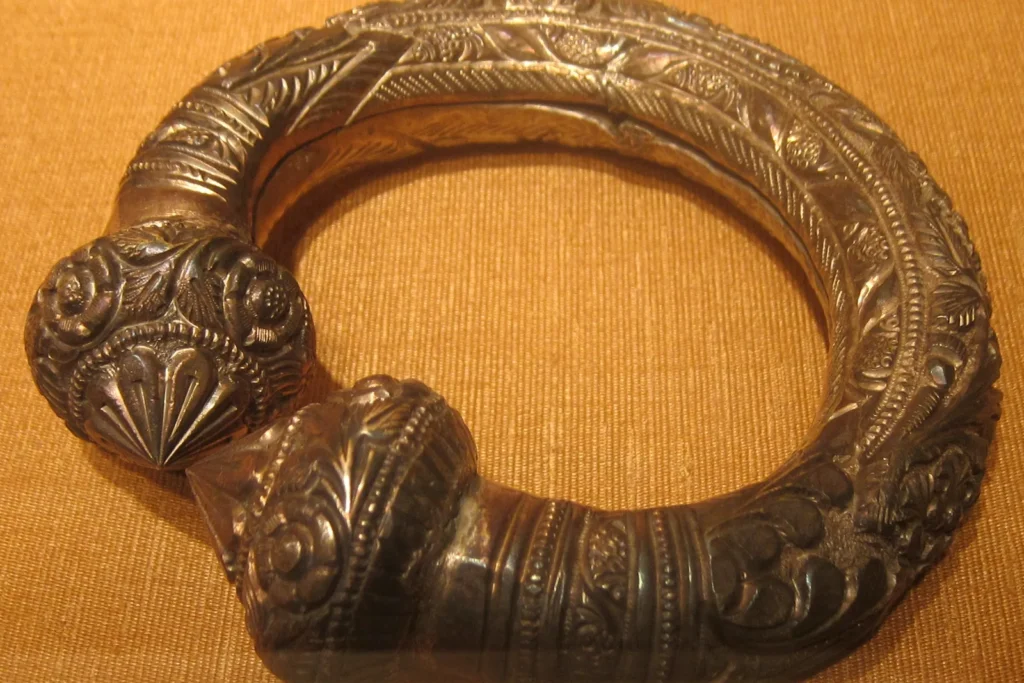
The photograph at the top of this article shows a 19th-century Indian silver anklet with a gold wash. Over time, the raised decoration has worn back to dark, tarnished silver.
Repairs and polishing
- Solid gold can be sized, soldered and polished. Jewellers do this routinely.
- Vermeil and plated pieces lose plating wherever they are soldered, sized or polished. After repair, they need replating.
- Do not use polishing cloths, dips or abrasive pastes on plated items. These remove metal and will strip the plating. Wipe with a soft cloth, and wash only gently.
Material disclosure: what an honest listing says
- “Solid 18K gold, BIS hallmarked 18K750, HUID stated, 4.20 g net”
- “Gold vermeil: 925 sterling silver plated with 18K gold, about 2.5 µm”
- “Gold-plated brass, plating thickness not specified”
- “1 gram gold jewellery: brass base with gold plating”
And watch out for:
- “Gold” with no karat or base metal
- “24K gold” on a very inexpensive piece
- “Real gold” on plated items
- “Vermeil” with no base metal stated
Value and resale
- Solid gold is valued on resale or exchange by its net gold weight × tested purity × the day’s rate, minus any deductions. Making charges are not recovered. See selling or exchanging old gold.
- Vermeil keeps the scrap value of its silver; the gold layer adds almost nothing.
- Plated base metal has negligible metal value. You are paying for design.
- Gold-filled contains real gold, but recovering it is rarely economic for small pieces.
What the invoice should say
| Item | Solid gold | Vermeil or plated |
|---|---|---|
| Material | Karat and fineness (e.g. 22K916), “solid” | Base metal (e.g. “925 silver” or “brass”) and “gold plated” |
| Hallmark | BIS hallmark with HUID | Not applicable to plating; for vermeil, the silver may be BIS hallmarked |
| Weight | Gross and net gold weight | Gross weight |
| Plating details | — | Karat of plating and thickness, if the seller states them |
| Price build-up | Gold value, making charges, stones, tax | Usually a single price for the piece |
| Return terms | Including exchange or buy-back | Including plating defects |
Decision framework
| If you want… | Choose |
|---|---|
| Lasting value and repairability | Solid gold, hallmarked |
| The look of gold on a silver budget, worn sometimes | Vermeil with a stated thickness |
| Everyday wear on a budget, with a long life | Gold-filled (if genuinely gold-filled) or solid 14K or 18K |
| A fashion piece for occasional wear | Gold-plated, accepting that it will wear |
| A gold-coloured ring worn daily | Solid gold (18K or 14K); plating wears fastest on rings |
FAQ
Is gold vermeil solid gold?
No. Vermeil is sterling silver with a gold layer on top. In the US, vermeil must have at least 2.5 microns of at least 10K gold, but India has no legal definition, so ask for the karat and thickness.
Does vermeil fade?
The gold layer wears over time at points of contact, revealing the silver underneath, which can then tarnish. Thicker layers last longer. Vermeil can be replated.
How can I tell what the base metal is?
Check the listing and invoice for the base metal, look for a 925 stamp or BIS silver hallmark on vermeil, and inspect wear points: white suggests silver, while yellowish or pinkish suggests brass or copper. A jeweller can test a discreet spot with an XRF analyser.
Is 24K gold plating more durable?
Not necessarily. Pure gold is soft. Durability depends mainly on the plating thickness and on where the piece rubs. A thicker layer of a harder alloy can outlast a thin 24K layer.
Can plated pieces be polished?
Only very gently, with a soft cloth. Polishing cloths, dips and pastes remove metal and will strip the plating. Repairs such as sizing and soldering damage plating and require replating afterwards.
What does “1 gram gold” jewellery mean?
It is a trade name for gold-plated or gold-coated jewellery, usually on a brass base. It does not mean the piece contains one gram of gold. Ask the seller exactly what the base metal is and how much gold has been applied.
Can vermeil be hallmarked in India?
The gold plating cannot be hallmarked as gold. The sterling silver underneath can be BIS hallmarked as silver: since 1 September 2025, a voluntary scheme has allowed a HUID for silver. Ask the seller.
Sources
- US FTC Jewelry Guides: 16 CFR §23.3 (gold-filled, rolled gold plate, gold plate, gold electroplate), 16 CFR §23.4 (vermeil) and 16 CFR §23.5 (silver). US definitions, quoted for reference only.
- Bureau of Indian Standards: Hallmarking FAQs, checked 9 October 2026.
- PTI via The Week: voluntary silver hallmarking with HUID from 1 September 2025.
Next steps
Read our gold jewellery guide, see how old gold is valued, or check a seller with our buying online safely checklist.