The short answer
- Construction beats style. Solid links, well-soldered joins and adequate thickness make a chain last. Very fine, hollow and heavily machine-cut chains are the most fragile.
- Hollow vs solid: hollow chains look larger for the same gold weight, so they cost less for their size, but they dent, crush and break more easily and are harder to repair.
- Karat affects strength. 22K is softer than 18K; for thin chains and daily wear, a sturdier design or 18K holds up better. See 18K vs 22K vs 24K.
- The lock is the weak point. Lobster clasps and box clasps with a safety catch are more secure than spring rings and open S-hooks.
- On the bill: gold value depends on net weight and purity, not on how big the chain looks. Check the hallmark and HUID.
Chain types and how they wear
| Chain | Construction | Durability | Notes |
|---|---|---|---|
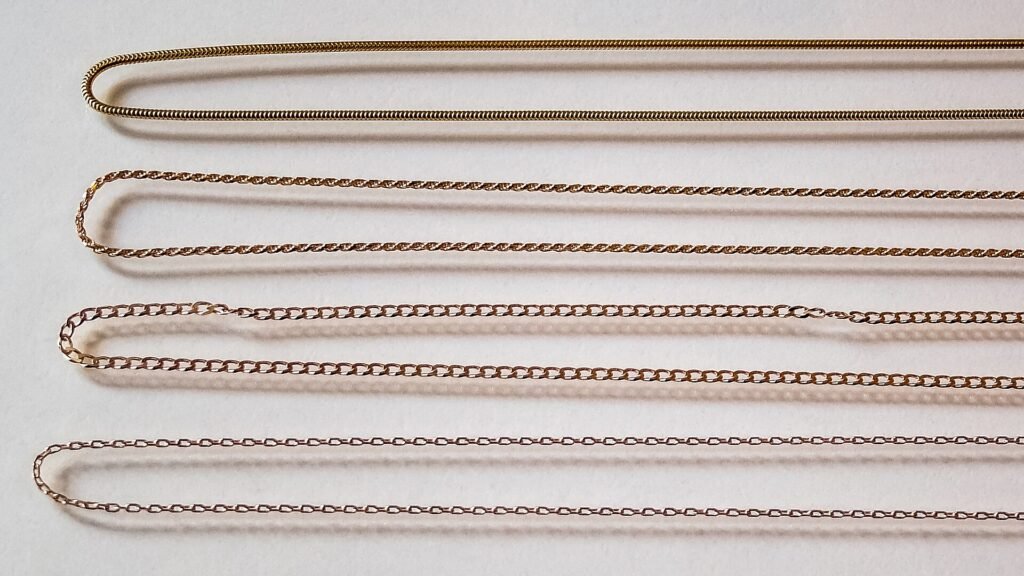
| Cable (anchor) | Oval or round links joined through each other | Good in medium and heavy weights | Easy to repair |
| Curb | Twisted links lying flat | Good; heavier curbs are robust | Diamond-cut faces can wear thin |
| Figaro | Curb pattern with short and long links | Good | Long links can catch on clothing |
| Rope | Small links twisted into a spiral | Good when solid | Hard to repair invisibly |
| Box | Square links | Good for its weight | Kinks if bent sharply |
| Wheat (spiga) | Interlocked oval links in a braid | Very good; resists tangling | A good choice for pendants |
| Snake | Tight tube of plates | Moderate | Kinks permanently; hard to repair |
| Singapore / twisted | Twisted, sparkling links | Moderate | Delicate in fine weights |
| Ball | Spheres on a wire | Low in fine weights | Pulls apart at the clasp |
| Machine-made fine chains | Very thin wire | Low | Light and inexpensive; break easily |
Tangle-free chains: heavier, stiffer constructions such as wheat, box and curb tangle less than fine cable or ball chains. For silver chains and stainless steel, see silver chains and clasps.
Hollow vs solid
| Hollow | Solid | |
|---|---|---|
| Look for the weight | Larger | Smaller |
| Gold value | Lower for the size | Higher for the size |
| Durability | Dents, crushes and breaks more easily | More robust |
| Repairs | Difficult; a dent may be permanent; soldering can collapse the tube | Usually straightforward |
| Making charges | Can be higher as a percentage | Often lower as a percentage |
| Exchange or sale | Valued on net gold weight like any piece | Same |
A worked comparison. Illustrative 22K rate ₹13,700 per gram.
| Hollow 22K chain, 8 g | Solid 22K chain, 14 g, similar look | |
|---|---|---|
| Gold value | ₹1,09,600 | ₹1,91,800 |
| Making (example) | 16% = ₹17,536 | 10% = ₹19,180 |
| Before GST | ₹1,27,136 | ₹2,10,980 |
| GST 3% | ₹3,814.08 | ₹6,329.40 |
| Total | ₹1,30,950.08 | ₹2,17,309.40 |
| Gold you own | 8 g of 22K | 14 g of 22K |
The hollow chain is far cheaper because it contains far less gold, and that lower gold content is also what you get back on resale. Making charges on hollow chains can be higher as a percentage. Ask for the net weight and the making charge in writing, and see our gold jewellery guide for every line of the bill.
Karat and strength
Pure gold is soft; alloys make it harder. 22K (91.6%) is common for Indian jewellery and is softer than 18K (75%). For thin chains, daily-wear bracelets and pieces that take knocks, either choose a sturdier construction in 22K or consider 18K. For heavy traditional pieces, 22K is standard and wears well. See 18K vs 22K vs 24K.
Bracelets and kadas
| Type | Construction | What to check |
|---|---|---|
| Chain bracelet | Any chain style with a clasp | As for chains; a safety catch helps |
| Kada (rigid bangle) | Solid or hollow; often wax- or lac-filled in traditional designs | Ask whether it is hollow or filled; filling adds weight but not gold |
| Openable kada | Hinged with a screw or pin lock | Check the hinge and screw for wear |
| Bangle (thin, rigid) | Usually slips over the hand | Size carefully; resizing is limited |
Filled pieces. Traditional hollow designs are sometimes filled with wax or lac for strength and weight. Filling is not gold; the net gold weight should be stated separately from the gross weight. Our guide to selling or exchanging old gold explains how buyers deduct non-gold weight.
Choosing a strong lock
| Clasp | Security | Best for |
|---|---|---|
| Lobster claw | Good | Chains and bracelets |
| Box clasp with safety catch | Very good | Bracelets, heavier chains |
| Spring ring | Moderate | Light chains |
| S-hook | Low to moderate | Traditional chains; check that it closes firmly |
| Hook and eye / kunda | Moderate | Traditional pieces |
| Magnetic | Variable | Convenience; not for valuable pieces |
What to check:
- The clasp is gold of the same purity, not plated base metal.
- Jump rings are closed and soldered.
- The clasp size suits the chain weight; a tiny clasp on a heavy chain wears quickly.
Hallmark and HUID
Hallmarking is mandatory for gold jewellery in notified districts. A hallmarked chain carries the BIS mark, the purity grade (for example 22K916) and a six-character HUID, which you can verify in the BIS CARE app; see how to verify a HUID. For chains, the mark is often on the clasp tag or a small plate near the clasp.
Buying checklist
- Construction: solid or hollow, and the chain style
- Net weight and purity, with the hallmark and HUID checked
- Making charge and its basis
- Clasp material and type; closed, soldered jump rings
- For kadas, whether the piece is hollow or filled, with net gold weight stated
- Repair and exchange terms
FAQ
What is the difference between a hollow and a solid gold chain?
A hollow chain has tube-shaped links, so it looks larger for its weight and costs less, but it dents and breaks more easily and is harder to repair. A solid chain contains more gold for the same look and lasts longer.
Which gold chain design is strongest?
Solid wheat, box, curb and heavier cable chains are among the most robust. Fine, hollow, snake and ball chains are the most fragile.
Which lock is best for a gold chain?
A lobster clasp, or a box clasp with a safety catch, made of gold of the same purity and attached with closed, soldered jump rings.
Do hollow chains lose value?
They are valued on net gold weight like any gold piece, but they contain less gold for their size, so they are worth less than a solid chain of the same appearance.
Is 22K or 18K better for a chain?
22K holds more gold and is traditional; 18K is harder. For thin, daily-wear chains, a sturdy design or 18K lasts better.
Sources
- Bureau of Indian Standards: Hallmarking FAQs (hallmark components and grades), checked 11 October 2026.
- Directorate of Commercial Taxes, West Bengal: FAQ on Gems & Jewellery under GST (3% GST on the total value of jewellery), checked 11 October 2026.
- India Bullion and Jewellers Association: published rates (rates exclude GST and making charges), checked 11 October 2026.