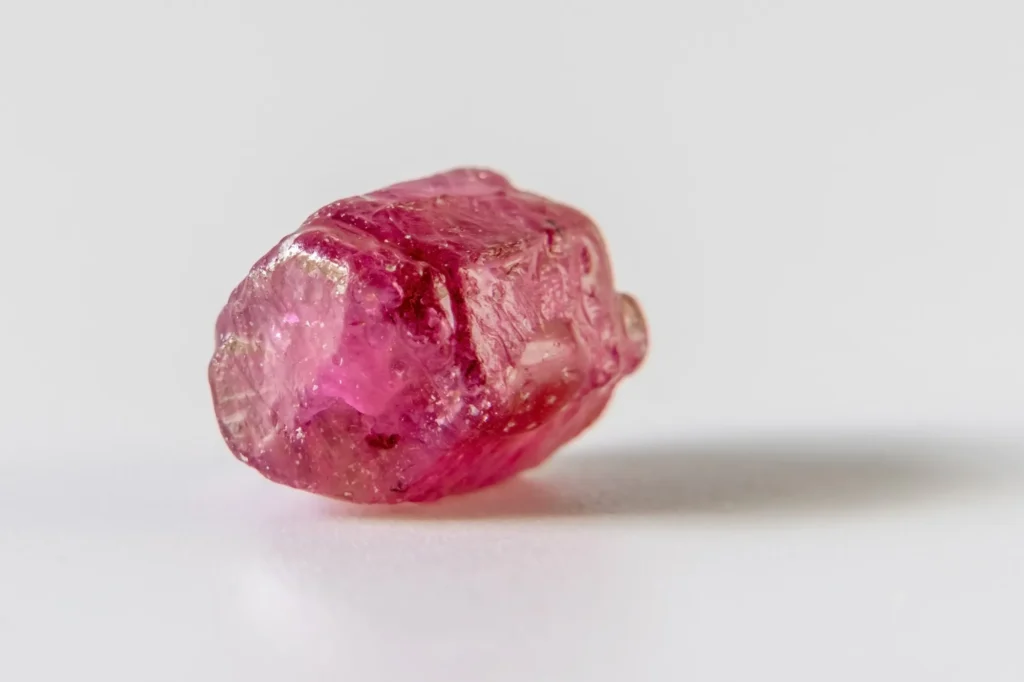
The short answer
- Untreated ruby: natural corundum that has only been cut and polished. A laboratory report from an independent lab stating no evidence of heat is what supports this claim. Untreated rubies “command a premium due to their rarity” (GIA).
- Heated ruby: natural ruby heated to improve colour or clarity. It is the norm: GIA advises, “You should assume your ruby is heated.” Heated ruby is durable and is a legitimate gem when disclosed.
- Glass-filled ruby: heavily fractured, low-grade corundum whose fractures are filled with high-lead glass. Laboratories describe it with terms such as “composite ruby” or “manufactured product”. It is far less durable, needs special care, and is “worth less than heated rubies” (GIA).
You cannot reliably tell the three apart by eye. A loupe can reveal some glass-filled stones. Only a laboratory report can confirm heating or its absence.
What ruby is
Ruby is the red variety of the mineral corundum (aluminium oxide). Corundum is hard: 9 on the Mohs scale (GIA ruby care). Its colour comes mainly from chromium. Sapphire is the same mineral in other colours, so heating and diffusion methods are shared between them; see our ruby, emerald and sapphire overview.
In India, ruby is sold as manik and is one of the Navratna stones; see our Navratna guide. Astrological buyers often ask for an “untreated” stone. That makes the difference between the three categories especially important, because the word “natural” alone does not tell you which one you have.
The three categories compared
| Untreated | Heated | Glass-filled (lead glass) | |
|---|---|---|---|
| What it is | Natural ruby, cut and polished only | Natural ruby heated to improve colour or clarity | Fractured low-grade corundum, fissures filled with high-lead glass |
| Natural? | Yes | Yes, treated | The corundum is natural; the product is ruby plus glass |
| How common | Rare in good qualities | “Assume your ruby is heated” (GIA) | “We commonly see glass-filled natural rubies” (GIA lab note) |
| Durability | Hard (9), tough | Similar to untreated | Glass is softer and attacked by heat and chemicals |
| Care | Warm soapy water; ultrasonic usually safe | Same as untreated | Damp cloth only; no ultrasonic or steam; avoid even lemon juice |
| Typical report wording | “No indications of heating” or similar | “Indications of heating” or similar | “Composite ruby”, “manufactured product” or similar |
| Value | Highest for the quality | Lower than comparable untreated | Lowest; “worth less than heated rubies” |
Report wording differs between laboratories. Read the comments section of the specific report; see “Reading the report” below.
Heated ruby: normal, and acceptable when disclosed
Heating improves colour and clarity by altering inclusions and colour distribution. It is so widespread that GIA tells buyers to assume a ruby has been heated (GIA heat-treatment FAQ).
What heating does not do: it does not make the stone weak or “fake”. Heated corundum is a durable gem for everyday jewellery. GIA’s care guidance groups untreated and heat-treated ruby together as “very durable” (GIA ruby care).
One clue labs use: silk. Ruby often contains fine needles of rutile called silk. GIA notes that intact silk proves “the ruby was not heat-treated at very high temperatures” (GIA ruby quality factors). Intact silk does not rule out lower-temperature heating, so even this clue is for a laboratory to interpret, not for a buyer.
Heating with residues. Some rubies are heated with a flux. GIA notes that heavily fractured Mong Hsu rubies “are often heated with a flux such as borax to fill voids and allow the fractures to partially heal” (Gems & Gemology, Spring 2025). The healed fissures can retain glassy residue. Laboratories may therefore comment on residues as well as heating. This is a different and much smaller intervention than lead-glass filling, but it is still a treatment. If a report mentions residues, ask the laboratory what the comment means for that stone.
Glass-filled ruby: a different product
What it is: low-grade, heavily fractured corundum is filled with a glass containing lead. The glass has a refractive index close to ruby’s, so the fractures nearly disappear and the stone looks far more transparent and “gem-like” than the original material. A GIA lab note describes the treatment as “very effective” (Gems & Gemology, Spring 2021).
Why it is not just “clarity-enhanced ruby”: laboratories treat it as a composite material because so much of the stone’s integrity depends on the glass. Labs name it differently, for example (JCK, 2012):
- AGL: “composite ruby”
- GIA: “a manufactured product”, “a combination of ruby and glass”
- GRS: “synthetic glass/treated ruby (GRS-type Hybrid Ruby)”
GIA’s 2021 lab note even describes a lead glass-filled laboratory-grown ruby: the filling and the synthetic origin both needed to be identified.
How it is identified
GIA writes that the treatment “is easily detected with magnification” by a gemmologist. The identifying features are “very low-relief fractures, flattened and rounded gas bubbles”, “voids (unfilled areas) in fractures” and “a blue and orange flash effect” (Gems & Gemology, Spring 2021, citing McClure et al., 2006).
What a buyer can try with a 10× loupe and good light:
- Tilt the stone and look along fracture lines for coloured flashes (blue, orange).
- Look for flattened gas bubbles inside fractures. Ruby does not contain gas bubbles; glass does.
- Look at the surface where fractures reach it. The filled area may have a slightly different lustre from the surrounding ruby.
If you see any of these, ask for a laboratory report before paying. If you see none, that proves nothing: small or sparse filling can be hard to spot even for labs (see the FAQ).
Durability and care
- GIA: “Fracture-filled, cavity-filled, or dyed material should only be cleaned with a damp cloth.” “Even relatively mild substances like lemon juice can cause changes in the high-lead content glass” (GIA ruby care).
- Labs warn that the glass “may be unstable to elevated temperatures and chemical agents” (GIA, quoted in JCK).
- Repairs: a jeweller’s torch during ring resizing or re-tipping prongs can damage the glass. Tell the jeweller what the stone is before any repair.
- Ritual and household substances: do not dip filled stones in acidic liquids, cleaning products or hot water.
Untreated ruby: what supports the claim
Only an independent laboratory report supports “untreated”. It should:
- identify the stone as natural ruby (corundum);
- state no indications of heating (exact wording varies by lab);
- have a report number you can verify on the laboratory’s website; see how to verify a report online.
A seller’s own certificate stating “100% natural untreated” is not the same thing. “Natural” on many cards only means “not synthetic”; it does not exclude heating. Our guide to authenticity guarantees explains the difference.
Reading the report
Look at three places on a ruby report:
- Identification / species and variety: “Natural corundum, ruby” (wording varies).
- Comments / treatment: heating, “residues”, “glass”, “composite” or “manufactured product”.
- Origin, if stated: origin opinions are a separate and often extra-cost service. Origin does not change whether the stone is treated.
Each lab has its own vocabulary. If a comment is unclear, ask the laboratory, not only the seller, what it means.
Value: why the categories are priced so differently
GIA’s ordering is clear: unheated stones with an independent report command a premium; “Rubies that have been diffused or are glass filled are worth less than heated rubies” (GIA).
We do not publish per-carat prices. They depend on size, colour, clarity, cut, origin and treatment, and published asking prices vary widely. A useful rule for buyers:
- Large, clean-looking, bright-red ruby at a low per-carat price: assume glass filling until a report says otherwise.
- Untreated at a heated-ruby price: ask for the report before believing it.
- Compare like with like: a report for each stone, the same treatment category, similar size and colour.
Mistakes and misconceptions
- “Natural ruby” means untreated. It usually means only “not synthetic”.
- “Heated” means fake. It does not. Heating is the norm and is acceptable when disclosed.
- “Glass-filled is just like oiled emerald.” Lead-glass filling is far more extensive. Labs describe the result as a composite or manufactured product.
- “A certificate means it is untreated.” Only if the certificate is from an independent lab, is verifiable, and actually says so.
- Home tests prove it. Scratch, fire and lemon “tests” can damage filled stones and prove nothing about heating.
Buying checklist
- Ask in writing: untreated, heated, or filled?
- For any significant purchase, get a report from an independent laboratory with an online lookup; see testing laboratories compared.
- Check that the report number, weight and measurements match the stone.
- Read the comments line for heating, residues or glass.
- Check the return terms in case a second lab disagrees.
- For glass-filled stones bought knowingly: accept the care limits, and tell any jeweller before repairs.
FAQ
Is a glass-filled ruby a real ruby?
It contains natural corundum, but laboratories describe the product as a composite of ruby and glass, using terms such as “composite ruby” or “manufactured product”. It should never be sold simply as “ruby”.
Can I tell a glass-filled ruby with a loupe?
Sometimes. Coloured flashes in fractures and flattened gas bubbles are signs. But a 2016 GIA lab note warned that “if the ruby has very few areas that are enhanced with lead glass, they may not be obvious under magnification”, and that FTIR and EDXRF instruments “may not detect them”. For a costly stone, rely on a full laboratory examination.
Is heated ruby bad for astrology?
That is a belief question, not a gemmological one, and traditions differ. Gemmologically, heated ruby is natural ruby that has been treated. If your astrologer specifies “untreated”, ask for a laboratory report that states no indications of heating.
Does heating fade or wear off?
Heat treatment of corundum is generally regarded as stable under normal wear. Glass filling is the treatment that is vulnerable to heat and chemicals.
Why is my ruby so cheap?
Most often because it is glass-filled, heavily included, or not ruby at all (for example red glass or synthetic). Ask for a laboratory report.
Can a glass-filled ruby be cleaned with soap and water?
GIA advises cleaning filled stones only with a damp cloth. Avoid ultrasonic or steam cleaners and acidic substances, even mild ones such as lemon juice.
Sources
- GIA: Ruby heat treatment FAQ, Ruby care and cleaning and Ruby quality factors, checked 11 October 2026.
- Zandi, F., Lead glass–filled laboratory-grown ruby, Lab Notes, Gems & Gemology, Spring 2021, citing McClure, S. F. et al., “Identification and durability of lead glass–filled rubies”, Gems & Gemology, Spring 2006, pp. 22–33; checked 11 October 2026.
- GIA, Micro-World: “evil eye” in ruby, Gems & Gemology, Spring 2025 (flux-assisted heating of Mong Hsu ruby), checked 11 October 2026.
- GIA, Lead glass-filled black star sapphire, Lab Notes, Gems & Gemology, Fall 2016 (limits of detection when filling is sparse), checked 11 October 2026.
- Heebner, J., Lead glass–filled rubies by any other name…, JCK, 20 May 2012 (laboratory nomenclature), checked 11 October 2026.
Related reading
- Ruby, emerald and sapphire: treatments, quality and value
- Gemstone treatments explained: heating, filling, dyeing, diffusion and how they should be disclosed
- How to verify a gemstone or rudraksha report online (GJSPC, IGI, GIA, GRS, IIGJ)
- Navratna gemstones: the nine stones, their traditions and a buying checklist