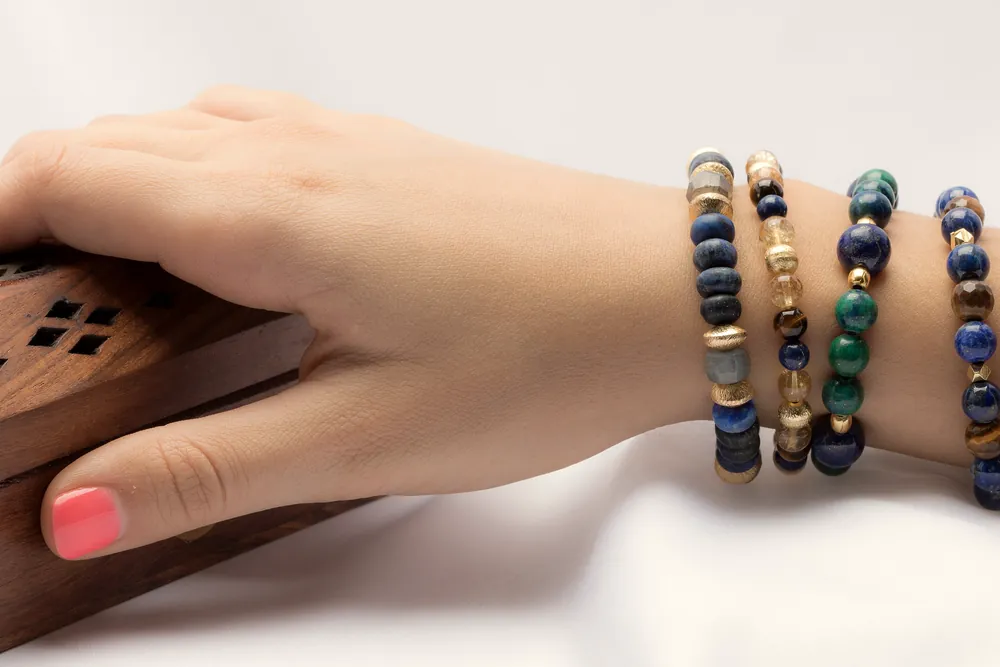
Updated October 2026. A ‘seven chakra’ bracelet and a personalised crystal bracelet are different design approaches. The first usually follows a traditional colour-and-chakra sequence; the second lets a buyer choose particular stones and proportions. Neither structure has established medical efficacy, but both can make attractive jewellery if the materials are described accurately.
What does ‘seven chakra’ mean on a listing?
In popular contemporary crystal practice, seven colours are associated with seven energy centres. Sellers may use different materials to create those colours: a purple segment might be amethyst, violet fluorite or glass; a blue segment might be lapis, sodalite or dyed stone. A product labelled seven chakra does not, by itself, tell you its mineral composition. Ask for the actual material name for every colour.
The practical strengths of a ready-made seven-chakra bracelet
- It provides a familiar, symmetrical pattern without requiring design decisions.
- Its colour story is easy to understand, especially for gifts.
- A simple ready-made option may be convenient if the recipient’s preferred stones are unknown.
Its weaknesses are mostly those of any preassembled bracelet: fixed proportions, limited bead selection, and often a small, medium or large fit. If a seller substitutes materials to achieve a colour, the substitutions should be disclosed.
Why customise instead?
A personalised bracelet can suit someone who wants two or three stones rather than seven, or who wants one material to dominate the appearance. For example, an understated black tourmaline design with a few citrine accents looks different from a repeating rainbow pattern. Choosing a gemstone’s count as well as its name is particularly useful when bead proportions matter to the wearer.
Three questions to ask before choosing quantities
- How many beads fit? Bead diameter, wrist measurement, clasp and comfort allowance influence the final count.
- How are the beads arranged? Equal repeats, alternating sequences and centred accents produce different appearances even with identical materials.
- Can the stone names be verified? A seller should distinguish natural mineral, dyed stone, imitation and purely decorative beads.
Read our wrist-measurement guide and bead-size comparison before finalizing a design.
An example of a made-to-order workflow
GemKrishna offers a custom gemstone-bracelet page where shoppers select wrist size, bead size, a combination of stones, closure and an arrangement. It also states that a separate GJSPC report accompanies the bracelet. Counts, prices and on-screen selections can change as the builder is updated, so the final checkout and report terms should control rather than an older blog article.
When a report matters
For a simple fashionable design, transparent material descriptions are a good start. For a higher-priced mixed gemstone piece, independent identification becomes more useful: ask which stones were examined, whether treatments are noted and how to verify the laboratory number. Do not mistake chakra-colour language for a mineralogical description.
Bottom line
Choose seven-chakra styling if you enjoy a fixed multicolour symbolism and straightforward buying. Choose custom selection if you care more about exact stones, proportions, closure and wrist fit. Whatever the design, the scientific checks concern materials and documentation, not promised spiritual outcomes.
References
For treatments and disclosure, consult GIA’s overview; for identifying a report, see our laboratory lookup guide.