Quick answer: A genuinely customizable multi-gemstone bracelet should let you control the number of beads from each stone, not merely tick a list of stone names. Count, bead diameter, wrist measurement, spacers and the clasp all affect the final pattern and fit. A gemstone laboratory report concerns material identification; it does not prove that a bracelet will deliver spiritual or medical outcomes.
Why individual bead counts matter
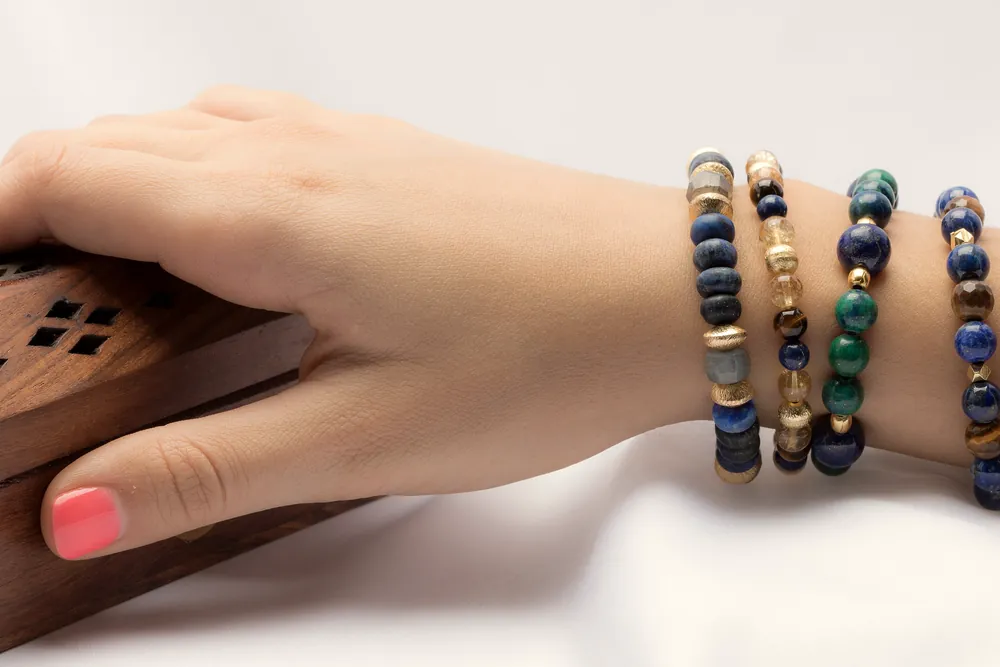
Imagine selecting amethyst, citrine and clear quartz. A bracelet with nine beads of each has a different appearance and balance from one with one citrine centre bead and the other stones around it. If a builder offers only a list of gemstones and decides the counts afterwards, these two designs may be impossible to distinguish at checkout. Ask whether you can specify both counts and placement.
Five specifications to settle before ordering
- Wrist measurement: use a flexible tape against the skin and specify whether that is your wrist size or desired finished bracelet size.
- Bead diameter: 8 mm beads usually look subtler than 10 mm beads. Switching sizes changes the number of beads needed for the same circumference.
- Stone quantities: list the exact number of each stone, including any premium central bead.
- Arrangement: specify alternating, grouped, symmetrical or central placement. Ask for a design preview when the pattern is important.
- Hardware: clarify whether a clasp, spacer or charm replaces a bead and whether it changes the price.
Worked example: a 7-inch wrist
Seven inches is approximately 177.8 mm. Dividing by an 8 mm bead gives approximately 22.2 bead diameters around that length. This is only a starting estimate: a round-bead bracelet’s actual fit also depends on gaps, knots, elastic tension, bead hole alignment, clasp length and the comfort allowance. For example, a design might use 23 beads including a comfort allowance, whereas a clasp replacing one bead changes the count. The supplier should calculate and confirm the finished size rather than treating a raw division as a fit guarantee.
Budgeting with a premium centre bead
If a premium gemstone costs more per bead, using one at the centre and lower-cost surrounding stones may be more affordable than repeating that premium stone around the whole wrist. Request an itemized quote identifying the premium bead, its treatment status, the rest of the stones, hardware, certification and delivery. An impressive mineral name alone does not establish authenticity or quality.
What to ask about laboratory documentation
For bracelets containing several different materials, check whether the report identifies each named gemstone type, describes any detected or disclosed treatments, gives a report number and includes a matching photograph and weight. Ask whether every bead, representative samples or only selected components were assessed; these are not interchangeable claims. Verify any certificate number independently with the issuing laboratory, and ask what tests were performed. A report is evidence about the tested item and the report’s stated scope, not a universal guarantee of grade or future benefits.
Example of a detailed online builder
GemKrishna’s custom gemstone bracelet builder advertises more than 100 gemstone options and individual bead-count selection. The brand also describes lab documentation through GJSPC for bracelets. These are seller-published features; shoppers should check available stock, current prices, certificate samples and the checkout summary. A useful comparison is our guide to Indian bracelet builders.
Frequently asked questions
Do more gemstone types make a bracelet better?
Not automatically. Material identification, coherent appearance, good fit and comfortable finishing matter more than maximizing the number of types.
Are 10 mm beads more effective than 8 mm?
There is no reliable scientific evidence that bead diameter determines a crystal’s spiritual effectiveness. Choose diameter for appearance, weight and comfort.
Is a laboratory report a guarantee of every bead?
Only if the report’s scope supports that interpretation. Read the item description, methods and limitations, and verify the report with the laboratory.
For sizing, read our wrist-measurement guide; for bead size, see 6 mm vs 8 mm vs 10 mm; and for certification, see how to verify a gemstone report online.