The short answer
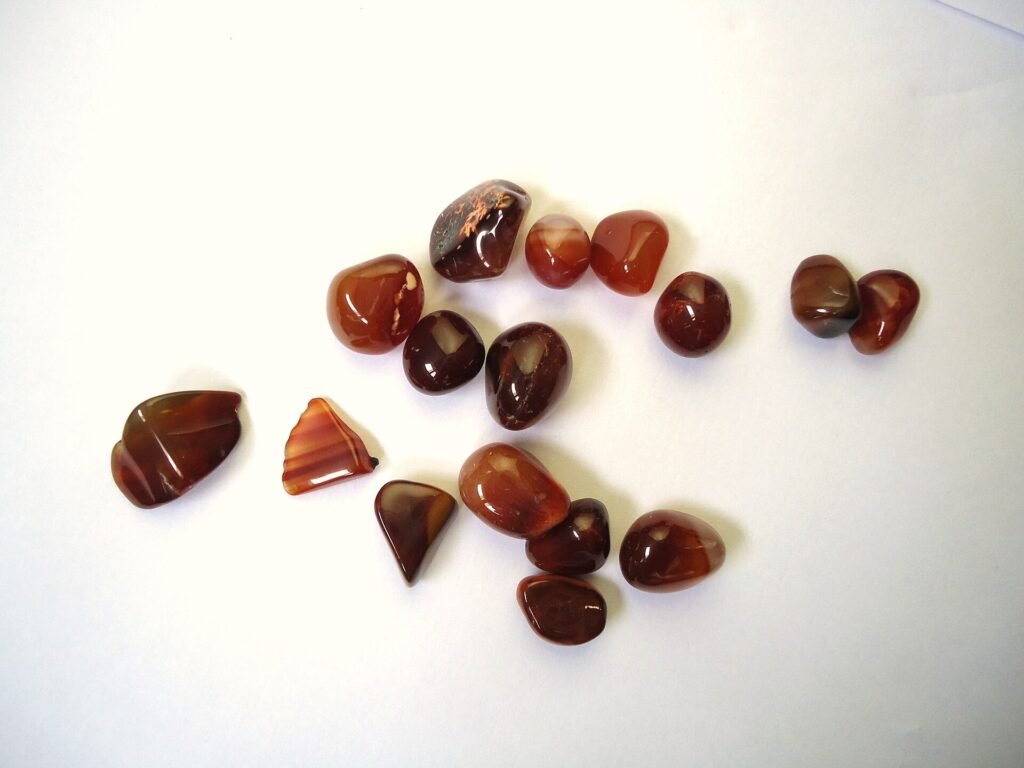
- Carnelian is “translucent to semi-opaque, red, orange-red, or brownish chalcedony”, a fine-grained quartz (International Gem Society). India is one of its classic sources.
- Heating is common and stable. IGS notes that “almost any chalcedony can be turned red by heating in an oven”, because of the iron compounds it contains. Heated agate sold as carnelian is chemically the same material; it should still be disclosed.
- Dyeing is also common: chalcedonies are “relatively porous”, and dyeing is “an ancient and common practice”. Dyed beads often show colour concentrated in cracks, bands and drill holes.
- Red jasper is opaque; red coral is organic and much softer; ruby is corundum, far harder, denser and more valuable.
- Check: hold a bead to the light (carnelian glows translucent orange), look at the drill hole and cracks for dye, and compare beads for natural variation.
What carnelian is
Carnelian belongs to the chalcedony family: quartz made of microscopic crystals. The International Gem Society (IGS) lists chalcedony’s refractive index as 1.540–1.553, specific gravity 2.55–2.91, hardness 7 and wearability “excellent”, and names carnelian’s sources as Brazil, Egypt, India and Uruguay (IGS, chalcedony). A brownish version is called sard.
Because it is quartz, carnelian is durable and suits daily-wear bracelets and rings.
Heated and dyed: what is common, and what to ask
| Treatment | What it does | Detectable? | Disclosure |
|---|---|---|---|
| Heating | Turns brownish or pale chalcedony orange-red by oxidising its iron content | Generally not at home; often not certain even in a lab | Should be disclosed; stable and widely accepted |
| Dyeing | Adds colour to porous chalcedony and agate | Often visible: colour in cracks, bands and holes | Should be disclosed; usually stable but can fade |
IGS describes dyeing of chalcedony as “usually a stable process” that “should be disclosed to consumers”. The questions are therefore “Is it heated or dyed?” and “Is the price consistent with that?”, not simply “Is it real?”.
Signs of dye
- Colour concentrated in fractures, along bands, or around the drill hole.
- Unnaturally even, saturated colour in every bead, especially very bright red or orange.
- Banding with sharp colour contrast that looks painted rather than natural.
- Colour on a damp cloth or cotton bud after rubbing (only test an inconspicuous bead).
Our guide to whether a crystal bracelet is real explains these checks for all dyed stones.
Carnelian vs similar red stones
| Carnelian | Red agate | Red jasper | Red coral (moonga) | Ruby (manik) | |
|---|---|---|---|---|---|
| What it is | Translucent orange-red chalcedony | Banded or patterned chalcedony | Opaque, oxide-stained quartz | Organic (marine) calcium carbonate | Corundum |
| Translucency | Translucent: glows when held to light | Translucent to opaque, banded | Opaque | Opaque | Transparent to translucent |
| Hardness | 7 | 7 | About 7 | Much softer | 9 |
| Typical price | Low to moderate | Low | Low | High for natural coral | High |
| Common treatment | Heating; dyeing | Dyeing; heating | Dyeing | Dyeing; coating; imitations | Heating; glass filling |
Sources: IGS chalcedony (carnelian, agate, jasper definitions and data); GIA, ruby (corundum, hardness 9). For red coral, see our Navratna guide.
Jasper vs agate vs carnelian. IGS explains that “jasper usually refers to an opaque, solid colored stone stained by oxides”, while “agate is defined either by its translucency, or by having a pattern to its colors”. Carnelian is the translucent, more evenly orange-red variety. The names overlap in the trade.
Carnelian as a substitute. Some sellers offer carnelian as a substitute for red coral in astrological contexts. That is a seller’s convention, not an equivalence: coral is an organic material and carnelian is quartz.
A simple home check
- Hold a bead up to a light. Carnelian glows translucent orange; red jasper blocks the light.
- Look at the hole with a loupe. Darker colour pooled at the hole suggests dye.
- Compare several beads. Natural carnelian varies a little in tone; identical, intensely coloured beads deserve questions.
- Check the price. Carnelian is not expensive; a very low price for “red coral” or “ruby” beads suggests carnelian, dyed agate, glass or plastic.
Care
Carnelian is durable (hardness 7). Clean with warm soapy water and a soft brush; dry the cord at once. Dyed beads should be wiped rather than soaked. See our crystal bracelet care guide.
FAQ
Is carnelian dyed?
Some is and some is not. Chalcedony is porous and is commonly dyed; it is also commonly heated to deepen orange-red colour. Ask the seller, and look for colour concentrated in cracks and drill holes.
Is all carnelian heated?
Not all, but heating is common, and IGS notes that almost any chalcedony can be turned red by heating. Heated carnelian is stable; it should be disclosed.
What is the difference between carnelian and red agate?
Both are chalcedony. Carnelian is the translucent, more evenly orange-red variety; agate is usually banded or patterned. The names overlap.
What is the difference between carnelian and red jasper?
Carnelian is translucent and glows when held to light; red jasper is opaque. Both are quartz-family materials.
Is carnelian the same as red coral or ruby?
No. Red coral is organic and much softer; ruby is corundum, far harder and more valuable. Carnelian is quartz.
Sources
- International Gem Society: Chalcedony value, price and jewellery information (carnelian, sard, agate, jasper, onyx; dyeing; heating; data; sources), checked 11 October 2026.
- GIA: Ruby (corundum data), checked 11 October 2026.
Related reading
- How to tell if a crystal bracelet is real: 9 checks, dyes and trade names
- 25 crystal bracelet stones: mineral identity and traditional meanings
- Navratna gemstones: the nine stones, their traditions and a buying checklist
- Crystal bead bracelets: choosing stones, bead sizes, fit, construction and reports