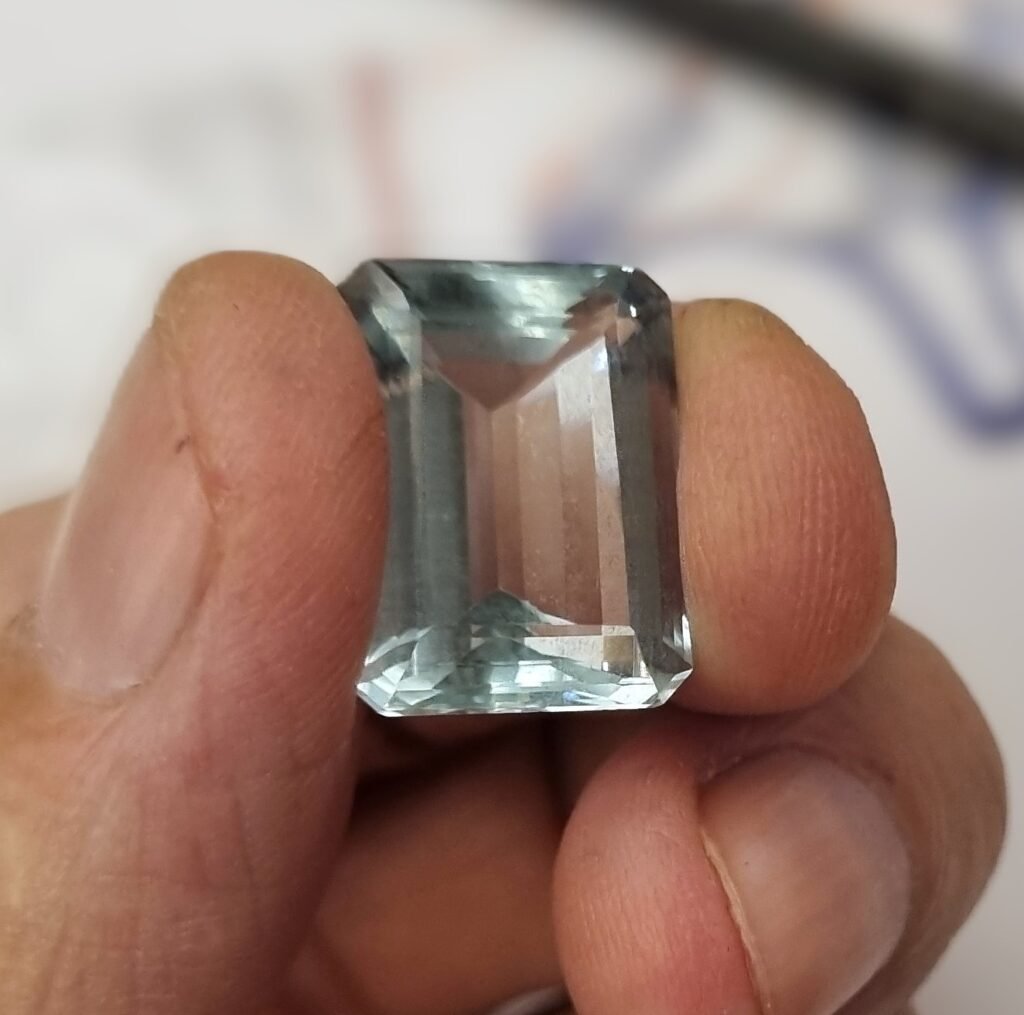
The short answer
- Aquamarine is the blue to green-blue variety of beryl, the same mineral as emerald. Its colour is usually a light pastel greenish blue, and “heat treatment usually gives it a more bluish appearance” (GIA).
- Blue topaz is a different mineral. GIA notes that topaz’s blue colour “is hardly ever natural: it’s almost always caused by treatment”, typically irradiation followed by heating (GIA, topaz; GIA, gem treatments).
- Blue glass imitates both. It often shows bubbles or swirl lines and is softer.
- A laboratory separates them in minutes: aquamarine reads 1.577–1.583 on a refractometer with specific gravity about 2.72; topaz reads 1.619–1.627 with specific gravity about 3.53 (GIA).
- Price: fine aquamarine generally costs considerably more than treated blue topaz of similar size. A stone sold as aquamarine at a blue-topaz price deserves a report.
The three compared
| Aquamarine | Blue topaz | Blue glass | |
|---|---|---|---|
| Mineral | Beryl | Topaz | Man-made glass |
| Typical colour | Light, pastel greenish blue to blue; deeper blues are rarer | Sky blue to deep “London” blue; often more saturated | Any blue; often very even |
| Usual treatment | Heating to remove green and give a purer blue | Irradiation followed by heating to create blue | None (it is a manufactured material) |
| Clarity | “Most faceted aquamarines are eye-clean” (GIA) | Usually eye-clean | Often clean; may show round bubbles or swirls |
| Refractive index | 1.577–1.583 | 1.619–1.627 | Single reading; varies |
| Specific gravity | 2.72 | 3.53 | Varies |
| Mohs hardness | 7.5–8 | 8 | About 5–6 for common glass |
| Weight at the same size | Lighter | Noticeably heavier | Varies |
Sources: GIA aquamarine, aquamarine quality factors and description; GIA topaz and description. Glass hardness is approximate.
Why they are confused
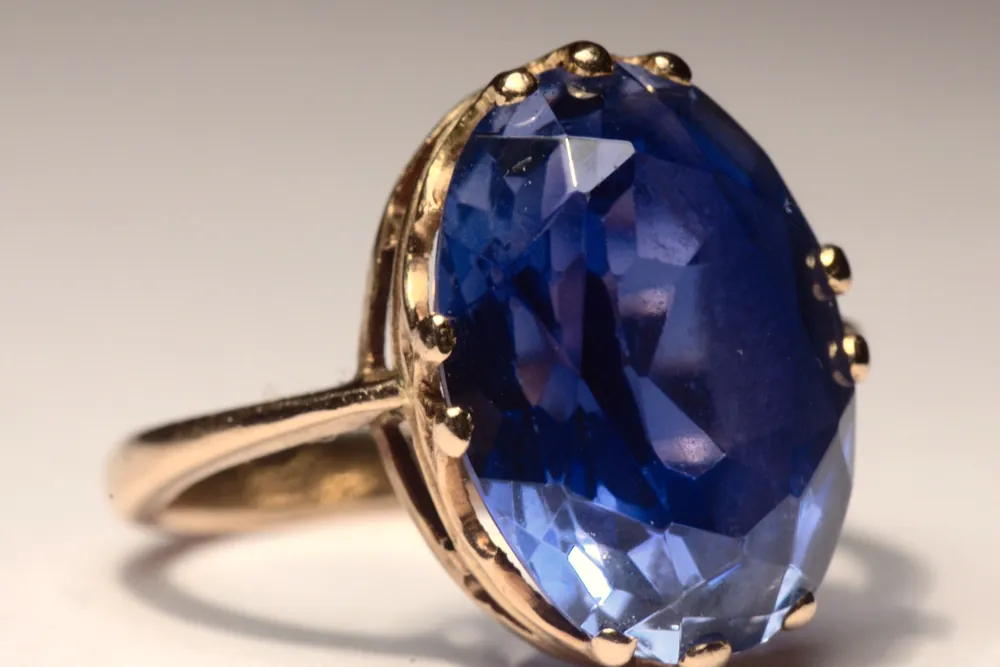
At a glance, a light blue topaz and a fine aquamarine can look almost the same. Both are usually transparent and eye-clean, both are cut in the same shapes, and both are often sold in silver jewellery. The trade term “aqua” is also used loosely for any light blue stone.
Treated blue topaz is a large, consistent supply. GIA explains that colourless topaz can be “irradiated followed by heating”, which “results in a desirable blue color” (GIA, gem treatments). That makes vivid blue topaz affordable and widely available.
Aquamarine’s best colour is a strong, pure blue. Lighter, greener stones are more common. Heating is widely used to move greenish stones towards blue, and GIA considers heat treatment of aquamarine durable under normal conditions.
What you can check yourself
- Colour. A very saturated, electric or inky blue in an inexpensive stone is more typical of treated blue topaz than of aquamarine. This is a hint, not a test.
- Weight in the hand. Topaz is about 30% denser than aquamarine (3.53 vs 2.72), so a topaz of the same dimensions feels heavier. You need two stones of similar size to compare.
- Loupe check for glass. Round gas bubbles and swirl lines are typical of glass. Both natural stones may be clean or show small natural inclusions.
- Edges and wear. Glass, being softer, shows rounded or chipped facet edges sooner.
- The price. If an “aquamarine” is priced like blue topaz, ask for a report before you buy.
None of these replaces a laboratory test. For anything bought as aquamarine at a meaningful price, ask for a report from a recognised laboratory and verify its number online (how to verify a report).
What a laboratory measures
| Test | Aquamarine | Blue topaz | Glass |
|---|---|---|---|
| Refractometer | 1.577–1.583, doubly refractive | 1.619–1.627, doubly refractive | One reading (singly refractive) |
| Specific gravity | 2.72 | 3.53 | Depends on composition |
| Magnification | Natural inclusions, if any; liquid inclusions occur | Natural inclusions, if any | Bubbles, swirls, mould marks |
| Treatment opinion | Heating is not always detectable | Irradiation-and-heat blue is assumed for most blue topaz | Not applicable |
A report on blue topaz will typically identify the stone as topaz and may note that its colour is the result of treatment. A report on aquamarine identifies the species (beryl) and variety.
Value and buying
GIA’s quality factors for aquamarine emphasise colour. GIA notes that “most of the aquamarine in the market was heat-treated to give it more of a pure blue”, and that cut aquamarines “generally over 5 carats” are needed to show intense colour, although some African sources produce intense colour in smaller sizes, so “smaller, top-color stones might sell for more per carat than larger stones of the same color” (GIA, aquamarine quality factors). For topaz, the market for treated blue material is large and prices are modest compared with fine aquamarine.
We do not publish per-carat prices, because colour, size and cut move them too much. Practical guidance:
| If you want… | Choose | Why |
|---|---|---|
| A light, classic sea-blue at a modest price | Blue topaz, sold as blue topaz | Stable, durable, widely available |
| Aquamarine specifically | Aquamarine with a report | Price only makes sense with confirmed identity |
| A durable everyday ring | Aquamarine, or topaz in a protective setting | Topaz’s cleavage makes it vulnerable to hard knocks |
| The lowest price | Blue glass, sold honestly as glass | Fine for fashion pieces, never at gem prices |
Care. Both stones are hard. Topaz, though, has a basal cleavage, and GIA rates its toughness as poor: “a hard blow might split it”, and sudden temperature changes can break it. GIA advises avoiding steam and ultrasonic cleaning for topaz; warm, soapy water works best (GIA, topaz care).
Coated topaz. GIA also describes colourless topaz coated with “a microscopic layer of metallic oxide”. The coating “is not very durable” and abrasive cleaners remove it. Ask whether a strongly coloured or iridescent topaz is coated.
Astrology. Aquamarine and blue topaz are not among the nine Navratna stones. If a stone is bought for astrological reasons, the identity question still comes first; see our Navratna guide.
Buying checklist
- The stone named as aquamarine (beryl) or topaz, not “aqua” or “sea blue stone”
- Treatment disclosed: heating for aquamarine; irradiation and heating for blue topaz
- Weight and dimensions stated
- For aquamarine at a meaningful price, a laboratory report with a verifiable number
- Return terms if a second laboratory disagrees
FAQ
How can I tell aquamarine from blue topaz?
A laboratory can, quickly, by refractive index (aquamarine 1.577–1.583; topaz 1.619–1.627) and specific gravity (2.72 vs 3.53). At home, a topaz of the same size feels heavier, and a very saturated blue at a low price is more typical of treated topaz.
Is blue topaz irradiated?
GIA notes that blue topaz colour is “almost always caused by treatment”, typically irradiation followed by heating.
Which is better, aquamarine or blue topaz?
Neither is “better”; they are different stones. Aquamarine is generally more valuable; blue topaz is affordable and durable. Choose by budget and the colour you like, and make sure the stone is named correctly.
How can I tell if aquamarine is real?
Look for natural inclusions rather than bubbles, and for a soft, slightly greenish to pure blue. For certainty, get a laboratory report.
Is heated aquamarine less valuable?
Heating is common and widely accepted for aquamarine. Value depends mainly on colour, clarity, cut and size; a report should state any treatment the laboratory detects.
Sources
- GIA: Aquamarine (refractive index, specific gravity, hardness), Aquamarine description (beryl; heat treatment) and Aquamarine quality factors (colour; clarity), checked 11 October 2026.
- GIA: Topaz (refractive index, specific gravity, hardness) and Topaz description (blue colour “almost always caused by treatment”), checked 11 October 2026.
- GIA: Topaz care and cleaning (cleavage, toughness, cleaning, coated topaz), checked 11 October 2026.
- GIA: An introduction to gem treatments (aquamarine heating; blue topaz irradiation followed by heating; heat treatments durable), checked 11 October 2026.
Related reading
- How to judge a coloured gemstone’s quality: colour, clarity, cut and carat weight
- Gemstone treatments explained: heating, filling, dyeing, diffusion and how they should be disclosed
- Buying gemstones: natural, lab-grown and imitation stones, treatments and lab reports
- How to verify a gemstone or rudraksha report online (GJSPC, IGI, GIA, GRS, IIGJ)