The short answer
Real pyrite (iron sulphide, sold in India as swarna makshik) is:
- pale brass-yellow and metallic;
- noticeably heavy for its size (specific gravity about 5);
- hard (Mohs 6–6.5, so a steel knife will not easily scratch it);
- it leaves a greenish-black to brownish-black streak when rubbed on unglazed porcelain.
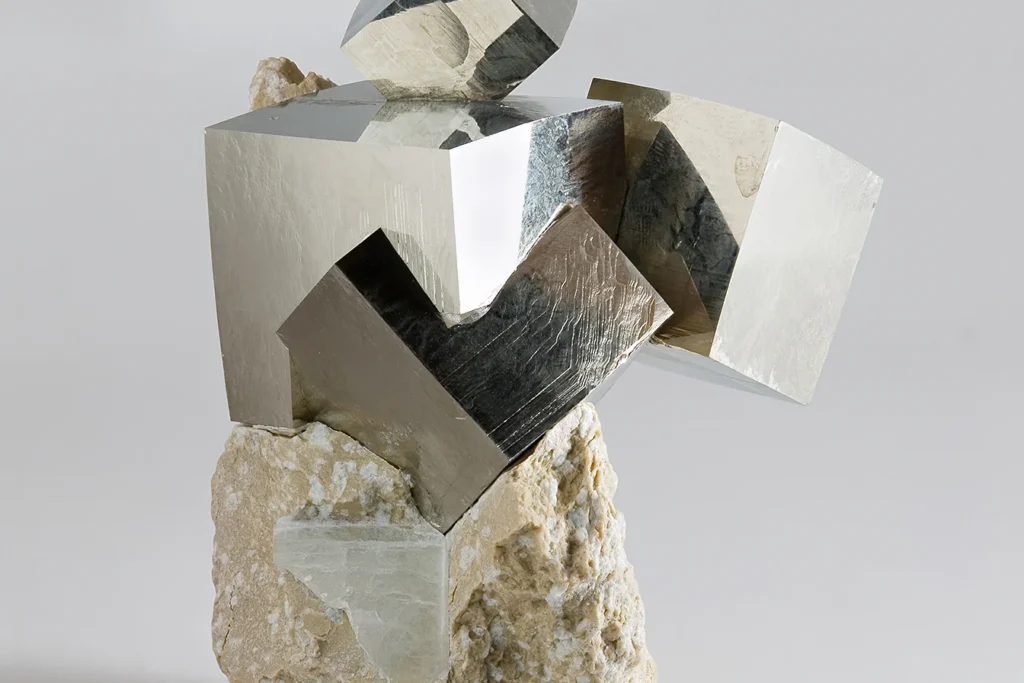
Natural crystals are often cubes with fine parallel lines (striations) on their faces.
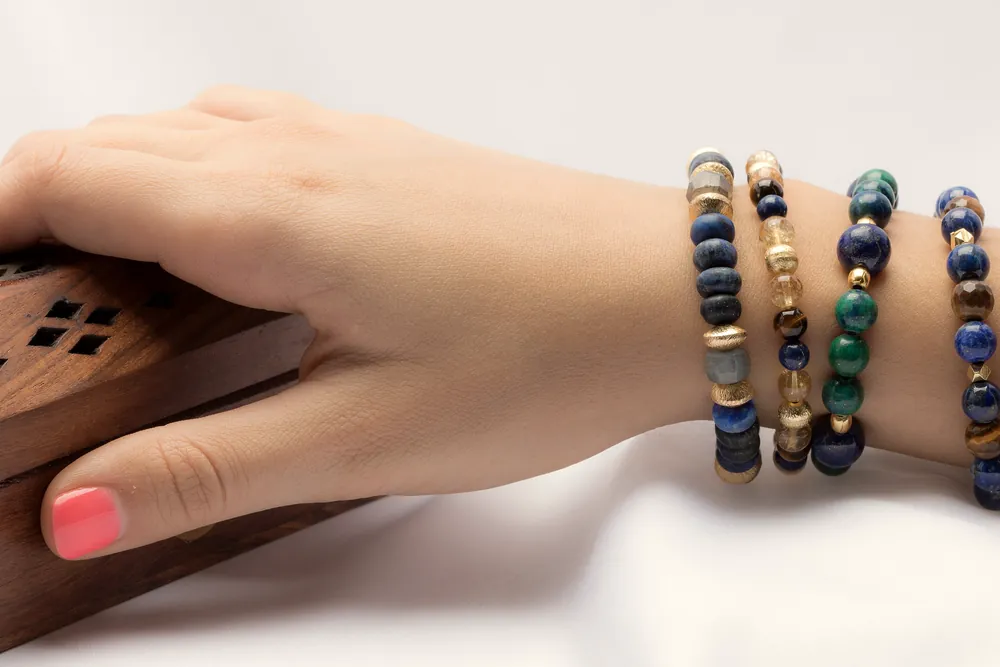
Bead bracelets are harder to judge. Uniform, perfectly shiny beads may be plated, painted, reconstituted or a different material. Ask for a report on an expensive piece. Pyrite also needs dry storage: in damp conditions it can oxidise and crumble.
What pyrite is
Pyrite is iron disulphide (FeS₂), the most common sulphide mineral, nicknamed “fool’s gold”. The standard reference values (Pyrite, summarising mineralogical handbooks):
| Property | Pyrite | Why it helps |
|---|---|---|
| Colour | Pale brass-yellow; tarnishes darker and iridescent | Brighter yellow or greenish material may be another mineral |
| Streak | Greenish-black to brownish-black | Paint, plating and gold give different streaks |
| Hardness (Mohs) | 6–6.5 | Harder than steel needles and glass; gold and chalcopyrite are much softer |
| Specific gravity | 4.95–5.10 | Heavy in the hand, about twice quartz |
| Lustre | Metallic | Plastic and painted fakes look flat or too glossy |
| Crystal habit | Cubes (often striated), octahedra, pyritohedra | Natural shapes are hard to fake convincingly |
| Magnetism | Not noticeably magnetic | A bead that jumps to a fridge magnet is probably not pyrite |
Checks you can do at home
1. Heft (weight for size)
Hold a pyrite piece and a similar-sized quartz or glass bead. Pyrite should feel about twice as heavy. Plastic or resin imitations feel light. This is one of the most useful quick checks for beads.
2. Streak (raw pyrite only)
Rub a corner of the stone firmly across the back of an unglazed tile. A real pyrite streak is greenish-black to brownish-black:
- gold leaves a gold-yellow streak;
- painted or plated items may leave colour, or none.
Do not streak-test finished beads. It damages the polish.
3. Shape and surface
Look for cubic crystals with straight, parallel striations, sharp edges and natural growth faces. Clusters with varied, slightly imperfect cubes are typical. Perfectly smooth cubes with no striations may have been polished, or may be manufactured.
4. Magnet
Natural pyrite is not attracted noticeably to an ordinary magnet. Strong attraction suggests magnetite, a man-made ferrite or a steel core.
5. Hardness (with care)
A steel pin should not easily scratch pyrite. Gold and chalcopyrite (Mohs 3.5–4) scratch easily. Test only on an inconspicuous spot of a raw piece, never on beads you intend to wear.
What does not work
- “Spark when struck with steel”. Pyrite can spark (its name comes from the Greek for fire), but this is destructive and unhelpful for beads.
- Smell. A sulphur smell from decaying pyrite shows decay, not authenticity.
- Price alone. Pyrite is not rare, so genuine pyrite is often inexpensive. A low price does not mean fake.
Pyrite vs look-alikes
| Material | Colour | Streak | Hardness | Weight | Notes |
|---|---|---|---|---|---|
| Pyrite | Pale brass-yellow | Greenish-black | 6–6.5 | Heavy | Cubes, striations |
| Gold | Rich yellow | Gold-yellow | 2.5–3 | Very heavy | Bends rather than breaks |
| Chalcopyrite | Brighter, greener yellow, often iridescent tarnish | Greenish-black | 3.5–4 | Heavy | Softer; “peacock” colours when tarnished |
| Marcasite | Paler, whiter yellow | Greyish-black | 6–6.5 | Heavy | Less stable; crumbles more readily |
| Plated or painted metal | Even, mirror-bright | Variable | Variable | Variable | Colour wears at edges |
| Plastic or resin imitation | Even, too uniform | None | Low | Light | Feels warm and light |
In the jewellery trade, “marcasite” often means small faceted pyrite set in silver, a long-standing naming convention.
Pyrite bracelets: what to check
- Weight. An 8 mm pyrite-bead bracelet should feel distinctly heavy compared with a quartz one.
- Edges and holes. Look around the drill holes for flaking, which suggests a coating. Natural pyrite beads show slight colour variation and tiny pits.
- Too perfect. Identical mirror-bright beads with no variation may be reconstituted (crushed pyrite in resin) or plated. Reconstituted material can be legitimate if it is disclosed.
- Documentation. For an expensive piece, ask for a report that identifies the beads. Our crystal bracelet guide covers bead documentation.
Caring for pyrite
Pyrite reacts with oxygen and moisture. Over time, especially in humid conditions, it can decompose to iron oxides and sulphates. You may see a white or yellow powder, a sulphur smell, cracking and rust stains (Pyrite; Tacker 2020).
- Keep it dry. Remove pyrite bracelets for washing, bathing and swimming.
- Wipe, do not wash. Use a dry soft cloth after wearing.
- Store in a dry box, with silica gel in humid climates, away from other jewellery: the decay products are acidic.
- Do not soak pyrite in water or salt water for “cleansing”. Our bracelet care guide lists other stones that dislike water.
Traditional associations
In modern crystal practice, pyrite is associated with prosperity and confidence. In Indian trade it is called swarna makshik. These are traditions and marketing associations, not tested effects.
FAQ
Is pyrite magnetic?
No, not noticeably. Strong attraction to a magnet means the piece is probably something else, or has a steel core.
Can pyrite get wet?
Briefly, yes, but do not soak it or store it damp. Moisture speeds up its decay.
Why is my pyrite turning white or rusty?
That is oxidation (“pyrite decay”). Dry the piece and store it with a desiccant. Badly affected pieces cannot be fully restored.
Is cheap pyrite fake?
Not necessarily. Pyrite is common, so genuine material can be inexpensive. Judge by weight, shape, streak (raw pieces) and seller disclosure, not price.
Is “marcasite” jewellery made of marcasite?
Usually not. In jewellery, “marcasite” traditionally refers to small faceted pyrite.
Sources
- Pyrite, Wikipedia (properties from mineralogical handbooks), checked 10 October 2026.
- Tacker, R. C. (2020), A review of “pyrite disease” for paleontologists, Palaeontologia Electronica.
- Marcasite, Wikipedia (on the jewellery trade usage), checked 10 October 2026.