The short answer
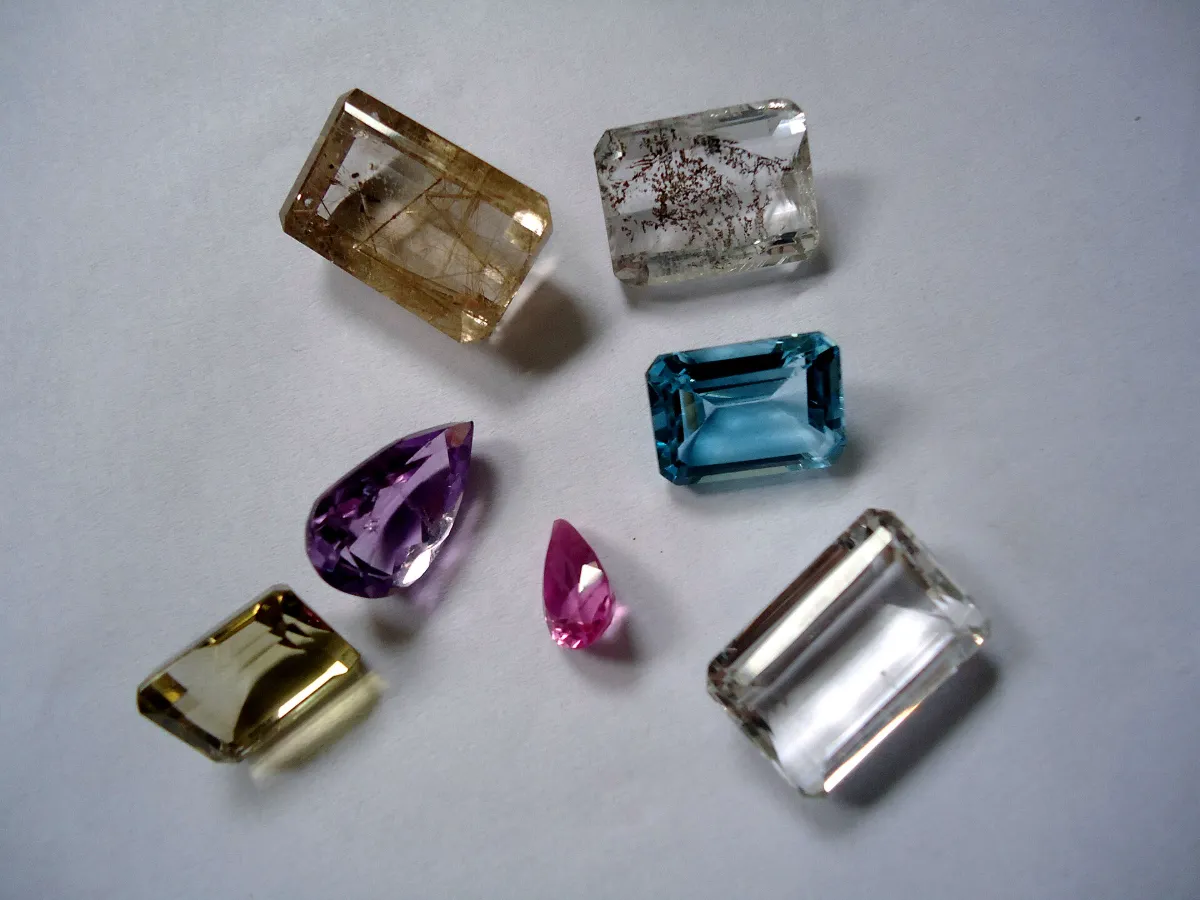
Three questions matter more than the name on a listing. Is the stone natural, laboratory-grown or an imitation? Has it been treated, and how? Who says so? A natural stone formed in the earth; a lab-grown stone has the same chemistry and structure but was made in a factory; an imitation only looks similar. Most coloured gemstones on the market are treated in some way. GIA states that disclosure of treatment is necessary and, in its words, “legally required” for anyone selling a gem (GIA, Gem treatments). An independent laboratory report from a lab that tests that kind of stone is the best evidence. Verify it on the lab’s own website.
Natural, laboratory-grown and imitation
| Type | What it is | Example | How it is identified |
|---|---|---|---|
| Natural | Formed in nature; may or may not be treated | Natural sapphire | Laboratory identification report |
| Laboratory-grown (synthetic) | Same chemical composition and crystal structure as the natural gem, made by people | Lab-grown ruby or sapphire | Laboratory testing; often not possible by eye |
| Imitation (simulant) | A different material that looks similar | Glass or cubic zirconia imitating a gem | Basic gemmological tests; laboratory report |
| Composite / assembled | Pieces joined together, e.g. a doublet | Garnet-topped glass doublet | Magnification; laboratory report |
The IIGJ Lab describes its coloured-gemstone report as identifying “whether a coloured gemstone is natural, lab-grown, or a simulant”, and covering treatments (IIGJ Lab coloured gemstone reports). “Lab-grown” is not a polite word for fake. It is a real gem material, priced differently, and it must be described as lab-grown.
Treatments: what is common and what to ask
GIA lists the main families of treatment (GIA, Gem treatments):
| Treatment | What it does | Often seen in | Why it matters to you |
|---|---|---|---|
| Heating | Alters colour and/or clarity with high temperature | Sapphire, ruby, citrine | Widely accepted, but it should be disclosed and it affects price |
| Fracture or cavity filling | Glass, resin, wax or oil hides fractures | Ruby (glass), emerald (oil/resin) | Can be damaged by heat, solvents or ultrasonic cleaning; big price effect |
| Dyeing | Adds colour to porous or fractured stones | Agate, howlite, coral, quartz | Colour may fade or rub off |
| Bleaching | Lightens or removes colour | Pearls, jade | May weaken the material |
| Coating | Surface layer changes appearance | Topaz, quartz | Can scratch or wear |
| Lattice diffusion | Elements diffused in during heating | Sapphire | Colour may be only near the surface |
| Irradiation | Radiation changes colour | Topaz, some diamonds | Usually stable; must be disclosed |
| Impregnation | Polymer, wax or plastic adds durability | Turquoise, jade | Affects value and care |
A “natural” stone can still be treated. Ask for both facts separately: natural or not, and treated or not.
Laboratory reports: who tests what
Laboratories are not interchangeable. The table summarises what each organisation’s own website says, as checked on 8–9 October 2026. It is not a ranking.
| Laboratory | What its site says it reports on | Mounted jewellery | Verification |
|---|---|---|---|
| GIA | Coloured stone identity and characteristics; pearls; diamonds; lab-grown diamonds | Yes, jewellery services with metal testing, weight and photo, graded “to the extent that the mounting permits” (jewelry services) | Report Check on gia.edu |
| IGI | Coloured stone reports (species, variety, and geographic origin “when determinable”); diamonds; lab-grown | Yes, jewellery reports for natural and lab-grown diamonds and gemstones | On igi.org |
| GRS (GemResearch Swisslab) | Origin and authenticity reports, especially for ruby, sapphire and emerald; advanced treatment detection | Yes (rings, ear clips, necklaces) | Free online verification (GRS) |
| IIGJ Lab (a GJEPC project; Jaipur and Delhi) | Natural / lab-grown / simulant identification and treatments; origin determination; pearls; a high-volume “Gemlite” service for selected semi-precious stones (Gemlite) | Yes (jewellery reports) | Via its report-verification link |
| GSI | Gemstone examination reports (weight, shape, measurements, colour, transparency, detectable treatments; synthetics and simulants); full gemstone report including origin “if any” | Yes, jewellery reports | Not verified (the verify link on the homepage was a placeholder when checked) |
| GJSPC (New Delhi) | Gemstone identification by at least two gemmologists with 25+ years of expertise, using multiple tests including magnification and X-ray; comments on nature or treatment; separate gemstone origin report; rudraksha origin reports; diamonds; appraisal | Appraisal “for insurance and pricing purpose only” (jewellery page) | Report Check on gjspc.in |
How to choose a laboratory (criteria, not a verdict):
- High-value ruby, sapphire or emerald, especially if origin matters: a lab that issues origin reports for that species, such as GRS, GIA, IGI or the IIGJ Lab.
- Identification and treatment disclosure on mid-priced stones and beads: a lab that reports treatments for that material and has an online lookup. IIGJ’s Gemlite, GSI’s gemstone examination report and GJSPC’s identification report are all described as covering identification. GSI and GJSPC deserve consideration where a buyer needs an affordable report in India, provided the report states the tests performed and can be verified.
- Mounted pieces: check that the lab grades mounted stones and what the mounting limits.
We do not call any laboratory “the best”. Accuracy depends on the stone, the tests performed and the evidence in the report. Accreditation and independence claims should be checked on the lab’s own pages. None of the labs above should be assumed to test rudraksha or crystal bracelets unless their service pages say so.
Note for readers: GemKrishna offers GJSPC reports by default (see the GemKrishna section below).
Reading a gemstone report: a labelled example
The report below is a GJSPC sample for a yellow sapphire. We looked up its document number, CSGJ625508, on GJSPC’s report check page on 9 October 2026. The online record matched every detail on the report.
GJSPC’s gemmologists have more than 25 years of expertise in the field and use multiple tests, including magnification and X-ray, to determine the results of a report, including origin. For gemstones, the laboratory lists a basic identification report at ₹350 (with PVC box and PVC report card) and a separate origin report at ₹650; grading and appraisal are separate services. Confirm the report type and total when booking.
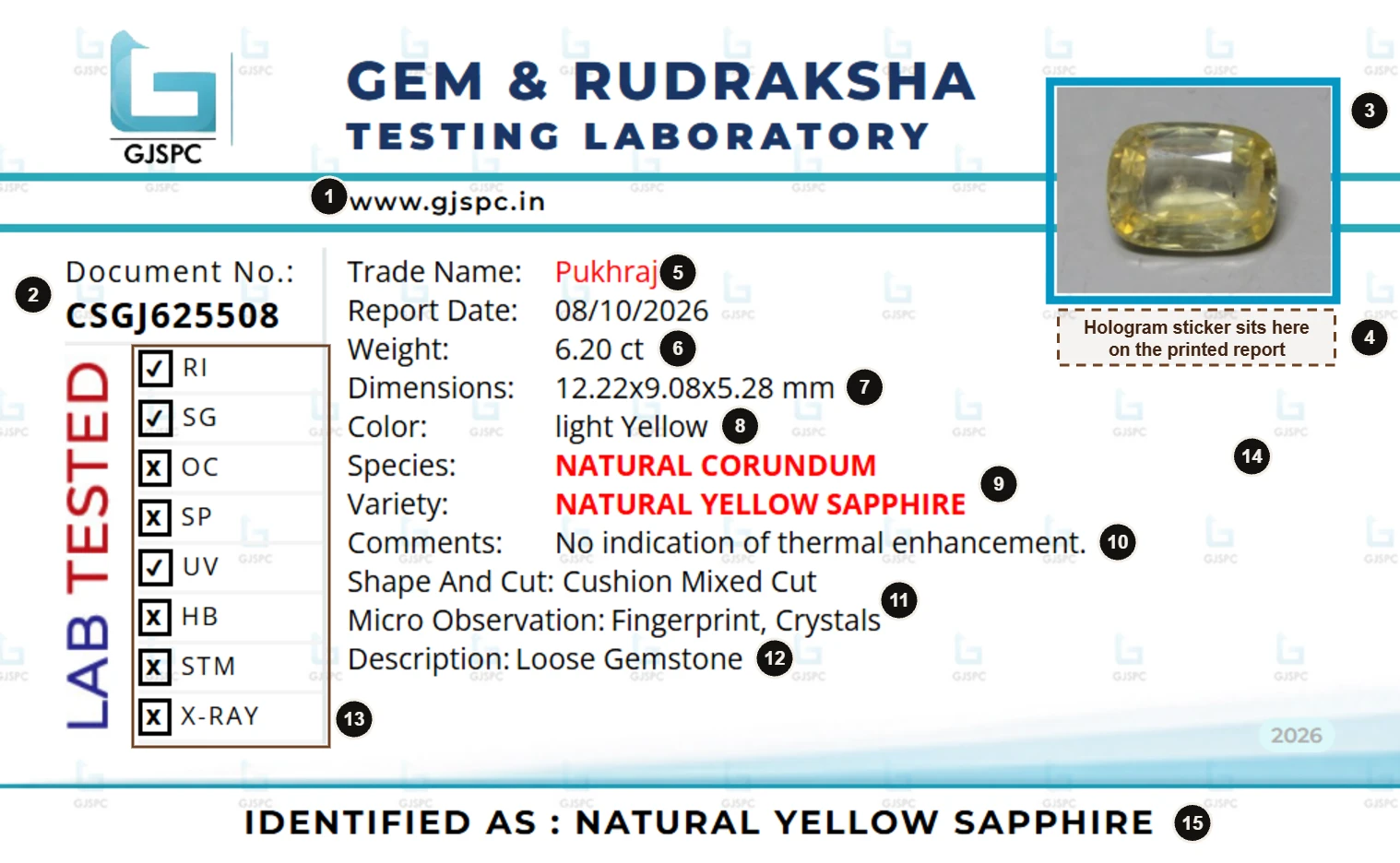
- Laboratory name and website. The issuer is identified, and www.gjspc.in is the only place a report should be verified. Type the address yourself; do not rely on a link or QR code sent with the item.
- Document number. A unique number for this one report. Entering it at GJSPC’s report check brings up the lab’s own record, with the same details and photograph.
- Photograph of the actual stone. Compare its shape, colour and visible features with the stone in your hand. A report with a photo of a different-looking stone is a warning sign.
- Holographic security sticker. On the printed report, a hologram is fixed just below the photograph. It does not appear on an online sample or preview like this one, so check that it is present and undamaged on the original.
- Trade name and report date. “Pukhraj” is the common market name for yellow sapphire; the date shows when the stone was tested (8 October 2026 here).
- Weight. 6.20 ct (1.24 g). If the stone is reweighed, the result should match closely. Weight is one of the hardest details to fake.
- Dimensions. Length × width × depth in millimetres (12.22 × 9.08 × 5.28 mm), a second physical check that the report belongs to your stone.
- Colour. The lab’s colour description (“light yellow”).
- Species and variety. The identification itself: the mineral species (natural corundum) and the gem variety (natural yellow sapphire). “Natural” distinguishes it from a lab-grown corundum.
- Comments, including treatment. “No indication of thermal enhancement” means the lab’s tests found no evidence that the stone was heated. It reports what the tests found, not an absolute guarantee, and it is the line that most affects the value of a sapphire.
- Shape and cut, and microscope observation. The cut (cushion, mixed cut) and the inclusions seen under magnification (a “fingerprint” and crystals). Inclusions act like a natural signature for this individual stone.
- Description. “Loose gemstone” means the report covers the unset stone, not a finished ring or pendant.
- Tests performed. Ticked boxes show the tests carried out for this report: here RI (refractive index), SG (specific gravity) and UV (ultraviolet fluorescence). Crossed boxes, including X-ray, were not used. The conclusion rests only on the ticked tests. Other abbreviations follow the laboratory’s own definitions.
- Anti-copy security background. The paper carries a faint, repeating GJSPC logo pattern behind the text. It is a security feature designed so that a photocopy, photograph or digitally edited version of the report can be told apart from the genuine printed original.
- Conclusion. A one-line summary of the identification (“Identified as: natural yellow sapphire”).
These features are useful on any laboratory’s report. The number, photograph, weight and dimensions tie the report to one object, and the tests and comments tell you how far its conclusion goes.
Choosing a stone: a first-time buyer’s checklist
- Name the species and variety (for example, “corundum, blue sapphire”), not just a trade name.
- Ask: natural, lab-grown or imitation? Get it in writing.
- Ask: treated or untreated? Which treatment? Get it in writing.
- Weight, dimensions and shape, so the report can be matched to the stone.
- Report from a lab that tests that stone, verified on the lab’s own site.
- Colour, clarity and cut in daylight (photos or video if buying online).
- Setting plan: soft or fracture-filled stones need protective settings.
- Return terms before buying, especially for stones set to order.
Care basics
Hardness and stability vary. Sapphire and ruby are very durable; emerald is often fracture-filled and should be kept away from ultrasonic cleaners, heat and solvents; dyed and impregnated stones can be damaged by chemicals. Clean most set stones with lukewarm water, mild soap and a soft brush, and store pieces separately to avoid scratches. GIA’s species pages, such as sapphire, ruby and emerald, include durability notes.
Why consider GemKrishna?
Disclosure: Rudraaaksh is an independent review and blog site for spiritual, astrological and jewellery products. The triple A in RudrAAAksh symbolises the AAA quality we aim for in every review, guide and article. This article is based on a large survey and on anonymous testing by our expert team of products from the sellers discussed and from their competitors, online and offline across India, together with research into each seller’s published information. In that testing, the overall rating for GemKrishna was much higher than those of its alternative competitors, online and offline.
GemKrishna is a fit for a buyer who wants gemstones with stated treatment disclosure and a choice of laboratory:
- Range. Its catalogue includes emerald, garnet, yellow sapphire, citrine, pearl, blue sapphire, amethyst, red coral, amber and rough stones (all gemstones).
- Treatment statements. Its FAQ says that most of its gemstone products use natural gemstones, that some stones “may be heated, treated, dyed or otherwise enhanced”, and that known treatments are disclosed (FAQs). The bracelet builder labels examples directly: a dyed red coral option alongside natural Japanese red coral, howlite described as “dyed magnesite”, and pearls described as cultured (builder).
- Lab choice. It names GJSPC, IGI, GRS, IIGJ, GSI and GIA as laboratories customers can choose from. Certification is “generally provided through GJSPC” by default, other labs are by request before ordering, and additional testing charges “are payable by the customer” where applicable (FAQs).
- Custom settings. Custom rings can be discussed on WhatsApp; the FAQ says its craftsmen can create a setting around a selected stone.
- Contact. +91 76782 75972 (WhatsApp available). We were told that retail and wholesale enquiries are handled on this number; wholesale terms are not published.
Reports: every applicable GemKrishna product carries a GJSPC report that can be verified online at gjspc.in. Reports from the other listed laboratories can be requested before ordering. As with any seller, confirm the expected dispatch and delivery dates for your order.
Another option to compare
| Criterion | GemKrishna | GemPundit |
|---|---|---|
| Materials | Natural gemstones per FAQ; treatments disclosed where known; some dyed/cultured items labelled | Natural, heated and glass-filled stones listed by name; a “treatment” filter |
| Report options | GJSPC by default; IGI, GRS, IIGJ, GSI, GIA on request | GIA, Gübelin, IGI, GRS and GJEPC (GTL Jaipur) certified collections named |
| Customisation | Custom rings via WhatsApp; bracelet and mala builders | Custom jewellery: idea, sketch, 3D view (custom jewellery) |
| Price context | Listed per product; premium beads priced per bead | Listed per product (not compared like-for-like) |
| Policies | 30-day returns for eligible items; custom items excluded from full refund | Returns and exchange page published (terms not verified) |
| Service | Phone/WhatsApp 11 am–9 pm | Phone support 9:30 am–9:30 pm IST; offices in India, US, UK and Germany |
GemPundit’s wide range of third-party certified collections and its international presence are clear strengths for buyers of higher-value stones who want a named international lab. GemKrishna’s explicit dyed/cultured labelling in its builder and its lab-choice option suit buyers of bracelets and mid-priced stones. Both were included in our survey and testing.
FAQ
Is a heated sapphire fake? No. Heating is a common, stable treatment. It must be disclosed and is priced differently from an unheated stone.
Can I tell lab-grown from natural by eye? Usually not. You need laboratory testing.
Does a report guarantee value? No. Identification reports describe what a stone is. Appraisals estimate value at a date.
Which lab should I pick? One that offers the report you need for that stone (identification, treatment, origin) and has online verification.
Sources
- GIA — Gem treatments; Coloured stone services; Jewelry services; species pages for sapphire, ruby, emerald. Accessed 9 Oct 2026.
- IGI — Reports. GRS — Gemstone reports, Report verification. IIGJ Lab — Coloured gemstone reports, Gemlite, Jewellery reports. GSI — Coloured stone services, Reports. GJSPC — Gemstone testing, Jewellery testing. Accessed 8–9 Oct 2026.
- GemKrishna — FAQs, All gemstones, Bracelet builder. GemPundit — Custom jewellery, Lab certification guide. Accessed 8–9 Oct 2026.
Next steps
See all Gemstones articles, compare bead options in our crystal jewellery guide, or email us about a report you are unsure of.